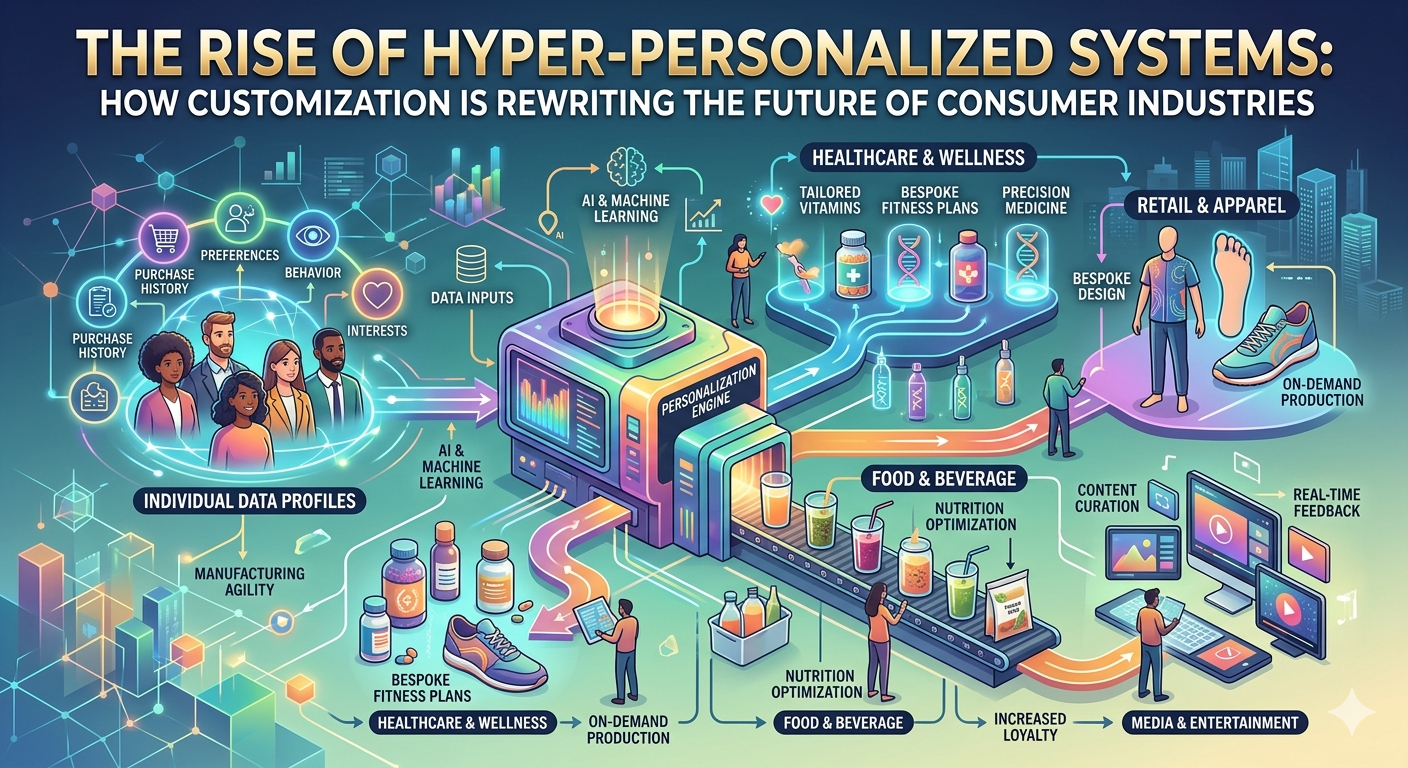
Introduction: The Shift from Products to Systems
For decades, global industries have operated on a simple principle: companies design standardized products, manufacture them at scale, and distribute them to mass markets. This model has powered industrial growth since the early 20th century and remains the foundation of most consumer sectors today.
However, a structural shift is underway. The modern consumer is no longer satisfied with “one-size-fits-all” solutions. Expectations have evolved toward precision, individuality, and adaptive systems that respond to personal needs in real time.
This transition is not just a branding trend—it represents a fundamental change in how value is created. Industries are moving from static products to dynamic personalization systems, where users actively participate in shaping outcomes.
The most visible expression of this transformation can be seen in sectors like beauty tech, fashion, wellness, food customization, and even logistics. At the core of this evolution lies a single idea: the future belongs to systems that create unique outputs for every individual.
1. The End of Mass Standardization
Mass production succeeded because it solved a historical problem: efficiency. Producing identical goods at scale reduced cost, simplified logistics, and expanded accessibility.
But today, three major pressures are eroding this model:
1.1 Consumer Identity Fragmentation
Modern consumers are no longer part of a single dominant cultural identity. Instead, they represent fragmented micro-identities shaped by:
- Digital influence
- Social media aesthetics
- Cultural blending
- Personal expression
As a result, standardized products fail to represent individual identity accurately.
1.2 Rising Expectations of Precision
Consumers now expect products to align with:
- Skin tone, body type, or lifestyle
- Environmental conditions
- Emotional or psychological preferences
Generic solutions are increasingly perceived as outdated.
1.3 Technology Enablement
Advances in AI, IoT, and smart devices have made customization scalable. What was once expensive and manual is now automated and precise.
This combination is dismantling traditional manufacturing logic and replacing it with adaptive production systems.
2. The Rise of Customization Systems
The new industrial paradigm is not about products—it is about systems that generate products dynamically.
A customization system typically includes:
- A digital interface (for user input)
- A data model (for preference analysis)
- A physical output mechanism (for production)
- A feedback loop (for continuous refinement)
Instead of selecting from predefined options, users define parameters, and the system generates a personalized output.
This model is already visible across industries:
- Streaming platforms recommend content individually
- E-commerce platforms personalize storefronts
- Fitness apps design adaptive training programs
- Beauty systems generate customized formulations
The shift is clear: production is becoming computational.
3. Beauty Tech as a Leading Example of Personalization
One of the clearest demonstrations of hyper-personalized systems can be found in the beauty industry, particularly in advanced cosmetic customization platforms.
Modern beauty systems are no longer limited to selling fixed shades or formulas. Instead, they operate as interactive creation environments, where users define parameters such as:
- Undertone
- Coverage level
- Finish (matte, gloss, shimmer)
- Color intensity
The system then generates a tailored product in real time.
This transforms beauty from a retail experience into a design experience.
Why beauty became the first major adopter
The beauty industry is uniquely suited for personalization due to:
- High variability in human skin tones
- Strong emotional connection to appearance
- Frequent product experimentation cycles
- High dissatisfaction with standard shade ranges
Traditional product lines struggled to cover the diversity of human appearance. Custom systems solve this by removing “fixed inventory limitations” entirely.
4. The Technology Behind Hyper-Personalization
At the core of modern customization systems lies a combination of hardware and software innovation.
4.1 Data-Driven Preference Mapping
Systems begin by analyzing user input:
- Physical characteristics (color, tone, shape)
- Behavioral preferences
- Environmental context
This data is translated into a digital profile.
4.2 Algorithmic Formulation Engines
Instead of selecting pre-made variants, algorithms generate outputs based on formula logic. These systems adjust:
- Ingredient ratios
- Color composition
- Intensity curves
This allows infinite variation within controlled boundaries.
4.3 Precision Dispensing Hardware
Physical systems translate digital decisions into real-world output using:
- Micro-dispensing mechanisms
- Cartridge-based systems
- Automated mixing chambers
The result is a product created “on demand” rather than pre-manufactured.
4.4 Feedback Learning Loops
User feedback is integrated to improve future outputs, making the system adaptive over time.
This is where personalization becomes intelligent rather than static.
5. Why Customization Systems Outperform Traditional Models
The shift toward personalization systems is not aesthetic—it is structural.
5.1 Reduced Waste
Traditional manufacturing produces excess inventory. Custom systems produce only what is needed.
5.2 Infinite Variability
Instead of limited SKUs, systems can generate millions of variations dynamically.
5.3 Higher Customer Satisfaction
Products are aligned precisely with individual needs, reducing mismatch and returns.
5.4 Stronger Brand Engagement
Users become co-creators, not passive buyers. This increases emotional attachment to the system.
6. Economic Impact: From Supply Chains to Demand Chains
Traditional business models are supply-driven. Companies forecast demand, produce goods, and push them into markets.
Customization systems reverse this logic.
They create demand-first production systems, where:
- Demand is expressed digitally
- Product is generated instantly
- Supply chain becomes reactive rather than predictive
This has major implications:
- Inventory risk is minimized
- Storage requirements decrease
- Production becomes decentralized
- Logistics shift toward micro-distribution
The supply chain becomes a real-time response system rather than a static pipeline.
7. Psychological Drivers Behind Personalization Demand
The success of customization systems is not only technological but psychological.
7.1 Identity Expression
Consumers increasingly use products as identity markers. Personalized systems allow direct expression of individuality.
7.2 Control and Agency
Users prefer systems where they can influence outcomes rather than accept predefined choices.
7.3 Novelty and Experimentation
Customization introduces variability and creativity into everyday consumption.
7.4 Perceived Exclusivity
A personalized output feels inherently unique, increasing perceived value.
8. Expansion Beyond Beauty: The Broader Industrial Shift
While beauty tech is a visible example, similar transformations are occurring in multiple sectors.
8.1 Fashion
On-demand clothing manufacturing based on body scanning and AI design systems.
8.2 Food Industry
Nutrition-based meal customization driven by health data and dietary algorithms.
8.3 Healthcare
Personalized treatment plans based on genetic and lifestyle analysis.
8.4 Logistics and Supply Chain Systems
Adaptive logistics platforms that route, store, and deliver goods based on real-time demand signals.
The common thread is clear: industries are moving from standardized output to adaptive systems.
9. Challenges of Hyper-Personalized Systems
Despite their advantages, these systems introduce new complexities:
9.1 Infrastructure Cost
Advanced systems require significant upfront investment in hardware and software integration.
9.2 Operational Complexity
Managing real-time production systems is significantly more complex than batch manufacturing.
9.3 Data Privacy Concerns
Personalization relies heavily on user data, raising ethical and regulatory concerns.
9.4 Scalability Constraints
Some systems struggle to maintain consistency at extreme scale without optimization.
10. The Future: From Products to Living Systems
The next phase of industrial evolution will not focus on better products—but on living systems that evolve continuously.
Future systems will likely:
- Learn continuously from user behavior
- Adapt in real time
- Predict needs before they are expressed
- Generate outputs autonomously
In this model, the boundary between product, service, and platform disappears entirely.
We move toward a world where:
The system itself becomes the product.
Conclusion: The End of Fixed Products
The global economy is undergoing a structural transition from mass production to intelligent personalization. This shift is not incremental—it is foundational.
Industries that once relied on static inventory and standardized design are being replaced by systems capable of dynamic, real-time creation.
Whether in beauty, fashion, healthcare, or logistics, the underlying principle remains consistent:
Value is no longer in what is produced, but in how precisely it is adapted to the individual.
As this transition accelerates, businesses that fail to adopt system-based personalization will gradually lose relevance. Those that embrace it will define the next industrial era.
Leave a Reply