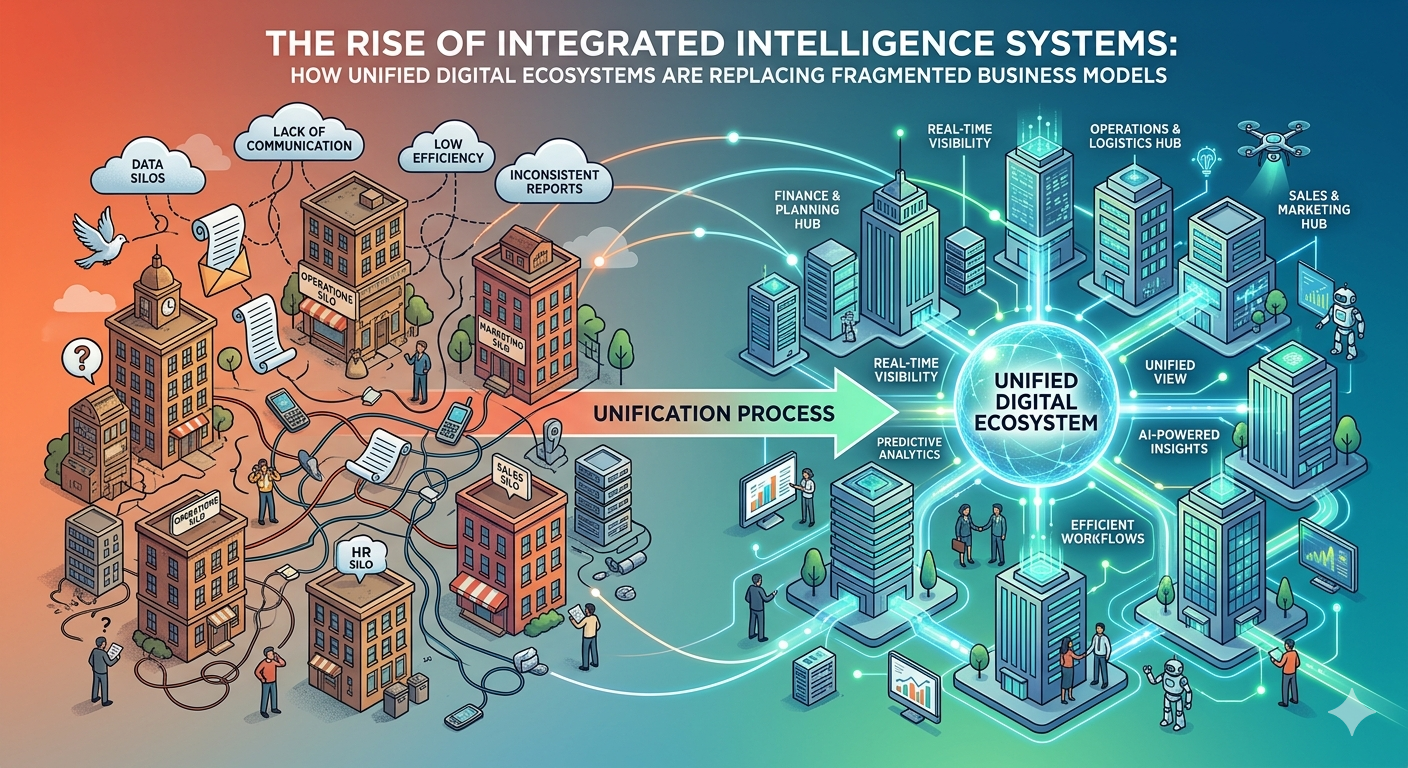
Introduction: The End of Fragmented Thinking
For decades, businesses have been built on separation. Marketing operated independently from operations. Sales teams rarely aligned deeply with product development. Logistics, finance, branding, and customer experience existed as isolated departments with minimal synchronization.
This fragmentation was once considered normal. In fact, it was seen as necessary for specialization.
But the global digital transformation of the last ten years has exposed a structural weakness in this model: separated systems cannot compete in real-time environments.
Today, markets shift faster than organizational communication cycles. Customer expectations evolve faster than internal approvals. Data flows faster than decision-making structures.
As a result, a new paradigm is emerging: integrated intelligence systems—business ecosystems where strategy, data, execution, and experience operate as one unified system rather than disconnected parts.
This shift is not incremental. It is structural. And it is redefining how modern organizations are built, scaled, and sustained.
1. The Problem With Traditional Business Architecture
Traditional organizations are built like mechanical machines. Each department is a gear. Each gear performs a specific function. The assumption is simple: if every part performs well individually, the system performs well collectively.
However, modern environments do not behave like machines. They behave like networks.
In a networked environment:
- Information is non-linear
- Feedback is instantaneous
- Decisions are interconnected
- Delays compound system-wide inefficiencies
This creates a fundamental mismatch.
1.1 Information Lag
In traditional systems, data moves through layers:
Customer → Sales → Reporting → Management → Strategy → Execution
By the time data reaches decision-makers, it is already outdated.
1.2 Execution Disconnect
Even when insights are correct, execution is delayed due to structural barriers between departments.
1.3 Optimization Failure
Each department optimizes for itself rather than for the system as a whole.
The result is a paradox: highly efficient parts, but an inefficient whole.
2. The Shift Toward System-Level Thinking
Modern organizations are beginning to adopt a different model: system-level integration.
Instead of optimizing departments independently, they optimize the interaction between components.
This shift is driven by three technological forces:
2.1 Real-Time Data Infrastructure
Cloud computing and API ecosystems now allow organizations to access real-time operational data across all functions.
2.2 Automation and AI Layering
Automation reduces dependency on sequential workflows. AI systems now connect marketing, analytics, customer service, and operations simultaneously.
2.3 Platform-Based Architecture
Companies are transitioning from hierarchical structures to platform ecosystems where functions are modular and interconnected.
This leads to one central principle:
Competitive advantage is no longer about isolated excellence. It is about system coherence.
3. What an Integrated Intelligence System Actually Means
An Integrated Intelligence System is not just software integration.
It is a structural redesign of how an organization thinks and operates.
It combines:
- Strategy (decision logic)
- Data (real-time intelligence)
- Execution (workflow systems)
- Experience (customer interaction layers)
All four operate continuously in feedback loops.
3.1 Strategy Becomes Dynamic
Instead of annual or quarterly planning, strategy becomes adaptive and continuously updated based on live data.
3.2 Data Becomes Actionable
Data is no longer stored for reporting. It is used as an immediate input into decision-making systems.
3.3 Execution Becomes Automated
Repetitive tasks are handled through automated pipelines, reducing latency between decision and action.
3.4 Experience Becomes Personalized
Customer interaction is shaped in real time based on behavioral inputs and predictive models.
4. Why Fragmented Models Are Becoming Obsolete
The decline of traditional models is not theoretical—it is observable across industries.
4.1 Marketing vs Operations Misalignment
Marketing campaigns often promote promises that operations cannot consistently deliver at scale.
4.2 Supply Chain Blind Spots
Logistics systems frequently operate independently from demand forecasting systems, leading to inefficiencies and waste.
4.3 Customer Experience Gaps
Customer service is often reactive rather than predictive due to disconnected data systems.
The root issue is not competence. It is structure.
5. The Core Principle of Modern Systems: Feedback Loops
The most important concept in integrated systems is the feedback loop.
A feedback loop ensures that every action produces data that immediately informs the next action.
There are three types:
5.1 Internal Feedback Loop
Between departments within an organization.
5.2 External Feedback Loop
Between the organization and its customers or market environment.
5.3 Predictive Feedback Loop
Where systems anticipate outcomes before they fully occur using historical patterns and AI modeling.
Organizations that master feedback loops evolve faster than competitors because they reduce the delay between insight and adaptation.
6. From Linear Growth to Systemic Growth
Traditional business growth follows a linear pattern:
More customers → more revenue → more resources → more expansion
But integrated systems generate exponential growth dynamics because:
- Each improvement strengthens the entire system
- Efficiency compounds across departments
- Data improves decision quality continuously
- Automation scales execution without proportional cost increase
This creates a compounding effect known as systemic scaling.
7. The Role of Intelligence Layering
Modern systems are not just integrated—they are layered.
7.1 Data Layer
Raw information from users, operations, and markets.
7.2 Logic Layer
Rules, algorithms, and decision frameworks.
7.3 Execution Layer
Automated systems that implement decisions.
7.4 Experience Layer
User-facing interaction and engagement systems.
Each layer feeds the others continuously.
This structure replaces traditional hierarchy with functional interdependence.
8. Organizational Culture in Integrated Systems
Technology alone is not enough. Cultural transformation is required.
8.1 From Ownership to Flow
Employees no longer “own” isolated tasks. They participate in system flows.
8.2 From Departmental Identity to System Identity
The organization is no longer a collection of departments but a unified system with shared objectives.
8.3 From Control to Coordination
Leadership shifts from controlling processes to optimizing system coordination.
9. Competitive Advantage in the New Era
In integrated environments, competitive advantage is defined by:
- Speed of adaptation
- Quality of internal data connectivity
- Degree of automation
- Strength of feedback loops
- System coherence
Not by isolated excellence.
Companies that continue operating in fragmented models will face increasing inefficiency gaps compared to integrated competitors.
10. Future Direction: Self-Optimizing Organizations
The next stage of evolution is already emerging: self-optimizing organizations.
These systems will:
- Detect inefficiencies automatically
- Adjust workflows without human intervention
- Predict market changes in advance
- Reallocate resources dynamically
- Continuously refine strategy in real time
This represents a shift from management-driven systems to intelligence-driven systems.
Conclusion: The Structural Transformation of Business
The global economy is moving from fragmented organizational models toward integrated intelligence systems.
This is not a trend in tools. It is a transformation in structure.
Organizations that adapt will operate as unified systems where strategy, data, execution, and experience are seamlessly connected.
Organizations that do not will continue to operate in delayed cycles, inefficiencies, and disconnected decision-making structures.
The future belongs to systems—not silos.
And in that future, success is determined not by how strong individual parts are, but by how intelligently they work together.
Leave a Reply