Introduction: The End of Random Growth
For more than a decade, digital marketing has been treated as a collection of isolated activities—advertising, social media posting, SEO optimization, email campaigns, and content production. Each function operates independently, often without a unified structure connecting them.
This fragmented approach is now obsolete.
In 2026, the businesses that scale consistently are not those that “do more marketing,” but those that design intelligent growth systems—integrated ecosystems where every digital action is measurable, connected, and continuously optimized.
Growth is no longer a matter of execution alone. It is a matter of system intelligence.
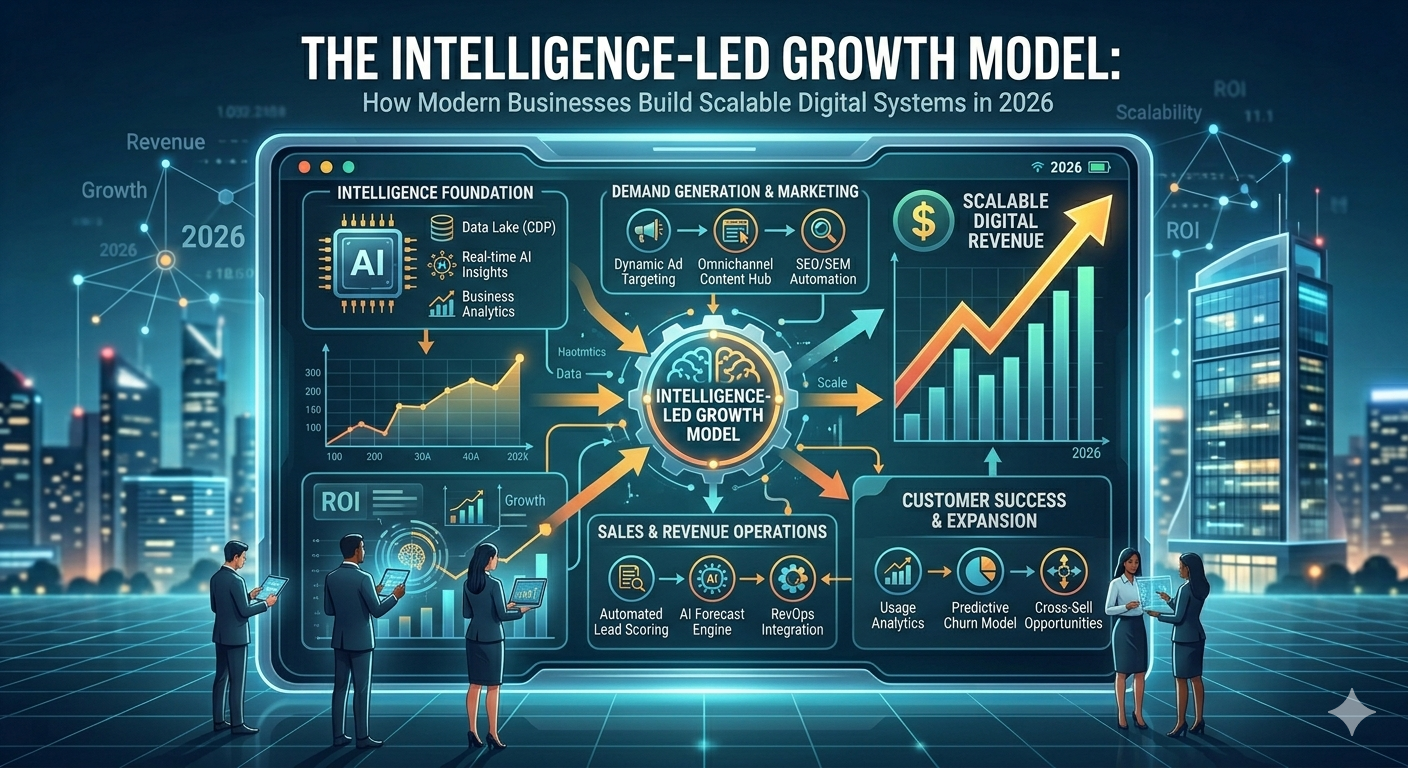
The Intelligence-Led Growth Model represents this shift. It replaces fragmented marketing with structured, data-driven, and self-improving revenue systems.
1. The Fundamental Problem With Traditional Digital Marketing
Traditional digital marketing suffers from three structural limitations:
1.1 Disconnected Channels
Most businesses treat each channel separately:
- SEO team works independently
- Paid ads run independently
- Social media operates independently
- Email marketing is reactive instead of integrated
This creates inconsistency in messaging, targeting, and performance tracking.
1.2 Short-Term Thinking
Campaign-based execution focuses on immediate results rather than compounding performance.
Once a campaign ends, momentum disappears.
1.3 Lack of System Feedback
Most businesses collect data but do not integrate it into a unified optimization loop.
As a result, decisions are reactive instead of predictive.
These limitations explain why many businesses experience growth spikes but fail to sustain them.
2. Defining Intelligence-Led Growth
Intelligence-Led Growth (ILG) is a structured model where every marketing, sales, and customer interaction is:
- Connected
- Measurable
- Adaptive
- Continuously optimized
It transforms marketing from a set of actions into a living system of performance intelligence.
The core principle is simple:
Every interaction generates data. Every data point improves the system.
3. The Four Layers of a Modern Growth System
A functional intelligence-led system is built on four interdependent layers.
3.1 Acquisition Layer: Structured Attention Generation
This layer is responsible for generating predictable and qualified traffic.
It includes:
- Paid media systems (search, social, programmatic)
- Organic visibility engines (SEO + content systems)
- Distribution networks (partners, affiliates, influencers)
However, unlike traditional marketing, acquisition is not treated as an endpoint. It is the entry node of a larger system.
Key shift:
Traffic is not the goal. Qualified attention is.
3.2 Conversion Layer: Turning Attention Into Action
This layer transforms attention into measurable business outcomes.
It includes:
- Landing page architecture
- Offer engineering
- Funnel optimization
- Behavioral persuasion design
In intelligence-led systems, conversion is not static. It evolves based on continuous behavioral data.
For example:
- If bounce rate increases → landing page structure is adjusted
- If drop-off occurs → offer positioning is refined
- If engagement improves → funnel is expanded
Conversion is a live optimization environment.
3.3 Intelligence Layer: The Core Differentiator
This is the most important but most overlooked layer.
The intelligence layer collects and processes system-wide data:
- Customer acquisition cost trends
- Funnel drop-off behavior
- Engagement depth
- Retention curves
- Lifetime value progression
- Channel attribution performance
This layer acts as the central nervous system of the business.
It answers questions such as:
- Which channel produces long-term value, not just leads?
- Where does the funnel lose efficiency?
- What behavioral patterns predict conversion?
Without this layer, growth becomes guesswork.
3.4 Retention Layer: Compounding Revenue Engine
Most businesses focus heavily on acquisition and ignore retention.
However, in modern systems:
Retention determines scalability.
Retention includes:
- Customer lifecycle automation
- Re-engagement systems
- Loyalty structures
- Community ecosystems
- Upsell/cross-sell logic
A strong retention layer reduces dependency on constant acquisition.
It converts one-time buyers into long-term revenue assets.
4. Why Systems Outperform Campaigns
Campaign-based marketing is linear:
- Spend → Launch → Results → Stop → Restart
System-based growth is cyclical:
- Acquire → Analyze → Optimize → Reinvest → Expand
The difference is compounding.
Systems improve over time. Campaigns reset.
This is why businesses using structured growth systems achieve:
- Lower acquisition costs
- Higher conversion efficiency
- Better retention rates
- More predictable revenue
5. Data as the Foundation of Predictability
In intelligence-led systems, data is not reporting—it is operational fuel.
However, most businesses misuse data in three ways:
5.1 Descriptive Use Only
They look at what happened instead of why it happened.
5.2 Fragmented Analytics
Data exists in separate dashboards without integration.
5.3 Delayed Decision Making
Insights are applied too late to impact performance.
Modern systems require:
- Unified tracking architecture
- Real-time behavioral signals
- Cross-channel attribution logic
- Predictive modeling inputs
The goal is not analysis.
The goal is system response.
6. The Role of Automation in Scaling Intelligence
Automation transforms intelligence into execution.
Without automation, insights remain theoretical.
Key automation layers include:
6.1 Behavioral Triggers
Actions based on user behavior:
- Email sequences triggered by inactivity
- Retargeting based on page visits
- Offers based on engagement depth
6.2 Lifecycle Automation
Customers move through structured stages automatically:
- Lead → Prospect → Customer → Repeat Buyer → Advocate
6.3 System Optimization Loops
Performance changes automatically based on thresholds:
- Ad budgets reallocated
- Funnel steps adjusted
- Audience segments refined
Automation ensures that intelligence is not passive—it becomes operational.
7. Content as a System Component, Not a Marketing Tool
In intelligence-led growth, content is not branding—it is infrastructure.
Content serves three strategic functions:
7.1 Attraction Layer
Drives inbound attention through search and distribution systems.
7.2 Education Layer
Reduces friction in decision-making by increasing clarity.
7.3 Conversion Layer
Supports final-stage persuasion through trust reinforcement.
Content must be engineered into the system, not produced independently.
8. Funnel Architecture in 2026: Dynamic, Not Linear
Traditional funnels assume linear progression:
Awareness → Interest → Decision → Purchase
Modern systems operate differently.
Funnels are now:
- Multi-entry
- Non-linear
- Behavior-adaptive
- Feedback-driven
A user may enter at any stage and still be guided through the system based on behavior signals.
This requires:
- Multi-path funnel design
- Dynamic content mapping
- Adaptive offer sequencing
Funnels are no longer static diagrams—they are adaptive systems.
9. Scaling Through System Replication
Once a growth system is built, scaling becomes replication, not reinvention.
Businesses can:
- Duplicate funnels across markets
- Clone acquisition systems across channels
- Reuse automation frameworks
- Expand intelligence models with new data inputs
Scaling becomes controlled expansion instead of chaotic growth.
10. The Strategic Advantage of Intelligence-Led Growth
The competitive gap between system-driven businesses and traditional marketers is widening.
System-driven businesses achieve:
- Lower marginal acquisition costs
- Higher lifetime value
- Predictable scaling patterns
- Faster optimization cycles
Traditional businesses remain dependent on:
- Ad spend fluctuations
- Platform algorithm changes
- Manual decision-making delays
In 2026, the dominant advantage is not creativity or budget.
It is system intelligence density.
Conclusion: Growth Is Now an Engineering Discipline
Digital growth is no longer a creative experiment.
It is an engineering discipline built on structure, intelligence, and continuous optimization.
The Intelligence-Led Growth Model replaces randomness with architecture. It replaces intuition with data-driven systems. It replaces campaigns with compounding infrastructure.
Businesses that adopt this model do not just grow faster.
They grow predictably.
And in modern digital ecosystems, predictability is the highest form of competitive advantage.
Leave a Reply