Introduction: Why Random Marketing No Longer Works
Most businesses today are not struggling because they lack marketing activities. They are struggling because their marketing is disconnected.
They run ads without a content system.
They publish content without conversion logic.
They collect traffic without a structured follow-up process.
They invest in SEO without understanding revenue pathways.
The result is predictable: inconsistent growth, unstable revenue, and unclear return on marketing investment.
In 2026, digital competition has evolved beyond isolated tactics. Success now depends on whether a business operates with a systemized growth architecture instead of fragmented marketing efforts.
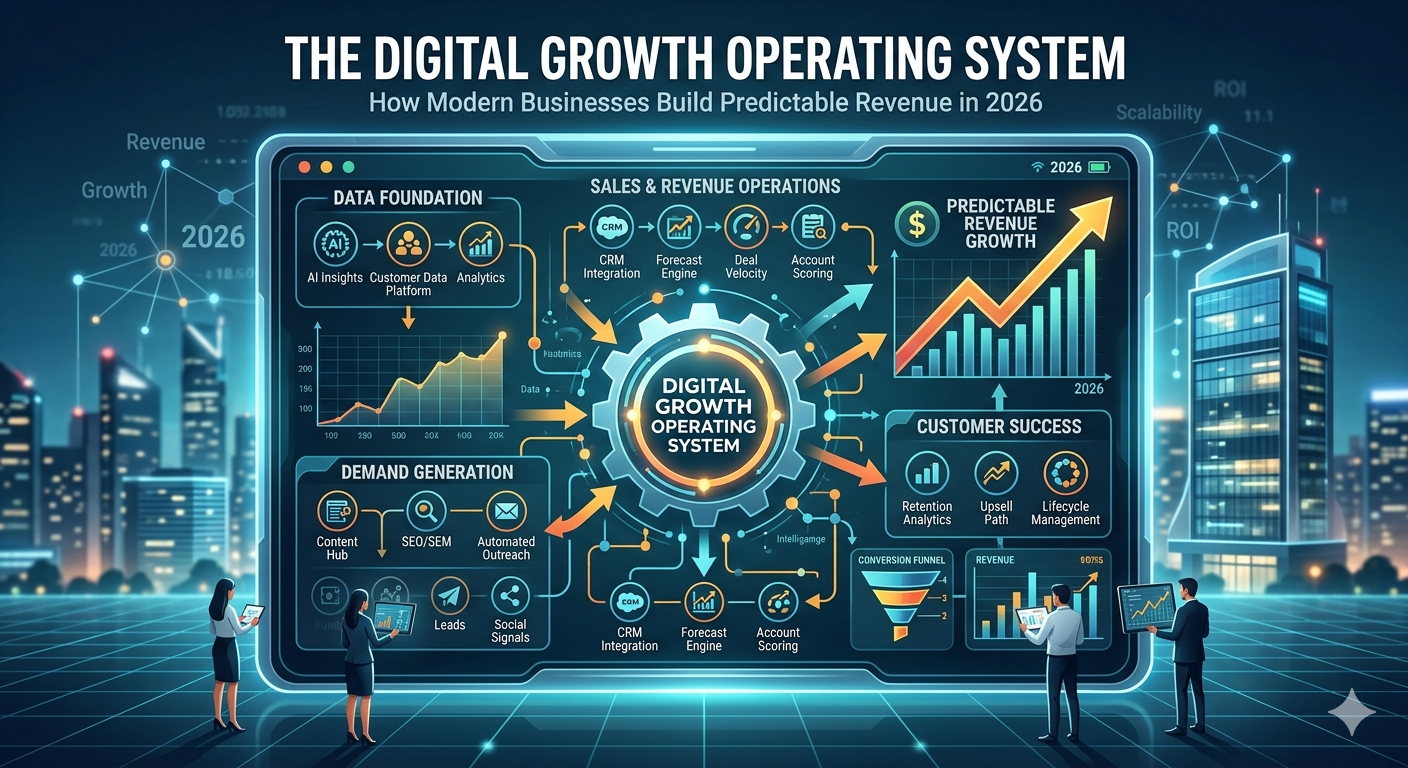
This article breaks down a structured framework—referred to here as a Digital Growth Operating System (DGOS)—that aligns traffic, branding, content, and conversion into a unified revenue engine.
1. The Core Problem: Fragmented Digital Execution
Modern businesses typically operate in four disconnected silos:
1.1 Traffic Generation Without Strategy
Paid ads, SEO, influencer campaigns, and social media bring visitors—but without clear intent mapping, most traffic is low-quality or untracked.
1.2 Content Without Conversion Logic
Blogs, reels, and posts are published for visibility rather than guided customer progression.
1.3 Branding Without Performance Tracking
Many companies invest in design and identity but cannot measure how branding affects revenue.
1.4 Sales Without Digital Integration
Sales teams operate separately from marketing systems, losing valuable behavioral data.
This fragmentation creates inefficiency at every stage of the funnel.
2. The Shift: From Marketing Campaigns to Growth Systems
Traditional marketing focuses on campaigns.
Modern growth focuses on systems.
A system ensures that every digital action contributes to one outcome:
predictable revenue generation
A Digital Growth Operating System connects five essential layers:
- Visibility Layer (SEO + Ads)
- Engagement Layer (Content + Social)
- Trust Layer (Branding + Authority)
- Conversion Layer (Funnels + UX)
- Retention Layer (CRM + Email + Loyalty)
When these layers operate together, growth becomes measurable and scalable.
3. The Visibility Layer: Controlled Attention Acquisition
Visibility is no longer about being everywhere—it is about being present in the right intent zones.
Key Components
- Search Engine Optimization (SEO)
- Paid Search Campaigns
- Social Discovery Algorithms
- Strategic Content Distribution
However, visibility without filtering is expensive. The key is intent-based acquisition, where traffic is segmented into:
- High intent (ready to buy)
- Mid intent (comparing solutions)
- Low intent (educational awareness)
Modern systems do not treat all traffic equally. They route users differently based on behavioral signals.
4. The Engagement Layer: Building Meaningful Interaction
Once users arrive, attention must be structured, not assumed.
Engagement is built through:
- Educational content
- Interactive assets
- Value-first messaging
- Problem-solution storytelling
The goal is not to entertain—it is to guide understanding.
At this stage, businesses must answer:
- What problem does the user recognize?
- What solution are they currently considering?
- What friction is stopping them from deciding?
Without structured engagement, traffic leaks immediately.
5. The Trust Layer: Why Branding Now Equals Revenue
Branding is often misunderstood as design. In reality, it is perception engineering.
In 2026, trust is built through:
- Consistent messaging across platforms
- Demonstrated expertise (case studies, data)
- Social proof systems
- Transparent communication
A strong brand reduces acquisition cost because it compresses the decision cycle.
Users no longer ask:
“What is this company?”
They ask:
“Can I trust this company to solve my problem?”
Trust is the currency that converts attention into action.
6. The Conversion Layer: Engineering User Decisions
Conversion is not a single button or checkout page.
It is a sequence of micro-decisions:
Conversion architecture includes:
- Landing page structure
- Offer positioning
- Psychological triggers
- CTA placement
- Friction reduction
A high-performing system ensures that every user interaction moves them closer to one of three outcomes:
- Purchase
- Lead submission
- Return engagement
Conversion optimization is not design-based alone—it is behavioral engineering.
7. The Retention Layer: Where Real Profit is Made
Most businesses over-invest in acquisition and under-invest in retention.
However, in stable growth systems:
Retention determines profitability more than acquisition.
Retention systems include:
- Email automation sequences
- CRM segmentation
- Loyalty mechanisms
- Personalized offers
- Re-engagement campaigns
A customer who returns costs significantly less than acquiring a new one.
Businesses that ignore retention effectively rebuild revenue from zero every month.
8. The Integration Principle: Why Systems Fail Without Alignment
Even when all five layers exist, many businesses still fail.
The reason is lack of integration.
A proper Digital Growth Operating System ensures:
- SEO data informs content strategy
- Content informs ad targeting
- Ads inform funnel optimization
- Funnels inform CRM segmentation
- CRM data loops back into content creation
This creates a continuous optimization cycle instead of isolated performance spikes.
9. The Role of Data: From Guesswork to Predictability
Data transforms marketing from creative guessing into operational science.
Key performance indicators include:
- Customer acquisition cost (CAC)
- Lifetime value (LTV)
- Conversion rate per funnel stage
- Engagement depth
- Retention curve
Businesses that track these metrics accurately can forecast revenue with high precision.
10. The 2026 Advantage: AI-Augmented Growth Systems
Artificial intelligence has changed execution speed, not strategy fundamentals.
AI enhances:
- Content production scaling
- Audience segmentation
- Predictive analytics
- Ad optimization
- Personalization at scale
However, AI does not replace the need for structure. Without a system, AI simply produces faster chaos.
11. Implementation Framework: Building a Growth System Step-by-Step
A practical rollout follows this sequence:
Step 1: Define Core Offer
Clarify product-market fit and pricing structure.
Step 2: Build Visibility Engine
Establish SEO + paid acquisition channels.
Step 3: Design Content Architecture
Map content to customer intent stages.
Step 4: Build Conversion Funnel
Create structured landing pages and lead paths.
Step 5: Implement Retention System
Set up CRM and automated lifecycle communication.
Step 6: Connect Data Feedback Loop
Align analytics across all stages.
Conclusion: The Future Belongs to System-Driven Businesses
Marketing in 2026 is no longer about isolated tactics or viral moments.
It is about building structured systems that consistently convert attention into revenue.
Businesses that adopt a Digital Growth Operating System will achieve:
- predictable scaling
- reduced acquisition costs
- higher customer lifetime value
- stable long-term growth
Those that continue relying on fragmented strategies will face increasing inefficiency and rising marketing costs.
The difference is no longer creativity alone.
It is system design capability.
Leave a Reply