Introduction
We don’t design products anymore.
We design experiences.
That distinction matters—not because it sounds better, but because it reflects a fundamental shift in how people interact with the world. A product is static. An experience is dynamic. A product is owned. An experience is lived.
And in a world where everything is constantly changing—technologies, behaviors, expectations—the only thing that truly scales is the ability to design experiences that adapt.
The question is no longer:
“What are we building?”
The question is:
“What are people actually feeling, doing, and remembering?”
The Death of the Static Interface
There was a time when interfaces were predictable.
Websites had pages. Applications had screens. Users followed paths.
That time is gone.
Today, interaction happens across:
- Devices
- Environments
- Contexts
- Moments
The interface is no longer a place. It is a system of relationships.
A retail experience is not just a store—it’s:
- The physical environment
- The digital layer
- The behavioral triggers
- The emotional response
Designing within this reality requires a shift from interface design → experience orchestration.
Experience as a System, Not a Screen
An experience is not a single touchpoint.
It is a network of interactions connected by:
- Time
- Intent
- Context
- Memory
When someone interacts with a brand, they don’t see “channels.” They see continuity—or the lack of it.
The Real Problem
Most systems are built in fragments:
- Marketing builds awareness
- Design builds interfaces
- Engineering builds functionality
But the user experiences everything as one continuous flow.
The gap between these silos is where experience breaks.
The Role of Imagination in a Data-Driven World
We live in an era obsessed with data.
Everything is measured:
- Clicks
- Conversions
- Engagement
- Retention
But data has a limitation.
It tells you what happened.
It does not tell you what’s possible.
The Paradox
The more data-driven we become, the more we risk designing for:
- Optimization instead of exploration
- Efficiency instead of meaning
True innovation does not come from dashboards.
It comes from imagination.
As one principle suggests:
Logic gets you from A to B. Imagination takes you everywhere.
The challenge is not choosing between data and creativity.
It is knowing when to ignore one in favor of the other.
Designing for Behavior, Not Just Interaction
Clicks are not behavior.
Behavior is deeper. It includes:
- Motivation
- Friction
- Habit
- Emotion
If a user clicks a button, that’s interaction.
If a user returns, recommends, or remembers—that’s behavior.
Behavioral Design Requires:
- Understanding context, not just actions
- Reducing friction without removing meaning
- Creating feedback loops that reinforce engagement
The goal is not to make things easier.
The goal is to make things worth doing.
Technology as Material, Not Solution
Technology is often treated as the answer.
It’s not.
It’s the material.
Just like:
- Steel in architecture
- Paint in art
- Fabric in fashion
Technology enables—but it does not define.
The Mistake
Many projects start with:
- “Let’s use AI”
- “Let’s build an app”
- “Let’s integrate AR”
This is backwards.
The correct starting point is:
- What experience are we trying to create?
- What behavior are we trying to influence?
- What emotion are we trying to evoke?
Only then does technology become relevant.
The Power of Interactive Environments
The most impactful experiences are not passive.
They respond.
They adapt.
They engage.
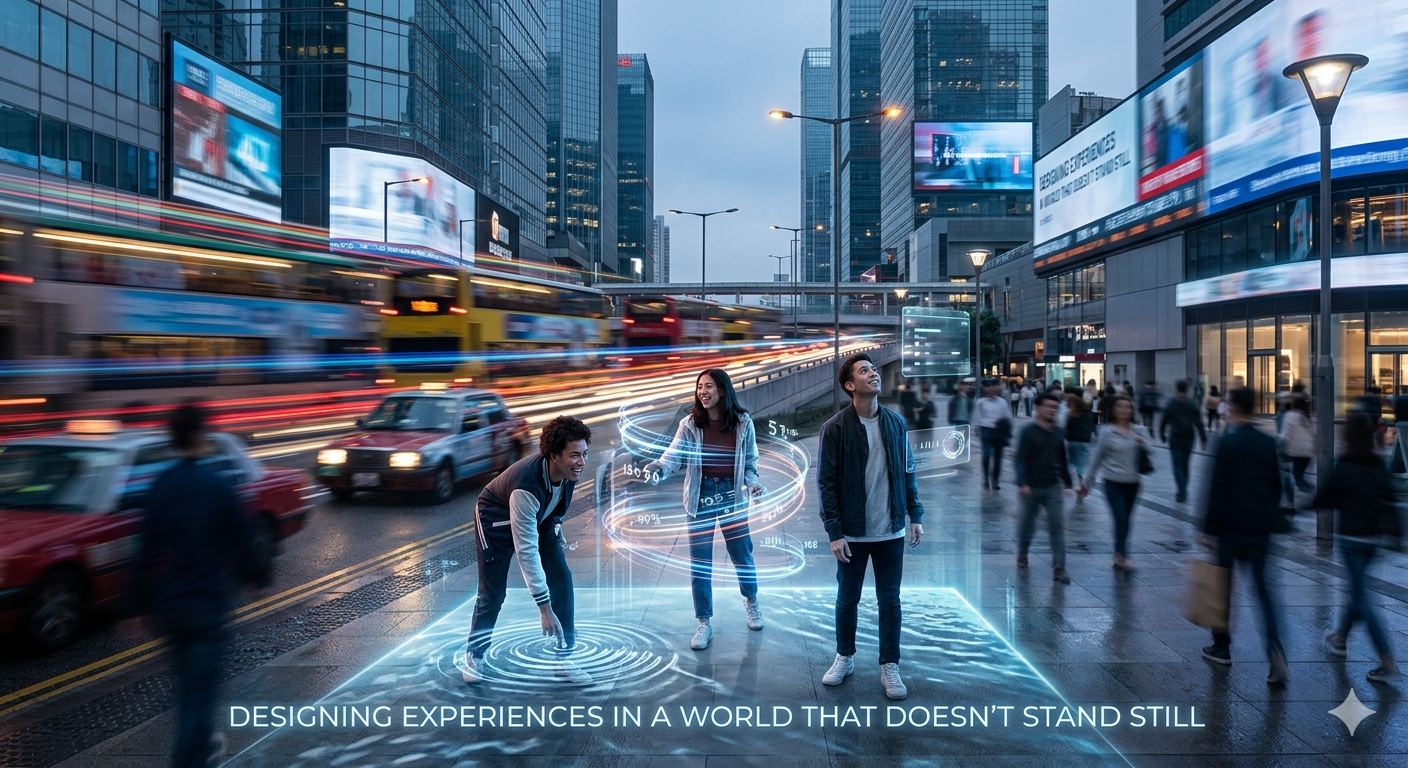
Interactive environments—whether in retail, exhibitions, or digital platforms—transform users from observers into participants.
Why This Matters
Participation creates:
- Deeper engagement
- Stronger memory
- Emotional connection
People don’t remember what they saw.
They remember what they did.
Retail Is No Longer About Selling
Retail has evolved.
It is no longer about transactions.
It is about experience layers:
- Discovery
- Interaction
- Personalization
- Engagement
Stores are becoming:
- Media platforms
- Experience hubs
- Data environments
The Shift
From:
“How do we sell this product?”
To:
“How do we create an environment where this product becomes meaningful?”
The Blurring of Physical and Digital
The boundary between physical and digital is dissolving.
What we’re seeing is not replacement—but integration.
Examples of Convergence
- Physical spaces enhanced by digital interaction
- Digital platforms influenced by physical behavior
- Hybrid environments where both coexist
This creates a new design challenge:
Designing for continuity across realities.
Failure as a Design Strategy
Most systems are built to avoid failure.
But innovation requires it.
Failure is not a flaw—it’s feedback.
Why Failure Matters
- It reveals assumptions
- It exposes limitations
- It drives iteration
The problem is not failure.
The problem is failing too late.
Design Approach
- Prototype early
- Test often
- Learn continuously
The faster you fail, the faster you evolve.
The Role of Story in Experience Design
Humans don’t connect with systems.
They connect with stories.
Every experience tells a story—whether intentionally or not.
Strong Experience Narratives Include:
- A clear beginning (entry point)
- A meaningful middle (interaction)
- A memorable end (takeaway)
Without narrative, experiences feel fragmented.
With narrative, they feel intentional.
Designing for Memory, Not Just Use
Most design focuses on usability.
But usability is the baseline—not the goal.
The real question is:
Will this be remembered?
Memory is Driven By:
- Emotion
- Surprise
- Participation
- Meaning
An experience that is easy but forgettable has limited impact.
An experience that is meaningful creates lasting value.
The Future of Experience Design
The next phase of design will be shaped by:
- Adaptive systems
- Real-time personalization
- Spatial computing
- AI-driven interaction
But technology alone will not define the future.
Human experience will.
What Will Matter Most
- Understanding behavior at a deeper level
- Designing systems, not screens
- Blending disciplines seamlessly
- Embracing uncertainty
The Role of the Designer
The role of the designer is changing.
It is no longer about:
- Making things look good
- Creating isolated interfaces
It is about:
- Connecting systems
- Shaping behavior
- Creating meaning
Designers are becoming:
- Strategists
- Technologists
- Storytellers
A Different Way to Think About Work
Traditional thinking separates:
- Art vs commerce
- Creativity vs business
- Design vs technology
This separation no longer works.
The most impactful work happens at the intersection.
The New Model
- Creative thinking drives strategy
- Technology enables execution
- Experience defines value
Conclusion
We are no longer designing objects.
We are designing realities.
In a world that moves constantly, the only stable advantage is the ability to create experiences that adapt, engage, and evolve.
The tools will change.
The platforms will change.
The expectations will change.
But one thing remains constant:
People.
Their behaviors. Their emotions. Their memories.
That is where design begins.
Final Thought
It’s not about what you build.
It’s about what people experience.
And more importantly—
what they carry with them after it’s over.
Leave a Reply