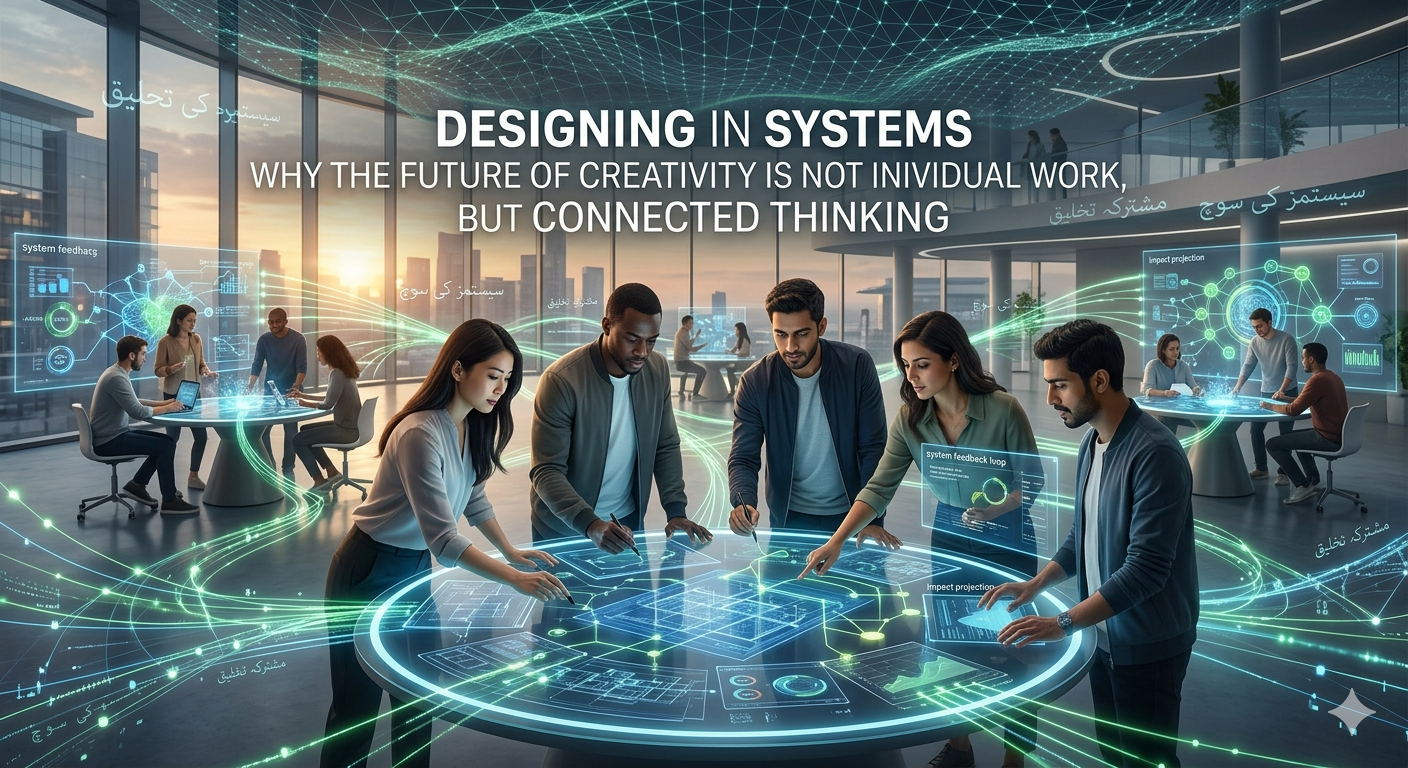
Introduction
We used to think creativity belonged to individuals.
A designer. A strategist. A developer. A writer.
Each working independently, producing outputs that would later be assembled into something called a “project.”
That structure is breaking.
Not slowly. Not partially. Completely.
What is emerging instead is something different: system-based creation, where ideas are not isolated outputs but interconnected components of larger, living frameworks.
In this environment, the question is no longer:
“What can I create?”
The question becomes:
“What system am I contributing to—and how does it evolve after I’m gone?”
The Shift from Output Thinking to System Thinking
Traditional creative work is output-driven.
You are assigned a task:
- Design a website
- Write a campaign
- Build an interface
Once delivered, the work is considered complete.
But systems don’t work like that.
A system is never finished. It is:
- continuously updated
- influenced by external inputs
- shaped by user behavior
- evolving over time
This means creative work is no longer about finishing objects.
It is about initiating living structures.
What a “System” Actually Means in Creative Practice
A system is not just technology.
It is a network of relationships between:
- People
- Interfaces
- Behaviors
- Content
- Environments
- Time
When these elements interact consistently, they form patterns.
Those patterns become experiences.
And those experiences define perception.
A brand is not a logo.
A product is not a screen.
A campaign is not a message.
They are all expressions of underlying systems.
Why Most Creative Work Fails at Scale
Most creative output is strong at the point of creation, but weak over time.
This happens because it is designed in isolation.
Common failure points:
- Design without behavioral feedback loops
- Marketing without product alignment
- Technology without user context
- Strategy without operational structure
Each discipline operates independently, assuming the others will adapt later.
They rarely do.
The result is fragmentation.
And fragmentation is the opposite of systems thinking.
The Invisible Layer: Behavior
Systems are not defined by what they look like.
They are defined by what people do inside them.
Behavior is the real architecture.
For example:
- A button is not design; it is a decision trigger
- A scroll is not navigation; it is attention flow
- A checkout process is not UI; it is trust conversion
If behavior is not designed intentionally, the system collapses into randomness.
Co-Creation as a Structural Principle
Modern systems cannot be built alone.
They require co-creation—not as collaboration in the traditional sense, but as distributed authorship.
In co-creation:
- No single role owns the system
- Inputs are continuous, not sequential
- Decisions are shared across disciplines
- Output is emergent, not predefined
This changes everything.
The designer is no longer the “creator.”
The designer becomes a system facilitator.
The End of Linear Workflows
Linear workflows assume predictability:
- Research
- Design
- Develop
- Launch
But systems don’t behave linearly.
Feedback arrives during every stage:
- Users interact before completion
- Stakeholders change direction mid-process
- Technology shifts during execution
Linear processes collapse under non-linear reality.
What replaces them is adaptive flow systems, where every stage is open, revisitable, and responsive.
Interfaces Are Becoming Environments
A major shift is happening quietly:
Interfaces are dissolving.
What once were screens are becoming environments.
We no longer interact with static surfaces. We interact with:
- Context-aware systems
- Spatial interactions
- Multi-layered digital-physical hybrids
This means design is no longer about “pages.”
It is about conditions.
An environment reacts differently depending on:
- time
- user
- intent
- behavior
Designing for environments requires thinking in probabilities, not fixed layouts.
The Role of Time in Experience Design
Time is often ignored in design.
But systems exist in time.
A user experience is not a moment. It is a sequence:
- First exposure
- Familiarity
- Habit formation
- Memory retention
Each stage changes perception.
A system that works instantly may fail over time.
A system that feels complex initially may become powerful later.
Design must account for temporal behavior, not just immediate usability.
Feedback Loops as Creative Infrastructure
A system without feedback is static.
A system with feedback becomes intelligent.
Feedback loops exist in multiple forms:
- User interaction data
- Behavioral repetition
- Emotional response
- Performance metrics
- Environmental adaptation
These loops define whether a system improves or decays.
Strong systems are not defined by their starting point.
They are defined by their ability to respond.
Minimalism Is Not Simplicity—It Is Reduction of Noise in Systems
Minimal design is often misunderstood.
It is not about removing elements.
It is about removing unnecessary interference within a system.
Noise exists when:
- multiple signals compete
- user intent is unclear
- hierarchy is inconsistent
- feedback is delayed
Minimal systems are not visually empty.
They are structurally precise.
The Illusion of Control in Creative Work
Most creative processes assume control:
- control over output
- control over interpretation
- control over outcome
But systems are partially uncontrollable by nature.
Once launched, they:
- evolve independently
- adapt based on usage
- generate unexpected behaviors
This is not failure.
This is emergence.
The goal is not control.
The goal is guidance through structure.
Designing for Emergence
Emergence happens when simple rules produce complex outcomes.
In systems design, this means:
- small inputs can produce large behavioral shifts
- minor interface changes can alter user patterns
- subtle timing differences can change outcomes
Designers must learn to work with:
- probability
- uncertainty
- indirect influence
Instead of dictating outcomes, systems should shape possibilities.
The Creative Stack Is Collapsing
Historically, creative work was divided into layers:
- Strategy
- Design
- Development
- Content
- Distribution
These layers are merging.
AI, automation, and integrated platforms are dissolving boundaries.
The future stack is not vertical.
It is networked.
Roles overlap. Responsibilities blend. Outputs become shared.
Identity in System-Based Work
In system-based creation, identity is no longer tied to output.
It is tied to:
- influence within systems
- ability to connect disciplines
- contribution to long-term evolution
A strong contributor is not someone who produces the most.
It is someone who improves the system itself.
The Future Is Not More Design—It Is Better Systems
We are entering a phase where execution is no longer the differentiator.
Tools are abundant. Platforms are standardized. Production is automated.
What remains valuable is:
- system clarity
- behavioral insight
- structural thinking
- adaptive design intelligence
The winners will not be the fastest creators.
They will be the best system thinkers.
Conclusion
Creativity is no longer a moment.
It is a system.
And systems do not belong to individuals. They belong to networks of interaction, shaped continuously by participation, feedback, and adaptation.
To design today is not to create objects.
It is to define conditions under which experiences evolve.
The question is no longer what you build.
It is:
What continues to happen because you built it?
Leave a Reply