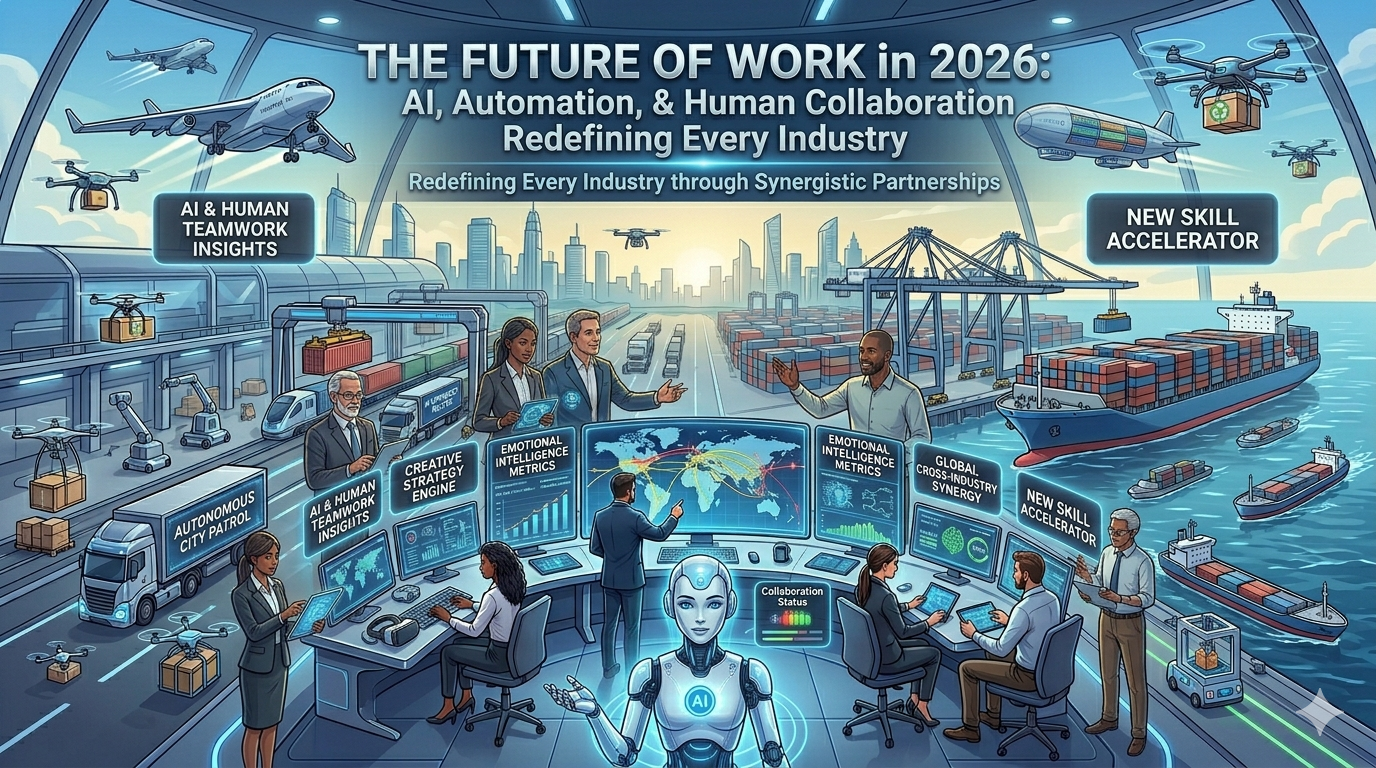
Introduction: A New Industrial Reality Is Already Here
The global economy is no longer evolving in predictable cycles. It is transforming through continuous disruption. Artificial intelligence, automation systems, distributed digital networks, and data-driven decision-making are reshaping how businesses operate, how teams collaborate, and how value is created.
What makes 2026 different from previous technological shifts is not the presence of AI itself—but its deep integration into everyday workflows. AI is no longer a separate tool; it is embedded into decision systems, operational processes, and even human creativity loops.
Organizations that once relied on static planning models are now shifting toward adaptive, real-time systems where intelligence is distributed across machines, software, and people.
This article explores how these shifts are reshaping industries, redefining work, and creating entirely new forms of collaboration between humans and intelligent systems.
1. The Collapse of Traditional Work Structures
For decades, organizations operated on rigid hierarchies:
- Management layers controlled decision flow
- Departments worked in isolation
- Information moved slowly through reporting structures
- Innovation was centralized and slow
In 2026, this structure is becoming obsolete.
Modern organizations are moving toward network-based operational systems, where teams form dynamically around problems rather than departments.
Instead of fixed roles, we now see:
- Fluid job definitions
- Project-based collaboration units
- AI-supported decision augmentation
- Cross-functional real-time execution teams
This shift is not cosmetic. It fundamentally changes productivity. Work is no longer a linear pipeline—it is a continuous adaptive system.
2. AI as an Operational Layer, Not a Tool
Earlier generations of AI adoption treated AI as a support tool:
- Chatbots for customer service
- Analytics dashboards for reporting
- Automation scripts for repetitive tasks
In 2026, AI functions as an operational layer of the organization.
This means AI now participates in:
- Strategic forecasting
- Resource allocation
- Workflow optimization
- Supply chain coordination
- Risk detection and mitigation
More importantly, AI systems are no longer passive. They are context-aware and continuously learning from operational feedback loops.
This creates what can be described as an intelligent enterprise architecture, where decisions are co-produced by human reasoning and machine computation.
3. Automation Is No Longer About Replacement
A common misconception about automation is that it replaces human labor. That framing is outdated.
In modern systems, automation is about:
- Removing friction from decision cycles
- Eliminating repetitive cognitive load
- Increasing execution speed
- Enhancing consistency across large systems
Rather than replacing humans, automation is increasingly used to amplify human output capacity.
For example:
- A logistics planner is no longer manually optimizing routes; AI generates multi-variable optimized options in seconds.
- A marketing strategist no longer tests campaigns manually; AI simulates audience response before launch.
- A supply chain manager no longer reacts to delays; predictive systems identify disruptions before they occur.
The result is not job elimination—it is role transformation.
4. The Rise of Collaborative Intelligence Systems
One of the most significant changes in 2026 is the emergence of collaborative intelligence frameworks.
These systems combine:
- Human judgment
- Machine learning models
- Real-time data streams
- Predictive analytics
- Automated execution engines
Instead of humans working with tools, humans are working within intelligence ecosystems.
This creates a new operational model:
Decision-making becomes a shared process between human cognition and machine intelligence.
In practice, this means:
- Teams co-create outputs with AI systems
- Workflows are dynamically adjusted based on real-time data
- Feedback loops continuously refine outputs
- Systems self-optimize over time
The boundary between “software” and “organization” is becoming blurred.
5. Data Has Become the New Operational Currency
In previous decades, data was treated as an analytical asset.
In 2026, data functions as an operational fuel source.
Every action inside a digital system produces structured signals that are immediately processed into insights and decisions.
Key transformations include:
- Real-time behavioral data driving product design
- Predictive models shaping customer experience
- Automated systems adjusting pricing dynamically
- AI interpreting market signals faster than human analysts
Organizations that fail to integrate real-time data pipelines are increasingly disadvantaged because they operate on delayed intelligence.
The competitive gap between real-time organizations and traditional ones is widening rapidly.
6. The Evolution of Digital Infrastructure
The underlying infrastructure of modern business has undergone a major transformation.
Instead of centralized monolithic systems, companies now rely on:
- Cloud-native architectures
- Microservices ecosystems
- API-first integrations
- Edge computing nodes
- Distributed data systems
This architecture allows organizations to:
- Scale instantly
- Integrate external services dynamically
- Update systems without downtime
- Deploy AI modules independently
The result is a shift from static IT systems to living digital ecosystems that evolve continuously.
7. Human Skills in the Age of Intelligent Systems
As automation handles execution-heavy tasks, human roles are shifting toward:
- Strategic thinking
- System design
- Ethical oversight
- Creative problem-solving
- Cross-domain integration
The most valuable skill in 2026 is no longer specialization alone—it is adaptive intelligence across domains.
Professionals are increasingly expected to:
- Understand data systems
- Interpret AI outputs critically
- Design workflows that integrate automation
- Collaborate across technical and non-technical boundaries
The modern workforce is less about execution and more about orchestration.
8. The Emergence of Real-Time Organizations
A defining trend in 2026 is the rise of real-time organizations.
These organizations operate with:
- Instant feedback loops
- Continuous deployment models
- Live performance optimization
- AI-assisted management systems
Key characteristics include:
- Decisions made in hours, not weeks
- Performance tracked continuously
- Teams reorganized dynamically
- Resources allocated algorithmically
This model significantly increases agility and reduces operational lag.
9. Supply Chains Become Intelligent Networks
One of the most transformative areas is supply chain evolution.
Traditional supply chains relied on:
- Static forecasting
- Fixed routing
- Manual coordination
- Delayed reporting systems
Modern supply chains now operate as intelligent networks:
- AI predicts demand fluctuations
- Logistics routes optimize in real time
- Inventory systems self-adjust automatically
- Risk detection systems prevent disruptions before they occur
The supply chain is no longer linear—it is a self-regulating ecosystem.
10. The Future of Collaboration: Humans + Systems
The defining characteristic of the future workplace is not automation or AI—it is co-evolution between humans and intelligent systems.
This includes:
- Humans defining objectives
- AI generating execution pathways
- Systems optimizing outcomes
- Continuous human oversight and refinement
This relationship creates a hybrid intelligence model where:
Neither humans nor machines operate independently—they function as integrated components of a unified system.
Conclusion: We Are Moving From Organizations to Intelligent Ecosystems
The future of work is not about digital transformation alone. It is about the transformation of how intelligence itself is structured inside organizations.
We are moving from:
- Hierarchies → Networks
- Static systems → Adaptive systems
- Manual workflows → Intelligent automation
- Isolated decision-making → Collaborative intelligence
In this new environment, the most successful organizations will not be the largest or the oldest—but the ones that can learn, adapt, and evolve continuously in real time.
The next decade will not reward stability. It will reward adaptability.
And adaptability, in the modern world, is no longer human or machine—it is both, operating together.
Leave a Reply