Introduction: Why Most Businesses Stop Growing (Even When They Are Doing Everything “Right”)
Most companies assume growth is a result of doing more—more marketing, more hiring, more campaigns, more tools.
But in reality, growth rarely fails due to effort. It fails due to misalignment.
Teams operate in silos. Marketing builds visibility without sales readiness. Recruitment expands headcount without operational structure. Leadership defines strategy without execution clarity.
The result is predictable:
- Increased cost
- Stagnant conversion
- Operational fatigue
- Unclear ROI across functions
Modern growth requires a shift in thinking. Not toward doing more, but toward connecting everything that already exists into a unified system.
This is where integrated growth becomes essential.
It is not a tactic. It is an operating model.
1. The Modern Growth Problem: Fragmentation
Today’s business environment is built on specialization. Companies separate functions to improve focus:
- Marketing handles awareness
- Sales handles conversion
- HR handles hiring
- Operations handles delivery
- Finance handles control
On paper, this structure is efficient. In practice, it creates disconnects between intent and execution.
The Core Issue
Each function optimizes for its own KPIs:
- Marketing optimizes for leads
- Sales optimizes for closing deals
- HR optimizes for hiring speed
- Finance optimizes for cost control
But no one optimizes for end-to-end business growth.
This leads to what can be described as “local optimization, global inefficiency.”
2. What Integrated Growth Actually Means
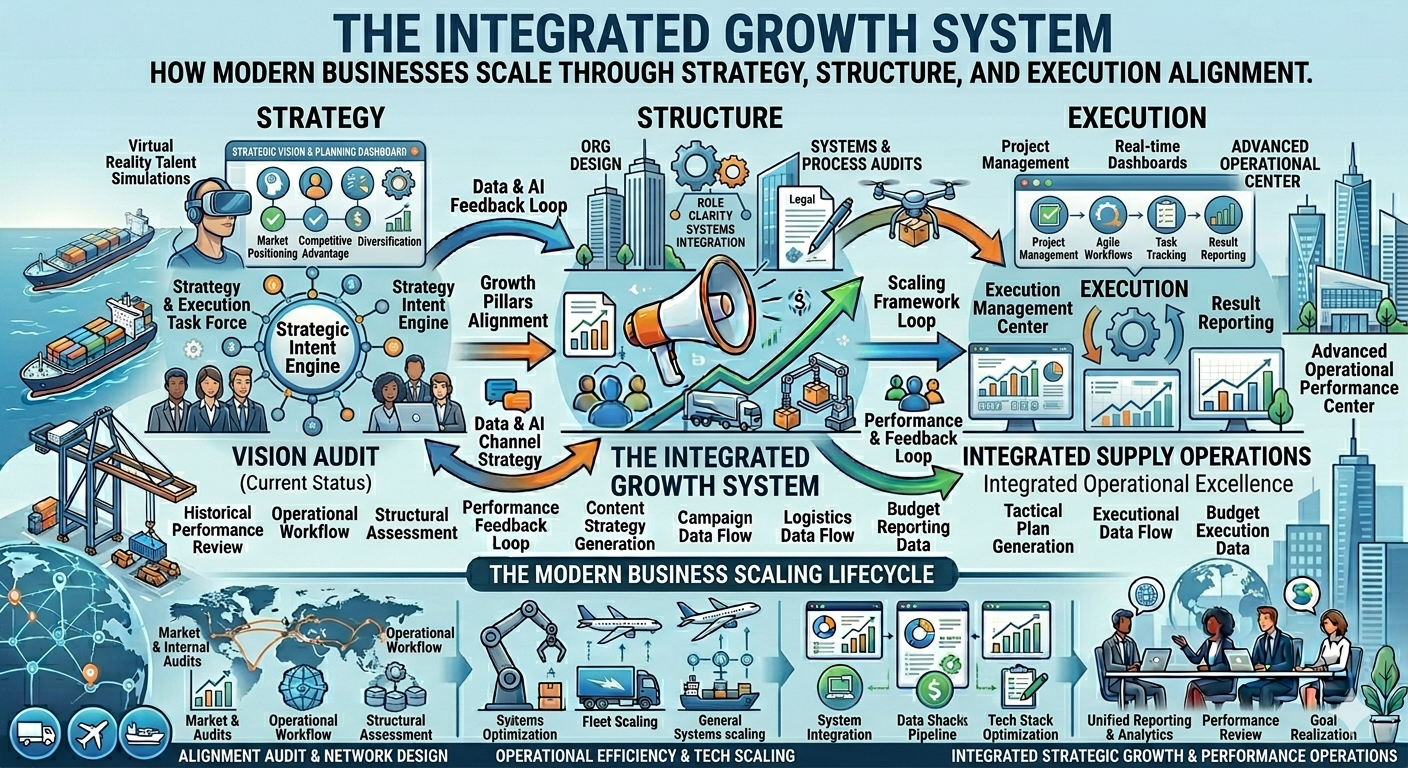
Integrated growth is not a buzzword. It is a structural approach where three core engines operate as one system:
- Talent Engine (Recruitment & Capability)
- Market Engine (Marketing & Demand Creation)
- Value Engine (Delivery, Operations, and Experience)
Instead of operating independently, these systems continuously feed each other.
Example of Integration
- Marketing identifies demand trends
- Recruitment builds capabilities aligned with that demand
- Operations ensures delivery quality matches expectations
- Customer feedback loops back into marketing positioning
This creates a self-reinforcing growth loop instead of isolated output streams.
3. Recruitment as a Strategic Growth Lever (Not Just Hiring)
Traditional recruitment focuses on filling vacancies.
Integrated recruitment focuses on building capability architecture.
The Shift in Thinking
Instead of asking:
“Who do we need to hire?”
Integrated systems ask:
“What capabilities must exist for the business to scale 12–18 months from now?”
This includes:
- Skill forecasting
- Culture alignment with scaling stages
- Role evolution planning
- Leadership pipeline development
Why This Matters
Companies often hit a growth ceiling not due to lack of market demand, but due to lack of internal capability readiness.
Hiring reactively creates instability. Hiring strategically creates scalability.
4. Marketing as a Demand Engineering System
Marketing is often treated as a visibility function.
In integrated growth, marketing is repositioned as demand engineering.
This means marketing is responsible not just for attention, but for shaping:
- Market perception
- Buyer readiness
- Category positioning
- Conversion pathways
Key Shift
Traditional:
- “How do we get more traffic?”
Integrated:
- “How do we align market perception with our delivery capability so conversion becomes inevitable?”
The Three Layers of Modern Marketing
- Attention Layer – visibility, awareness, reach
- Intent Layer – trust, positioning, authority
- Conversion Layer – structured buyer journey
Most businesses only operate at layer 1.
Sustainable growth requires alignment across all three.
5. M&A as a Structural Growth Accelerator
Mergers and acquisitions are often treated as financial decisions.
In integrated systems, M&A is a capability acceleration mechanism.
Why Businesses Acquire
Not just for revenue expansion, but for:
- Talent acquisition at scale
- Market entry acceleration
- Technology integration
- Operational efficiency gains
The Strategic Reality
Organic growth is slow and sequential.
Acquisition allows:
- Parallel scaling instead of linear scaling
- Immediate capability injection
- Faster market positioning shifts
However, M&A only works when internal systems are aligned enough to absorb and integrate new entities effectively.
Without integration capability, acquisitions create complexity instead of growth.
6. The Missing Layer: Operational Intelligence
Most companies overlook operational intelligence.
This refers to how well a business can:
- Measure real performance (not vanity metrics)
- Detect inefficiencies early
- Adjust execution in real time
- Translate data into decisions
The Core Problem
Data exists everywhere, but insight is fragmented.
Marketing tools, CRM systems, HR platforms, and finance dashboards all generate data—but not unified intelligence.
What Integrated Systems Require
- Centralized performance visibility
- Cross-functional KPI alignment
- Real-time feedback loops
- Decision frameworks tied to outcomes
Without this layer, businesses operate blind between departments.
7. The Integrated Growth Loop
When recruitment, marketing, and M&A align, they form a continuous loop:
Step 1: Market signals are identified
Demand patterns, customer behavior, and competitive shifts are observed.
Step 2: Marketing shapes positioning
The business aligns messaging and demand generation accordingly.
Step 3: Recruitment builds capability
The right talent is acquired to support execution.
Step 4: Operations deliver value
Systems ensure consistent service/product delivery.
Step 5: M&A accelerates gaps
Where internal development is slow, acquisitions fill capability gaps.
Step 6: Feedback resets the system
Performance data feeds back into market understanding.
This is not linear growth. It is compounding system growth.
8. Why Most Scaling Attempts Fail
Even well-funded businesses fail to scale effectively because they:
- Scale marketing without operational readiness
- Hire without strategic alignment
- Acquire without integration systems
- Optimize departments independently
The result is:
Growth in one area creates strain in another
This is why many companies experience “growth stress” rather than “growth success.”
9. Building a Scalable Growth Architecture
To implement integrated growth, businesses must redesign structure around three principles:
1. Alignment over expansion
Before scaling, ensure functions are aligned.
2. Systems over activity
Replace task-based execution with system-based workflows.
3. Feedback over assumptions
Decisions must be driven by real performance loops, not intuition.
10. The Future of Business Growth
The next decade of business will not be defined by who has the best marketing or the largest workforce.
It will be defined by:
- Who integrates fastest
- Who aligns functions most effectively
- Who converts data into decisions in real time
- Who builds systems that compound rather than fragment
Companies that master integration will scale exponentially.
Companies that don’t will continue to experience linear, expensive growth.
Conclusion: Growth is Not a Departmental Function
Growth is not owned by marketing, HR, or operations.
Growth is the outcome of system-wide alignment.
When recruitment, marketing, and strategic expansion (including M&A) operate as a single coordinated structure, businesses stop scaling by effort and start scaling by design.
That is the difference between working in growth… and engineering it.
Leave a Reply