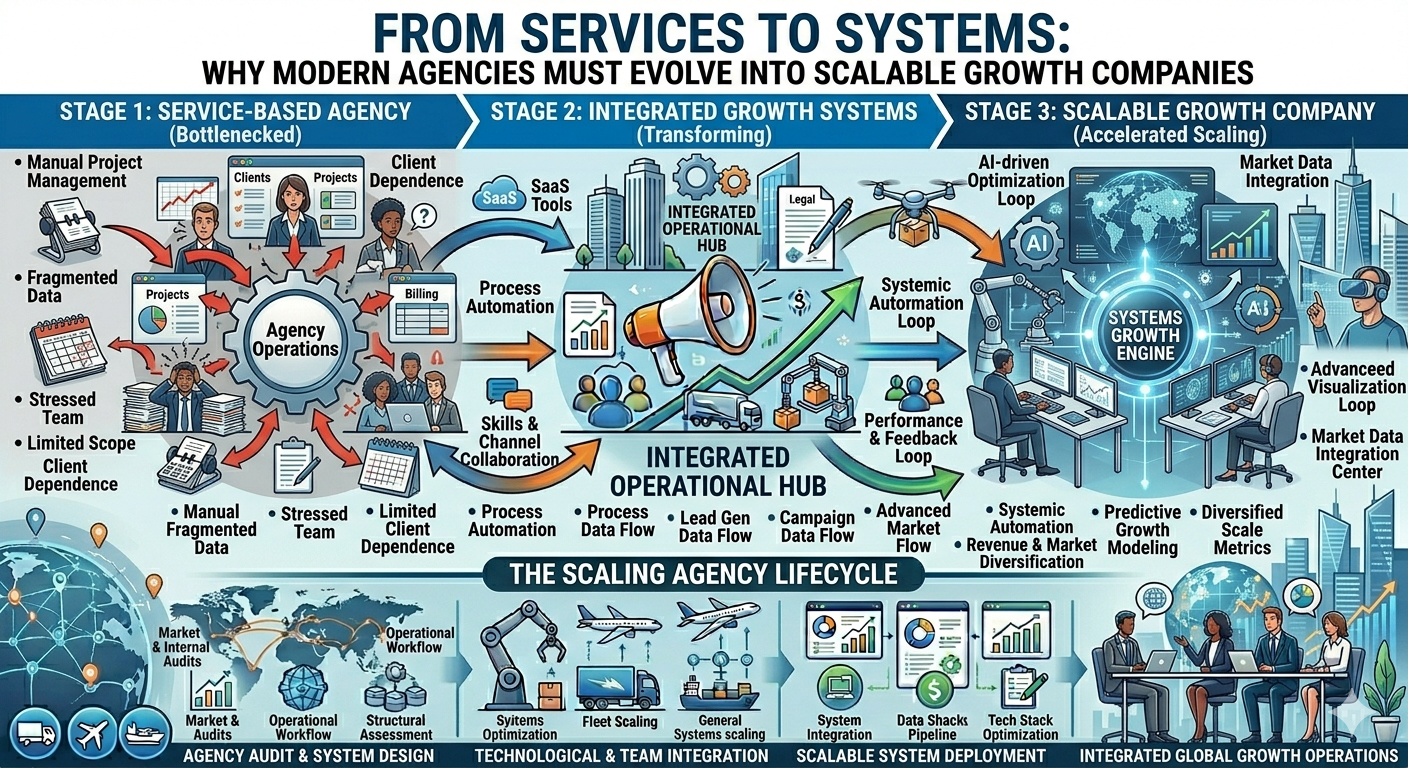
Introduction: The Agency Model Is Reaching Its Limit
The traditional agency model was built for a different era of business.
It was designed around:
- Project-based work
- Hourly or monthly retainers
- Function-specific execution (marketing, design, development, recruitment)
- Client-by-client delivery cycles
For a long time, this model worked.
But today, it is structurally constrained.
The modern market no longer rewards isolated execution. It rewards systems that compound value across multiple business layers simultaneously.
This shift is subtle but fundamental:
Agencies are no longer competing on output. They are competing on integration.
And integration requires a completely different operating model.
1. The Core Problem: Execution Without Architecture
Most agencies still operate as execution units.
They deliver:
- Campaigns
- Websites
- Funnels
- Content
- Recruitment pipelines
- Branding systems
But these outputs often exist in isolation.
The result is predictable:
- Marketing works, but sales underperform
- Hiring increases capacity, but not capability
- Branding improves perception, but not conversion
- Traffic increases, but revenue stagnates
This is not a skill issue.
It is an architecture issue.
Execution without architecture produces activity, not scale.
2. Why the Market Is Changing
Three structural shifts are redefining how businesses grow:
1. Increased Competition at Every Layer
Every niche is saturated. Tactical differentiation is no longer enough.
2. Tool Democratization
AI, automation, and no-code systems have reduced execution barriers dramatically.
3. Buyer Sophistication
Clients no longer want isolated services. They want outcomes tied to business performance.
These changes mean:
Execution is now cheap. Coordination is valuable.
3. The New Agency Paradigm: Systems Thinking
To remain relevant, agencies must evolve from service providers into systems builders.
A system is different from a service in one key way:
- A service delivers output
- A system delivers continuous outcomes
Example:
Service Model:
- Run ads
- Deliver leads
- Design website
System Model:
- Build demand engine
- Engineer conversion pathways
- Align hiring with demand cycles
- Optimize end-to-end revenue flow
The second model does not just execute growth.
It produces growth as a byproduct of structure.
4. The Three Engines of a Scalable Growth System
Modern scalable companies operate through three interconnected engines:
1. Demand Engine (Marketing & Positioning)
Responsible for:
- Market visibility
- Brand authority
- Lead generation
- Category positioning
2. Capability Engine (Talent & Recruitment)
Responsible for:
- Hiring aligned with growth direction
- Skill development
- Organizational scalability
- Leadership structuring
3. Delivery Engine (Operations & Experience)
Responsible for:
- Execution quality
- Customer experience
- Retention systems
- Operational efficiency
When these three engines operate independently, growth becomes fragmented.
When they operate together, growth becomes exponential.
5. The Failure of Traditional Agency Scaling
Most agencies attempt to scale in the same way:
- Get more clients
- Hire more staff
- Increase output volume
- Expand service offerings
This approach creates linear scaling.
But linear scaling introduces friction:
- Quality drops as team expands
- Communication overhead increases
- Margins compress
- Delivery inconsistency grows
- Founder dependency increases
Eventually, the agency hits a ceiling.
Not because demand is missing, but because structure cannot support scale.
6. The Shift From Clients to Ecosystems
A critical transition happens when agencies stop thinking in terms of clients and start thinking in terms of ecosystems.
A client is a single revenue unit.
An ecosystem is a multi-layer growth structure including:
- Acquisition channels
- Conversion infrastructure
- Talent systems
- Retention loops
- Brand positioning layers
In ecosystem thinking:
Every action is evaluated based on its impact across the entire system, not just one deliverable.
This changes decision-making entirely.
7. The Role of Integration in Modern Growth
Integration is the core differentiator between average agencies and scalable growth companies.
Integration means:
- Marketing informs hiring
- Hiring informs service design
- Service performance informs marketing messaging
- Customer feedback reshapes positioning
Without integration:
- Each function optimizes independently
- Misalignment compounds over time
With integration:
- Every function reinforces the others
This creates what can be described as a compounding feedback loop.
8. Why Most Agencies Cannot Transition
The transition from services to systems fails for three main reasons:
1. Skill-Based Identity Lock
Agencies define themselves by what they do:
- “We are a marketing agency”
- “We are a design studio”
- “We are a dev shop”
This limits strategic evolution.
2. Revenue Dependency on Execution Hours
Revenue is tied to output volume, not system value.
3. Lack of Cross-Functional Design Thinking
Teams are specialized but not integrated.
As a result, agencies optimize delivery instead of architecture.
9. The New Operating Model: System-Led Growth Architecture
To evolve, agencies must redesign their operating model around systems rather than services.
Step 1: Define the Growth Outcome
Not “deliver marketing” but:
- Increase qualified demand
- Improve conversion efficiency
- Increase lifetime value
Step 2: Map the Full Growth Flow
From:
- Awareness → Interest → Conversion → Retention → Expansion
Step 3: Identify System Leverage Points
Where does the system break?
Where does friction exist?
Step 4: Align Talent With System Needs
Hiring becomes architecture-driven, not task-driven.
Step 5: Close Feedback Loops
Performance data must continuously reshape execution.
10. The Role of Strategy in a System-Led Agency
Strategy is often misunderstood as planning.
In system-based organizations, strategy is:
The design of interdependencies between functions to maximize compounding outcomes.
This includes:
- Defining how marketing influences hiring
- Defining how operations influence positioning
- Defining how delivery influences demand
Strategy is not a document.
It is a structural blueprint.
11. What Scalable Agencies Actually Look Like
A scalable agency operating as a growth system has distinct characteristics:
1. Multi-layer revenue design
Revenue does not depend on one service line.
2. Cross-functional KPIs
Teams are measured on shared outcomes, not isolated metrics.
3. Embedded intelligence loops
Data flows across departments in real time.
4. Modular talent structure
Teams can expand or contract without breaking systems.
5. Outcome ownership
The agency is responsible for business outcomes, not deliverables.
12. The Competitive Advantage of Systems-Based Agencies
Systems-based agencies outperform service-based agencies because:
1. They scale without proportional cost increases
Execution is embedded in structure.
2. They reduce dependency on individual talent
Systems replace hero-based execution.
3. They create compounding value
Each improvement strengthens the entire system.
4. They become harder to replicate
Competitors can copy services, not systems.
13. The Future: Agencies as Growth Infrastructure Providers
The next evolution of agencies is not creative, technical, or marketing-focused.
It is infrastructural.
Future agencies will:
- Design growth architectures
- Build integrated business systems
- Orchestrate cross-functional performance
- Own end-to-end outcome responsibility
They will not sell services.
They will sell growth capacity.
Conclusion: The End of the Service Era
The agency industry is undergoing a structural transition.
The old model—based on execution, specialization, and isolated services—is reaching its natural limit.
The new model is built on:
- Integration
- Systems thinking
- Outcome ownership
- Structural design
- Compounding feedback loops
In this new environment, success will not belong to those who execute better.
It will belong to those who design better systems.
Because in modern business:
Growth is no longer produced. It is engineered.
Leave a Reply