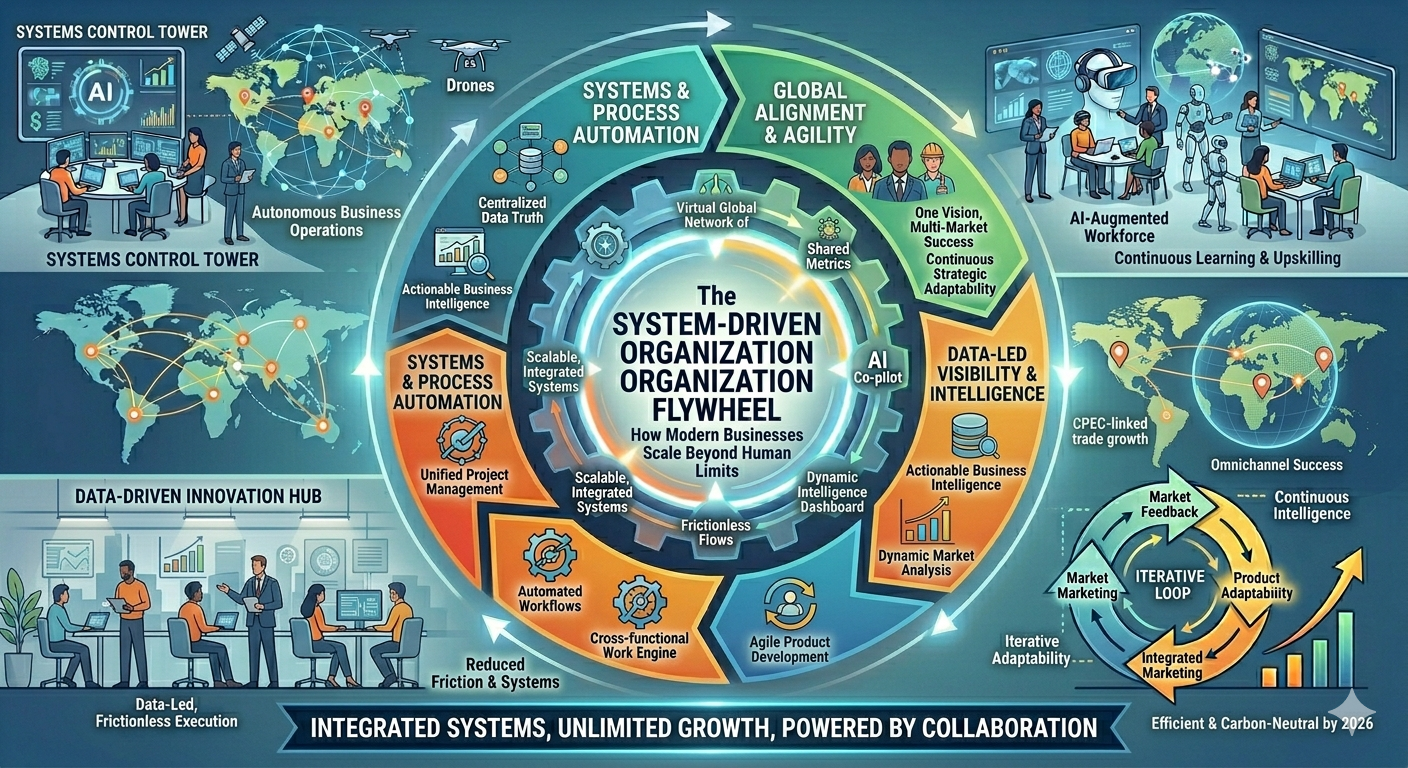
Introduction: Why Traditional Business Growth Is Breaking
For decades, business growth followed a simple logic: hire more people, increase output, expand revenue. But that model is increasingly fragile in a world defined by speed, digital transformation, and distributed teams.
Today, companies are no longer constrained by market demand alone. They are constrained by coordination capacity.
The real question is no longer “How do we grow?” but rather:
“How do we design systems that allow growth to happen without proportional complexity?”
This is where system-driven organizations emerge as the next evolution of business structure.
They are not defined by size, but by architecture:
- How work is structured
- How communication flows
- How decisions are made
- How execution is tracked and optimized
A system-driven business is essentially an organization that behaves more like software than a hierarchy.
1. The Shift from Hierarchies to Systems
Traditional organizations rely on layered management structures. Information flows vertically, decisions are bottlenecked, and execution depends heavily on individuals.
This model works in stable environments but fails under modern conditions:
- Remote and hybrid teams
- Rapid market changes
- Cross-functional collaboration
- Globalized operations
A system-driven organization replaces hierarchy with structured workflows and interconnected processes.
Instead of asking:
- “Who manages this?”
It asks:
- “What system ensures this always happens correctly?”
This subtle shift transforms scalability from a human limitation into a design problem.
2. The Core Components of a Scalable Business System
Every scalable organization, regardless of industry, is built on four structural layers:
2.1 Workflow Architecture
This defines how tasks move from initiation to completion.
Key elements:
- Clear task definitions
- Repeatable processes
- Standard operating procedures (SOPs)
- Automated handovers between stages
Without workflow architecture, growth creates chaos instead of output.
2.2 Communication Layer
Most businesses fail not due to lack of talent, but due to fragmented communication.
A structured communication system ensures:
- Context is preserved
- Decisions are traceable
- Conversations are organized by function or project
- Noise is minimized
The goal is not more communication, but relevant communication at the right point in the system.
2.3 Resource Allocation Layer
Growth requires intelligent distribution of:
- Time
- Talent
- Budget
- Tools
A scalable system ensures resources are dynamically assigned based on priority and impact rather than static job roles.
This is where operational efficiency becomes measurable.
2.4 Feedback and Optimization Loop
Without feedback, systems decay.
A high-performing organization continuously collects:
- Performance metrics
- Execution delays
- Bottleneck identification
- Outcome tracking
Then it uses this data to refine processes, not just evaluate people.
3. Why Most Businesses Fail to Scale Properly
Scaling failure is rarely a revenue problem. It is almost always a structural problem.
Common failure patterns include:
3.1 Dependency on Key Individuals
When knowledge lives in people instead of systems, scaling becomes risky and inconsistent.
3.2 Process Drift
Processes exist, but over time they are modified informally, losing standardization.
3.3 Communication Overload
As teams grow, communication channels multiply, creating confusion instead of clarity.
3.4 Lack of Visibility
Leadership cannot see real-time execution status, leading to reactive decision-making.
These issues are symptoms of one core problem:
The absence of an integrated operational system.
4. The Rise of Platform-Based Organizations
Modern organizations are increasingly adopting platform thinking.
Instead of isolated departments, they build:
- Centralized workspaces
- Shared collaboration environments
- Integrated communication systems
- Unified project tracking layers
This approach mirrors how digital platforms operate:
- Modular
- Connected
- Scalable
- Data-driven
In such environments, teams do not “report work”—they operate within a system that continuously reflects their progress.
5. Network-Driven Growth: The New Competitive Advantage
In traditional business, growth came from internal optimization.
In modern business, growth increasingly comes from:
- Partnerships
- External collaborators
- Ecosystem participation
- Network effects
The more connected a business system is, the more powerful its execution capacity becomes.
This creates a shift from isolated companies to networked organizations where external and internal contributors operate within the same structured environment.
6. The Role of Digital Workspaces in Scaling
Digital workspaces are becoming the operational backbone of modern businesses.
They unify:
- Tasks
- Communication
- Documentation
- Project lifecycle management
- Collaboration networks
Instead of fragmented tools, they provide a centralized environment where work is not just managed, but orchestrated.
The impact is significant:
- Faster decision cycles
- Reduced operational friction
- Higher transparency
- Improved accountability
Ultimately, they convert organizational complexity into structured clarity.
7. From Execution to Orchestration
The future of business is not execution-heavy; it is orchestration-heavy.
Execution implies manual effort at every step.
Orchestration implies:
- Systems that trigger actions
- Workflows that self-progress
- Data-driven adjustments
- Automated coordination between teams
In orchestration-based organizations, leadership focuses less on assigning tasks and more on designing systems that execute themselves.
8. Building a System-Driven Organization: Practical Framework
To transition toward a scalable structure, businesses should focus on:
Step 1: Map Core Processes
Identify repeatable workflows across departments.
Step 2: Standardize Execution
Convert informal practices into documented systems.
Step 3: Centralize Collaboration
Reduce fragmentation by unifying communication and task tracking.
Step 4: Introduce Measurable Outputs
Every function should have measurable performance indicators.
Step 5: Close Feedback Loops
Ensure continuous improvement through structured data review.
9. Strategic Advantage of System Thinking
Organizations that adopt system thinking gain:
- Predictable scaling
- Lower operational dependency
- Faster onboarding of teams
- Reduced communication friction
- Higher output consistency
More importantly, they become resilient to volatility because their structure—not individuals—drives performance.
Conclusion: The Future Belongs to Structured Organizations
The next decade of business evolution will not reward the largest companies, but the most structurally intelligent ones.
Growth will no longer be defined by headcount or capital alone, but by how effectively an organization can convert intention into execution through systems.
Businesses that master this shift will not just scale—they will compound.
And in that environment, structure becomes the most valuable asset of all.
Leave a Reply