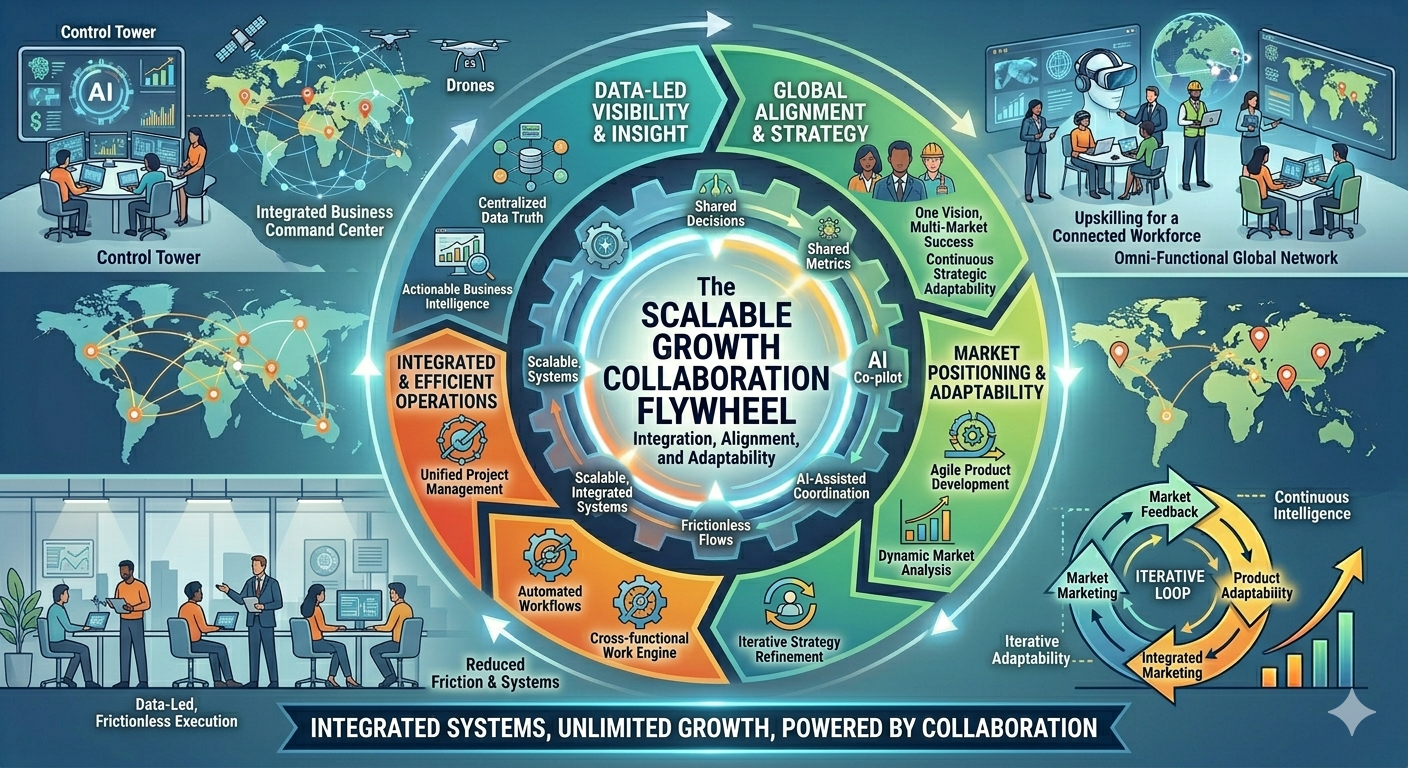
Introduction: A Shift in How Modern Businesses Scale
Business growth is no longer driven purely by capital, manpower, or isolated departments. Instead, the strongest organizations today operate through integrated collaboration ecosystems—systems where communication, operations, data, and decision-making flow continuously across teams, partners, and stakeholders.
This shift is not incremental. It represents a structural transformation in how companies build, scale, and sustain competitive advantage in a volatile global market.
The businesses that adapt early to this model gain faster execution cycles, improved operational intelligence, and stronger resilience under uncertainty.
This article explores how integrated systems are reshaping growth strategy, why traditional silos are becoming obsolete, and how organizations can transition toward scalable, network-driven performance models.
1. The End of Isolated Business Functions
Traditional business structures rely on segmented departments: marketing, operations, finance, HR, and IT working independently with periodic coordination points.
This structure introduces three core inefficiencies:
- Delayed decision-making due to communication gaps
- Data fragmentation across systems
- Reduced adaptability in fast-moving markets
In modern environments, these limitations directly impact competitiveness. Markets now reward speed, coordination, and real-time responsiveness rather than rigid hierarchies.
As a result, organizations are shifting toward connected operational models, where functions are integrated through shared platforms and continuous collaboration flows.
2. What Defines an Integrated Growth System
An integrated growth system is not just a software stack or communication tool. It is an operational philosophy built on four pillars:
a) Unified Communication Layer
All stakeholders operate through a centralized communication ecosystem, reducing dependency on fragmented channels.
b) Shared Operational Workflows
Tasks, projects, and workflows are visible across departments, improving accountability and coordination.
c) Real-Time Data Synchronization
Decision-making is driven by live data rather than delayed reports.
d) External Network Integration
Partners, vendors, and clients are included within controlled collaboration environments, extending organizational capability beyond internal teams.
Together, these pillars create a continuous execution environment, where strategy and operations remain tightly aligned.
3. Why Collaboration Infrastructure Is Now a Growth Driver
Historically, infrastructure referred to physical assets such as offices, machinery, or logistics systems. Today, infrastructure increasingly means digital collaboration architecture.
This shift is happening for three key reasons:
Speed of Execution
Organizations with integrated systems reduce operational delays and execute faster than competitors relying on manual coordination.
Scalability Without Linear Cost Growth
Traditional scaling requires proportional increases in headcount. Integrated systems allow output growth without equivalent cost expansion.
Decision Intelligence
When all operational data is centralized, leadership gains clearer visibility into performance trends, risks, and opportunities.
This transforms infrastructure from a support function into a primary growth engine.
4. The Role of Networks in Modern Business Expansion
One of the most important changes in modern strategy is the rise of network-based business models.
Instead of operating as isolated entities, companies now function as nodes within larger ecosystems:
- Suppliers become integrated partners
- Customers become active participants in feedback loops
- External experts contribute directly to internal workflows
This network-based approach increases adaptability and reduces dependency on internal constraints.
Organizations with strong collaboration networks often outperform larger but disconnected competitors.
5. From Project Management to Lifecycle Management
Traditional project management focuses on task completion within fixed timelines.
Modern systems extend this into lifecycle management, which includes:
- Ideation and planning
- Resource allocation
- Execution tracking
- Performance evaluation
- Continuous optimization
This approach ensures that projects are not treated as isolated events but as evolving systems that generate long-term value.
Lifecycle thinking also improves institutional learning, as each cycle feeds intelligence into the next.
6. Data as the Central Decision Layer
In integrated systems, data is no longer a reporting tool—it becomes the decision layer of the organization.
Key transformations include:
- Real-time dashboards replacing static reports
- Predictive analytics guiding operational adjustments
- Cross-functional data visibility enabling unified decision-making
This reduces reliance on intuition alone and increases precision in strategic execution.
Companies that fail to centralize data typically experience slower response times and reduced market sensitivity.
7. The Competitive Advantage of Operational Fluidity
The most successful organizations today share one defining trait: fluid operations.
Operational fluidity means:
- Teams can reorganize quickly around priorities
- Resources shift dynamically based on demand
- Communication flows without bottlenecks
- Execution is continuous, not episodic
This is only possible when systems are integrated and collaboration is embedded at every level.
Fluid organizations outperform rigid structures even with fewer resources.
8. Challenges in Transitioning to Integrated Systems
Despite the advantages, transitioning is not simple. Common challenges include:
Cultural Resistance
Employees accustomed to siloed operations may resist transparency and shared workflows.
System Integration Complexity
Legacy tools often lack compatibility with modern collaboration platforms.
Governance and Security Concerns
Expanding access across networks introduces new security and compliance requirements.
Successful transformation requires both technological upgrades and cultural alignment.
9. Strategic Roadmap for Implementation
Organizations aiming to transition toward integrated growth systems typically follow this progression:
Phase 1: Centralize Communication
Consolidate communication channels into a unified system.
Phase 2: Digitize Workflows
Convert manual processes into structured digital workflows.
Phase 3: Integrate Data Systems
Ensure all departments feed into a shared data architecture.
Phase 4: Extend to External Networks
Gradually include partners and stakeholders into controlled collaboration environments.
Phase 5: Optimize Through Analytics
Use real-time insights to continuously refine operations.
This staged approach minimizes disruption while maximizing adoption success.
10. The Future: Autonomous Collaborative Ecosystems
The next evolution of business systems is already emerging: semi-autonomous collaboration ecosystems.
These systems will combine:
- Artificial intelligence for decision support
- Automated workflow orchestration
- Predictive resource allocation
- Self-optimizing performance structures
In such environments, human leadership focuses less on coordination and more on strategic direction.
The organizations that begin building this foundation today will define tomorrow’s competitive landscape.
Conclusion: Growth Is Becoming a System, Not an Outcome
Business growth is no longer a result of isolated effort. It is the outcome of well-designed systems that connect people, data, and processes into a unified operational engine.
Organizations that embrace integrated collaboration models gain:
- Faster execution
- Higher adaptability
- Stronger scalability
- Smarter decision-making
The shift is already underway. The question is no longer whether this model will dominate, but how quickly businesses can adapt to it.
Those who build integrated systems now will not just compete—they will set the standard for the next generation of enterprise performance.
Leave a Reply