Author: Marketing access

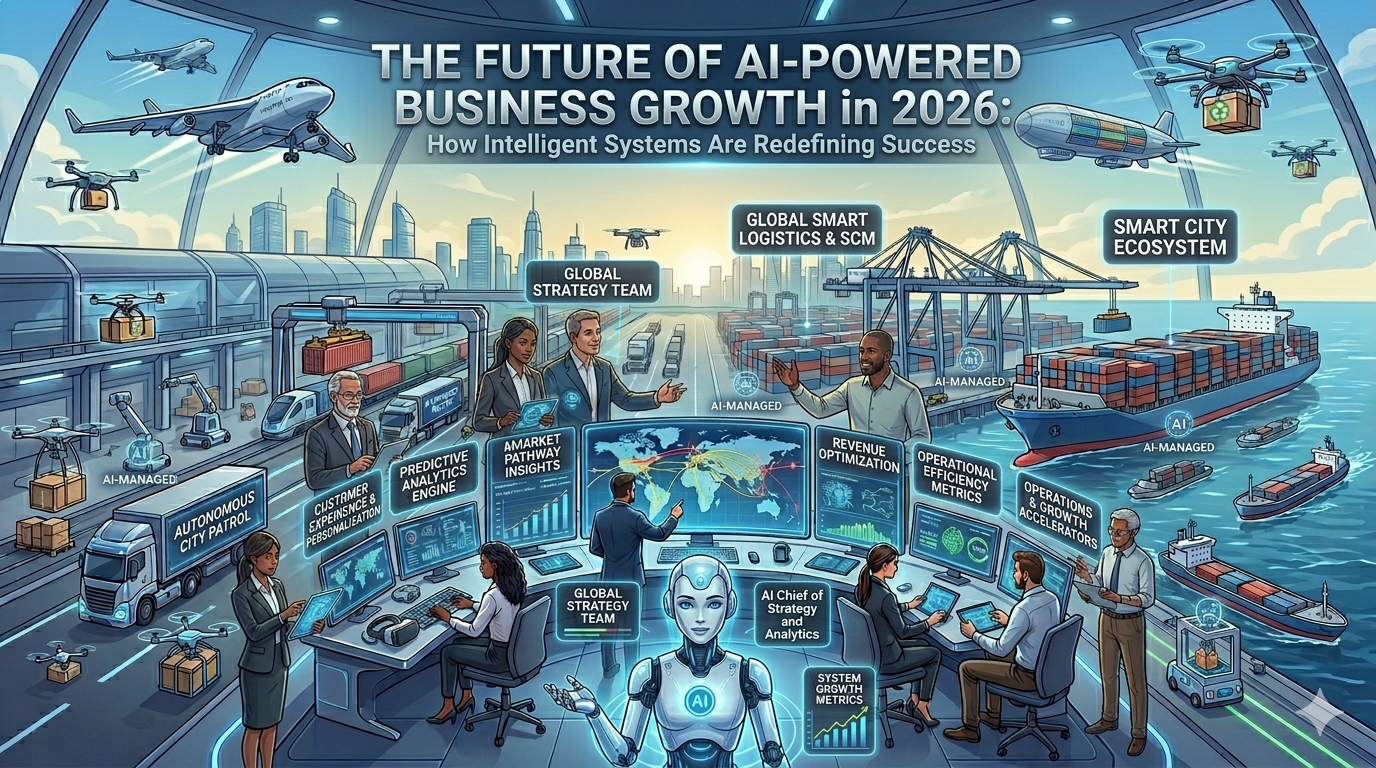
  • The Future of AI-Powered Business Growth in 2026: How Intelligent Systems Are Redefining Success

    The Future of AI-Powered Business Growth in 2026: How Intelligent Systems Are Redefining Success

    Introduction: A New Business Era Has Already Begun

    We are no longer in the early stages of digital transformation. By 2026, artificial intelligence is not just a supporting tool—it has become the core engine behind how modern businesses operate, scale, and compete.

    From small startups to global enterprises, organizations are shifting toward AI-powered ecosystems that automate decision-making, predict customer behavior, optimize operations, and accelerate growth at unprecedented speed.

    What used to take teams of analysts, marketers, and strategists can now be done in seconds by intelligent systems capable of learning, adapting, and improving continuously.

    This shift is not optional. It is structural.

    Businesses that fail to integrate AI deeply into their operations are already falling behind.


    1. The Rise of Intelligent Business Systems

    Traditional business models were built on manual decision-making and reactive strategies. Companies would analyze past data, make predictions, and then implement changes after delays.

    AI has completely disrupted this cycle.

    Today’s intelligent systems:

    • Process real-time data continuously
    • Detect patterns humans cannot easily see
    • Predict outcomes before they happen
    • Recommend optimized actions automatically

    This evolution has given rise to what experts now call self-optimizing businesses—organizations that improve themselves without constant human intervention.

    In practical terms, this means:

    • Marketing campaigns adjust automatically based on user behavior
    • Supply chains optimize themselves based on demand signals
    • Customer service systems resolve issues before complaints occur
    • Financial systems detect risks in real time

    The business is no longer static. It is alive, adaptive, and learning.


    2. AI in Decision-Making: From Human Guesswork to Predictive Precision

    One of the most significant transformations in modern business is the shift from intuition-based decisions to data-driven intelligence.

    AI systems now support decision-making in areas such as:

    • Market expansion strategies
    • Product development cycles
    • Pricing optimization
    • Customer segmentation
    • Risk assessment

    Instead of relying on historical reports, companies now use predictive models that simulate future scenarios.

    For example, AI can determine:

    • Which product will perform best in a specific region
    • When customer demand will spike or decline
    • What pricing strategy maximizes profit without losing customers
    • Which marketing channels deliver the highest ROI

    This eliminates guesswork and replaces it with measurable certainty.


    3. Automation Beyond Tasks: The Era of Cognitive Automation

    Automation is no longer limited to repetitive tasks like data entry or email responses.

    We are now in the era of cognitive automation, where AI systems handle complex intellectual processes.

    These systems can:

    • Write marketing content
    • Design ad creatives
    • Analyze legal documents
    • Conduct financial forecasting
    • Generate business insights

    Unlike traditional automation, cognitive systems can understand context, intent, and nuance.

    This is especially powerful in industries like:

    • E-commerce
    • Logistics
    • Healthcare
    • Finance
    • Digital marketing

    The result is a massive increase in productivity while reducing operational costs.


    4. AI and Customer Experience Transformation

    Customer experience has become the most critical competitive advantage in 2026.

    AI plays a central role in shaping how businesses interact with customers through:

    Hyper-Personalization

    Every customer receives a unique experience based on:

    • Past behavior
    • Preferences
    • Purchase history
    • Real-time interactions

    No two users see the same journey.

    Predictive Support

    AI systems now solve problems before customers even report them.

    For example:

    • Detecting failed transactions instantly
    • Offering refunds proactively
    • Suggesting solutions before complaints escalate

    Conversational AI

    Advanced AI chat systems now operate like human experts, providing:

    • Instant support
    • Sales guidance
    • Technical troubleshooting
    • Product recommendations

    This reduces dependency on large support teams while improving satisfaction.


    5. Data as the New Business Fuel

    In modern business ecosystems, data is more valuable than capital.

    However, raw data alone is not useful. The real value comes from AI interpretation systems that transform data into actionable intelligence.

    Companies now invest heavily in:

    • Data infrastructure
    • Real-time analytics engines
    • Machine learning pipelines
    • Behavioral tracking systems

    The goal is simple: convert every interaction into insight.

    Businesses that effectively leverage data can:

    • Identify emerging trends early
    • Predict customer churn
    • Optimize pricing strategies
    • Improve product-market fit

    In 2026, companies without strong data intelligence frameworks are essentially operating blind.


    6. AI in Marketing: The End of Traditional Campaigns

    Marketing has undergone one of the most radical transformations due to AI.

    Traditional campaigns relied on fixed strategies and scheduled adjustments. AI-driven marketing, however, is:

    • Continuous
    • Adaptive
    • Self-optimizing

    Key changes include:

    1. Real-Time Campaign Optimization

    Ads adjust automatically based on performance metrics.

    2. AI Content Generation

    Blogs, ads, emails, and social media posts are generated dynamically.

    3. Audience Prediction Models

    AI predicts which users are most likely to convert before targeting them.

    4. Creative Testing at Scale

    Hundreds of ad variations are tested simultaneously.

    The result is higher ROI, lower cost, and faster scaling.


    7. The Impact on Jobs and Human Roles

    A major concern surrounding AI adoption is its impact on employment.

    The reality is not simple replacement, but transformation.

    AI is eliminating repetitive roles while increasing demand for:

    • AI strategists
    • Data scientists
    • Automation engineers
    • Prompt engineers
    • Digital transformation consultants

    Human roles are shifting toward:

    • Strategy
    • Creativity
    • Oversight
    • Ethical decision-making

    The workforce is not disappearing—it is evolving.


    8. Challenges of AI-Driven Business Ecosystems

    Despite its advantages, AI integration comes with challenges:

    1. Data Privacy Risks

    Large-scale data usage increases exposure to privacy concerns.

    2. Algorithmic Bias

    AI systems can inherit biases from training data.

    3. Over-Automation Risks

    Excessive reliance on AI may reduce human oversight.

    4. Implementation Costs

    Advanced systems require significant initial investment.

    Businesses must balance innovation with responsibility.


    9. The Competitive Advantage of Early AI Adoption

    Companies that adopt AI early gain structural advantages:

    • Faster decision-making cycles
    • Lower operational costs
    • Better customer retention
    • Higher scalability
    • Improved forecasting accuracy

    These advantages compound over time, making early adoption a long-term strategic win.

    In contrast, late adopters face increasing difficulty catching up.


    10. The Future Outlook: Fully Autonomous Enterprises

    The next stage of evolution is already emerging: fully autonomous enterprises.

    These are organizations where:

    • AI handles operations
    • Systems self-optimize
    • Humans provide oversight only
    • Decision-making is largely automated

    This does not eliminate human involvement but redefines it.

    Humans become system designers, strategists, and ethical controllers rather than operational workers.


    Conclusion: Adaptation Is No Longer Optional

    AI is not a future concept—it is the present reality of business transformation.

    Organizations that embrace AI will:

    • Scale faster
    • Operate more efficiently
    • Deliver superior customer experiences
    • Dominate competitive markets

    Those that resist will struggle to survive in increasingly automated ecosystems.

    The question is no longer whether AI will change business.

    It already has.

    The real question is: how fast can you adapt?
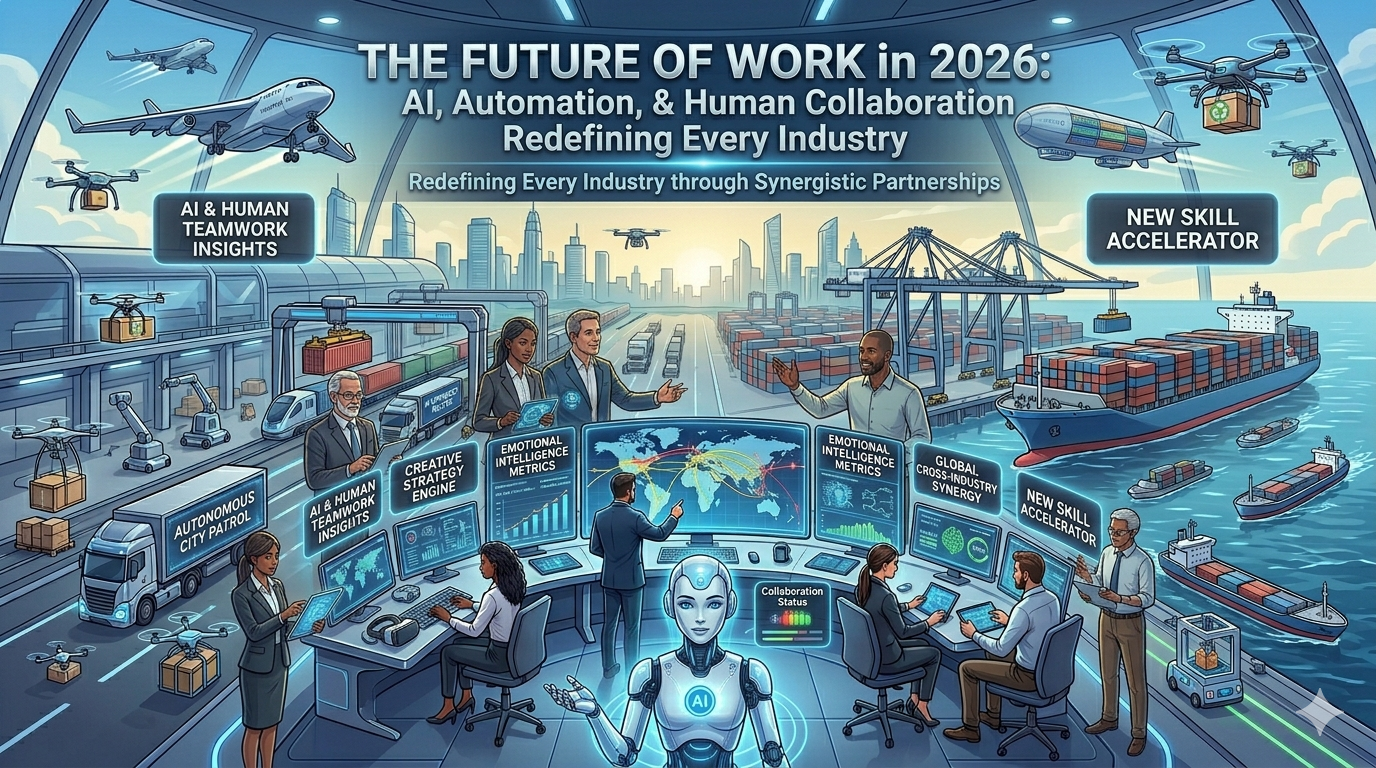
  • The Future of Work in 2026: How AI, Automation, and Human Collaboration Are Redefining Every Industry

    The Future of Work in 2026: How AI, Automation, and Human Collaboration Are Redefining Every Industry

    Introduction: A New Industrial Reality Is Already Here

    The global economy is no longer evolving in predictable cycles. It is transforming through continuous disruption. Artificial intelligence, automation systems, distributed digital networks, and data-driven decision-making are reshaping how businesses operate, how teams collaborate, and how value is created.

    What makes 2026 different from previous technological shifts is not the presence of AI itself—but its deep integration into everyday workflows. AI is no longer a separate tool; it is embedded into decision systems, operational processes, and even human creativity loops.

    Organizations that once relied on static planning models are now shifting toward adaptive, real-time systems where intelligence is distributed across machines, software, and people.

    This article explores how these shifts are reshaping industries, redefining work, and creating entirely new forms of collaboration between humans and intelligent systems.


    1. The Collapse of Traditional Work Structures

    For decades, organizations operated on rigid hierarchies:

    • Management layers controlled decision flow
    • Departments worked in isolation
    • Information moved slowly through reporting structures
    • Innovation was centralized and slow

    In 2026, this structure is becoming obsolete.

    Modern organizations are moving toward network-based operational systems, where teams form dynamically around problems rather than departments.

    Instead of fixed roles, we now see:

    • Fluid job definitions
    • Project-based collaboration units
    • AI-supported decision augmentation
    • Cross-functional real-time execution teams

    This shift is not cosmetic. It fundamentally changes productivity. Work is no longer a linear pipeline—it is a continuous adaptive system.


    2. AI as an Operational Layer, Not a Tool

    Earlier generations of AI adoption treated AI as a support tool:

    • Chatbots for customer service
    • Analytics dashboards for reporting
    • Automation scripts for repetitive tasks

    In 2026, AI functions as an operational layer of the organization.

    This means AI now participates in:

    • Strategic forecasting
    • Resource allocation
    • Workflow optimization
    • Supply chain coordination
    • Risk detection and mitigation

    More importantly, AI systems are no longer passive. They are context-aware and continuously learning from operational feedback loops.

    This creates what can be described as an intelligent enterprise architecture, where decisions are co-produced by human reasoning and machine computation.


    3. Automation Is No Longer About Replacement

    A common misconception about automation is that it replaces human labor. That framing is outdated.

    In modern systems, automation is about:

    • Removing friction from decision cycles
    • Eliminating repetitive cognitive load
    • Increasing execution speed
    • Enhancing consistency across large systems

    Rather than replacing humans, automation is increasingly used to amplify human output capacity.

    For example:

    • A logistics planner is no longer manually optimizing routes; AI generates multi-variable optimized options in seconds.
    • A marketing strategist no longer tests campaigns manually; AI simulates audience response before launch.
    • A supply chain manager no longer reacts to delays; predictive systems identify disruptions before they occur.

    The result is not job elimination—it is role transformation.


    4. The Rise of Collaborative Intelligence Systems

    One of the most significant changes in 2026 is the emergence of collaborative intelligence frameworks.

    These systems combine:

    • Human judgment
    • Machine learning models
    • Real-time data streams
    • Predictive analytics
    • Automated execution engines

    Instead of humans working with tools, humans are working within intelligence ecosystems.

    This creates a new operational model:

    Decision-making becomes a shared process between human cognition and machine intelligence.

    In practice, this means:

    • Teams co-create outputs with AI systems
    • Workflows are dynamically adjusted based on real-time data
    • Feedback loops continuously refine outputs
    • Systems self-optimize over time

    The boundary between “software” and “organization” is becoming blurred.


    5. Data Has Become the New Operational Currency

    In previous decades, data was treated as an analytical asset.

    In 2026, data functions as an operational fuel source.

    Every action inside a digital system produces structured signals that are immediately processed into insights and decisions.

    Key transformations include:

    • Real-time behavioral data driving product design
    • Predictive models shaping customer experience
    • Automated systems adjusting pricing dynamically
    • AI interpreting market signals faster than human analysts

    Organizations that fail to integrate real-time data pipelines are increasingly disadvantaged because they operate on delayed intelligence.

    The competitive gap between real-time organizations and traditional ones is widening rapidly.


    6. The Evolution of Digital Infrastructure

    The underlying infrastructure of modern business has undergone a major transformation.

    Instead of centralized monolithic systems, companies now rely on:

    • Cloud-native architectures
    • Microservices ecosystems
    • API-first integrations
    • Edge computing nodes
    • Distributed data systems

    This architecture allows organizations to:

    • Scale instantly
    • Integrate external services dynamically
    • Update systems without downtime
    • Deploy AI modules independently

    The result is a shift from static IT systems to living digital ecosystems that evolve continuously.


    7. Human Skills in the Age of Intelligent Systems

    As automation handles execution-heavy tasks, human roles are shifting toward:

    • Strategic thinking
    • System design
    • Ethical oversight
    • Creative problem-solving
    • Cross-domain integration

    The most valuable skill in 2026 is no longer specialization alone—it is adaptive intelligence across domains.

    Professionals are increasingly expected to:

    • Understand data systems
    • Interpret AI outputs critically
    • Design workflows that integrate automation
    • Collaborate across technical and non-technical boundaries

    The modern workforce is less about execution and more about orchestration.


    8. The Emergence of Real-Time Organizations

    A defining trend in 2026 is the rise of real-time organizations.

    These organizations operate with:

    • Instant feedback loops
    • Continuous deployment models
    • Live performance optimization
    • AI-assisted management systems

    Key characteristics include:

    • Decisions made in hours, not weeks
    • Performance tracked continuously
    • Teams reorganized dynamically
    • Resources allocated algorithmically

    This model significantly increases agility and reduces operational lag.


    9. Supply Chains Become Intelligent Networks

    One of the most transformative areas is supply chain evolution.

    Traditional supply chains relied on:

    • Static forecasting
    • Fixed routing
    • Manual coordination
    • Delayed reporting systems

    Modern supply chains now operate as intelligent networks:

    • AI predicts demand fluctuations
    • Logistics routes optimize in real time
    • Inventory systems self-adjust automatically
    • Risk detection systems prevent disruptions before they occur

    The supply chain is no longer linear—it is a self-regulating ecosystem.


    10. The Future of Collaboration: Humans + Systems

    The defining characteristic of the future workplace is not automation or AI—it is co-evolution between humans and intelligent systems.

    This includes:

    • Humans defining objectives
    • AI generating execution pathways
    • Systems optimizing outcomes
    • Continuous human oversight and refinement

    This relationship creates a hybrid intelligence model where:

    Neither humans nor machines operate independently—they function as integrated components of a unified system.


    Conclusion: We Are Moving From Organizations to Intelligent Ecosystems

    The future of work is not about digital transformation alone. It is about the transformation of how intelligence itself is structured inside organizations.

    We are moving from:

    • Hierarchies → Networks
    • Static systems → Adaptive systems
    • Manual workflows → Intelligent automation
    • Isolated decision-making → Collaborative intelligence

    In this new environment, the most successful organizations will not be the largest or the oldest—but the ones that can learn, adapt, and evolve continuously in real time.

    The next decade will not reward stability. It will reward adaptability.

    And adaptability, in the modern world, is no longer human or machine—it is both, operating together.

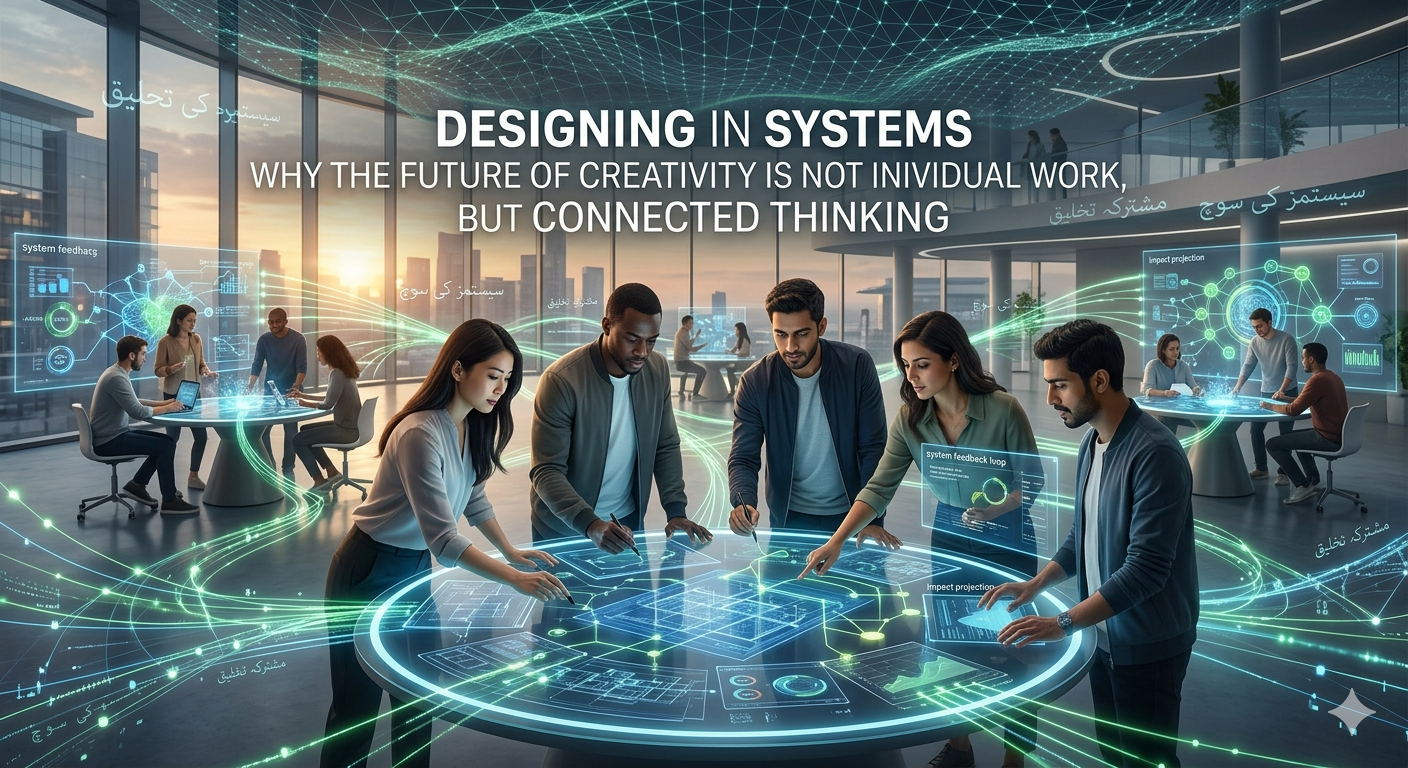
  • Designing in Systems: Why the Future of Creativity Is Not Individual Work, But Connected Thinking

    Designing in Systems: Why the Future of Creativity Is Not Individual Work, But Connected Thinking

    Introduction

    We used to think creativity belonged to individuals.

    A designer. A strategist. A developer. A writer.

    Each working independently, producing outputs that would later be assembled into something called a “project.”

    That structure is breaking.

    Not slowly. Not partially. Completely.

    What is emerging instead is something different: system-based creation, where ideas are not isolated outputs but interconnected components of larger, living frameworks.

    In this environment, the question is no longer:

    “What can I create?”

    The question becomes:

    “What system am I contributing to—and how does it evolve after I’m gone?”


    The Shift from Output Thinking to System Thinking

    Traditional creative work is output-driven.

    You are assigned a task:

    • Design a website
    • Write a campaign
    • Build an interface

    Once delivered, the work is considered complete.

    But systems don’t work like that.

    A system is never finished. It is:

    • continuously updated
    • influenced by external inputs
    • shaped by user behavior
    • evolving over time

    This means creative work is no longer about finishing objects.

    It is about initiating living structures.


    What a “System” Actually Means in Creative Practice

    A system is not just technology.

    It is a network of relationships between:

    • People
    • Interfaces
    • Behaviors
    • Content
    • Environments
    • Time

    When these elements interact consistently, they form patterns.

    Those patterns become experiences.

    And those experiences define perception.

    A brand is not a logo.

    A product is not a screen.

    A campaign is not a message.

    They are all expressions of underlying systems.


    Why Most Creative Work Fails at Scale

    Most creative output is strong at the point of creation, but weak over time.

    This happens because it is designed in isolation.

    Common failure points:

    • Design without behavioral feedback loops
    • Marketing without product alignment
    • Technology without user context
    • Strategy without operational structure

    Each discipline operates independently, assuming the others will adapt later.

    They rarely do.

    The result is fragmentation.

    And fragmentation is the opposite of systems thinking.


    The Invisible Layer: Behavior

    Systems are not defined by what they look like.

    They are defined by what people do inside them.

    Behavior is the real architecture.

    For example:

    • A button is not design; it is a decision trigger
    • A scroll is not navigation; it is attention flow
    • A checkout process is not UI; it is trust conversion

    If behavior is not designed intentionally, the system collapses into randomness.


    Co-Creation as a Structural Principle

    Modern systems cannot be built alone.

    They require co-creation—not as collaboration in the traditional sense, but as distributed authorship.

    In co-creation:

    • No single role owns the system
    • Inputs are continuous, not sequential
    • Decisions are shared across disciplines
    • Output is emergent, not predefined

    This changes everything.

    The designer is no longer the “creator.”

    The designer becomes a system facilitator.


    The End of Linear Workflows

    Linear workflows assume predictability:

    1. Research
    2. Design
    3. Develop
    4. Launch

    But systems don’t behave linearly.

    Feedback arrives during every stage:

    • Users interact before completion
    • Stakeholders change direction mid-process
    • Technology shifts during execution

    Linear processes collapse under non-linear reality.

    What replaces them is adaptive flow systems, where every stage is open, revisitable, and responsive.


    Interfaces Are Becoming Environments

    A major shift is happening quietly:

    Interfaces are dissolving.

    What once were screens are becoming environments.

    We no longer interact with static surfaces. We interact with:

    • Context-aware systems
    • Spatial interactions
    • Multi-layered digital-physical hybrids

    This means design is no longer about “pages.”

    It is about conditions.

    An environment reacts differently depending on:

    • time
    • user
    • intent
    • behavior

    Designing for environments requires thinking in probabilities, not fixed layouts.


    The Role of Time in Experience Design

    Time is often ignored in design.

    But systems exist in time.

    A user experience is not a moment. It is a sequence:

    • First exposure
    • Familiarity
    • Habit formation
    • Memory retention

    Each stage changes perception.

    A system that works instantly may fail over time.

    A system that feels complex initially may become powerful later.

    Design must account for temporal behavior, not just immediate usability.


    Feedback Loops as Creative Infrastructure

    A system without feedback is static.

    A system with feedback becomes intelligent.

    Feedback loops exist in multiple forms:

    • User interaction data
    • Behavioral repetition
    • Emotional response
    • Performance metrics
    • Environmental adaptation

    These loops define whether a system improves or decays.

    Strong systems are not defined by their starting point.

    They are defined by their ability to respond.


    Minimalism Is Not Simplicity—It Is Reduction of Noise in Systems

    Minimal design is often misunderstood.

    It is not about removing elements.

    It is about removing unnecessary interference within a system.

    Noise exists when:

    • multiple signals compete
    • user intent is unclear
    • hierarchy is inconsistent
    • feedback is delayed

    Minimal systems are not visually empty.

    They are structurally precise.


    The Illusion of Control in Creative Work

    Most creative processes assume control:

    • control over output
    • control over interpretation
    • control over outcome

    But systems are partially uncontrollable by nature.

    Once launched, they:

    • evolve independently
    • adapt based on usage
    • generate unexpected behaviors

    This is not failure.

    This is emergence.

    The goal is not control.

    The goal is guidance through structure.


    Designing for Emergence

    Emergence happens when simple rules produce complex outcomes.

    In systems design, this means:

    • small inputs can produce large behavioral shifts
    • minor interface changes can alter user patterns
    • subtle timing differences can change outcomes

    Designers must learn to work with:

    • probability
    • uncertainty
    • indirect influence

    Instead of dictating outcomes, systems should shape possibilities.


    The Creative Stack Is Collapsing

    Historically, creative work was divided into layers:

    • Strategy
    • Design
    • Development
    • Content
    • Distribution

    These layers are merging.

    AI, automation, and integrated platforms are dissolving boundaries.

    The future stack is not vertical.

    It is networked.

    Roles overlap. Responsibilities blend. Outputs become shared.


    Identity in System-Based Work

    In system-based creation, identity is no longer tied to output.

    It is tied to:

    • influence within systems
    • ability to connect disciplines
    • contribution to long-term evolution

    A strong contributor is not someone who produces the most.

    It is someone who improves the system itself.


    The Future Is Not More Design—It Is Better Systems

    We are entering a phase where execution is no longer the differentiator.

    Tools are abundant. Platforms are standardized. Production is automated.

    What remains valuable is:

    • system clarity
    • behavioral insight
    • structural thinking
    • adaptive design intelligence

    The winners will not be the fastest creators.

    They will be the best system thinkers.


    Conclusion

    Creativity is no longer a moment.

    It is a system.

    And systems do not belong to individuals. They belong to networks of interaction, shaped continuously by participation, feedback, and adaptation.

    To design today is not to create objects.

    It is to define conditions under which experiences evolve.

    The question is no longer what you build.

    It is:

    What continues to happen because you built it?

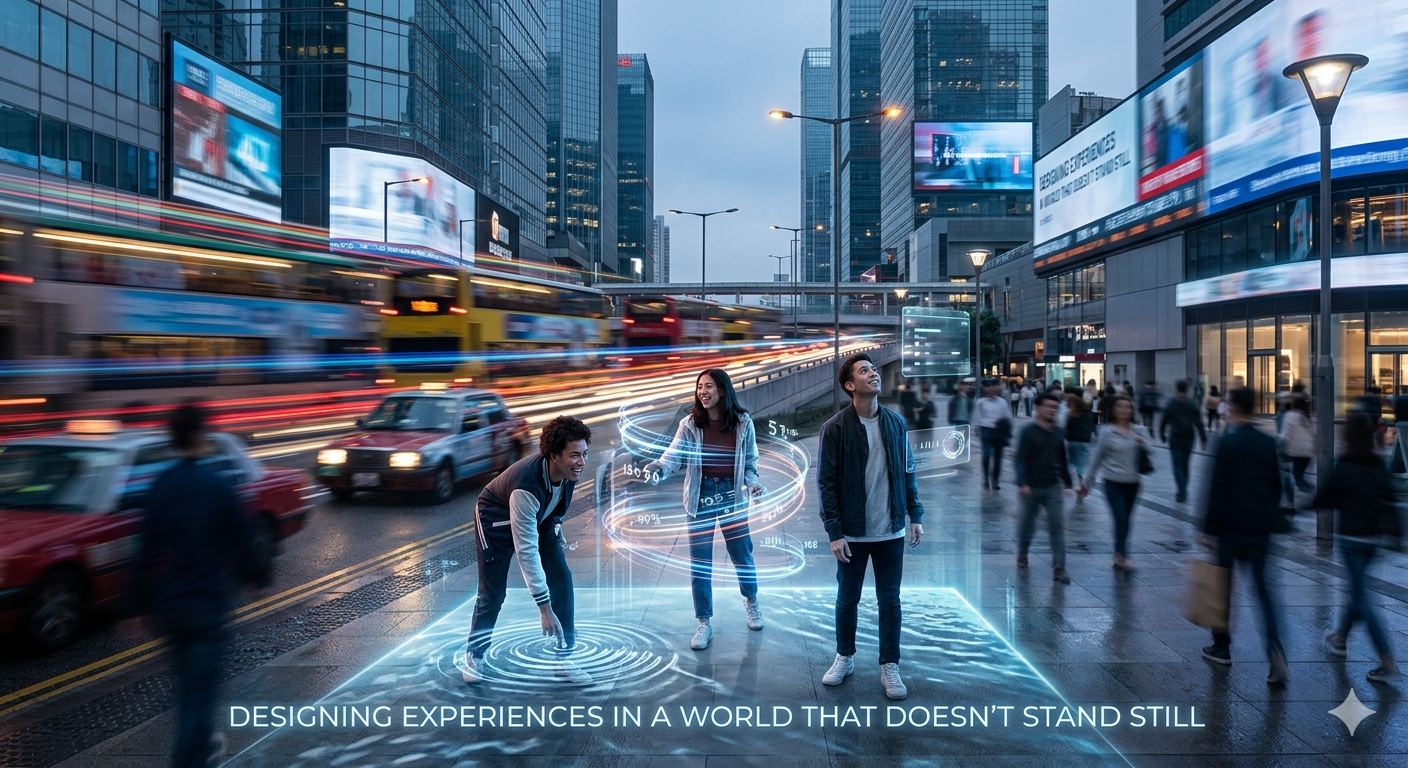
  • Designing Experiences in a World That Doesn’t Stand Still

    Designing Experiences in a World That Doesn’t Stand Still

    Introduction

    We don’t design products anymore.

    We design experiences.

    That distinction matters—not because it sounds better, but because it reflects a fundamental shift in how people interact with the world. A product is static. An experience is dynamic. A product is owned. An experience is lived.

    And in a world where everything is constantly changing—technologies, behaviors, expectations—the only thing that truly scales is the ability to design experiences that adapt.

    The question is no longer:
    “What are we building?”

    The question is:
    “What are people actually feeling, doing, and remembering?”


    The Death of the Static Interface

    There was a time when interfaces were predictable.

    Websites had pages. Applications had screens. Users followed paths.

    That time is gone.

    Today, interaction happens across:

    • Devices
    • Environments
    • Contexts
    • Moments

    The interface is no longer a place. It is a system of relationships.

    A retail experience is not just a store—it’s:

    • The physical environment
    • The digital layer
    • The behavioral triggers
    • The emotional response

    Designing within this reality requires a shift from interface design → experience orchestration.


    Experience as a System, Not a Screen

    An experience is not a single touchpoint.

    It is a network of interactions connected by:

    • Time
    • Intent
    • Context
    • Memory

    When someone interacts with a brand, they don’t see “channels.” They see continuity—or the lack of it.

    The Real Problem

    Most systems are built in fragments:

    • Marketing builds awareness
    • Design builds interfaces
    • Engineering builds functionality

    But the user experiences everything as one continuous flow.

    The gap between these silos is where experience breaks.


    The Role of Imagination in a Data-Driven World

    We live in an era obsessed with data.

    Everything is measured:

    • Clicks
    • Conversions
    • Engagement
    • Retention

    But data has a limitation.

    It tells you what happened.

    It does not tell you what’s possible.

    The Paradox

    The more data-driven we become, the more we risk designing for:

    • Optimization instead of exploration
    • Efficiency instead of meaning

    True innovation does not come from dashboards.

    It comes from imagination.

    As one principle suggests:

    Logic gets you from A to B. Imagination takes you everywhere.

    The challenge is not choosing between data and creativity.

    It is knowing when to ignore one in favor of the other.


    Designing for Behavior, Not Just Interaction

    Clicks are not behavior.

    Behavior is deeper. It includes:

    • Motivation
    • Friction
    • Habit
    • Emotion

    If a user clicks a button, that’s interaction.

    If a user returns, recommends, or remembers—that’s behavior.

    Behavioral Design Requires:

    • Understanding context, not just actions
    • Reducing friction without removing meaning
    • Creating feedback loops that reinforce engagement

    The goal is not to make things easier.

    The goal is to make things worth doing.


    Technology as Material, Not Solution

    Technology is often treated as the answer.

    It’s not.

    It’s the material.

    Just like:

    • Steel in architecture
    • Paint in art
    • Fabric in fashion

    Technology enables—but it does not define.

    The Mistake

    Many projects start with:

    • “Let’s use AI”
    • “Let’s build an app”
    • “Let’s integrate AR”

    This is backwards.

    The correct starting point is:

    • What experience are we trying to create?
    • What behavior are we trying to influence?
    • What emotion are we trying to evoke?

    Only then does technology become relevant.


    The Power of Interactive Environments

    The most impactful experiences are not passive.

    They respond.

    They adapt.

    They engage.

    Interactive environments—whether in retail, exhibitions, or digital platforms—transform users from observers into participants.

    Why This Matters

    Participation creates:

    • Deeper engagement
    • Stronger memory
    • Emotional connection

    People don’t remember what they saw.

    They remember what they did.


    Retail Is No Longer About Selling

    Retail has evolved.

    It is no longer about transactions.

    It is about experience layers:

    • Discovery
    • Interaction
    • Personalization
    • Engagement

    Stores are becoming:

    • Media platforms
    • Experience hubs
    • Data environments

    The Shift

    From:

    “How do we sell this product?”

    To:

    “How do we create an environment where this product becomes meaningful?”


    The Blurring of Physical and Digital

    The boundary between physical and digital is dissolving.

    What we’re seeing is not replacement—but integration.

    Examples of Convergence

    • Physical spaces enhanced by digital interaction
    • Digital platforms influenced by physical behavior
    • Hybrid environments where both coexist

    This creates a new design challenge:

    Designing for continuity across realities.


    Failure as a Design Strategy

    Most systems are built to avoid failure.

    But innovation requires it.

    Failure is not a flaw—it’s feedback.

    Why Failure Matters

    • It reveals assumptions
    • It exposes limitations
    • It drives iteration

    The problem is not failure.

    The problem is failing too late.

    Design Approach

    • Prototype early
    • Test often
    • Learn continuously

    The faster you fail, the faster you evolve.


    The Role of Story in Experience Design

    Humans don’t connect with systems.

    They connect with stories.

    Every experience tells a story—whether intentionally or not.

    Strong Experience Narratives Include:

    • A clear beginning (entry point)
    • A meaningful middle (interaction)
    • A memorable end (takeaway)

    Without narrative, experiences feel fragmented.

    With narrative, they feel intentional.


    Designing for Memory, Not Just Use

    Most design focuses on usability.

    But usability is the baseline—not the goal.

    The real question is:
    Will this be remembered?

    Memory is Driven By:

    • Emotion
    • Surprise
    • Participation
    • Meaning

    An experience that is easy but forgettable has limited impact.

    An experience that is meaningful creates lasting value.


    The Future of Experience Design

    The next phase of design will be shaped by:

    • Adaptive systems
    • Real-time personalization
    • Spatial computing
    • AI-driven interaction

    But technology alone will not define the future.

    Human experience will.

    What Will Matter Most

    • Understanding behavior at a deeper level
    • Designing systems, not screens
    • Blending disciplines seamlessly
    • Embracing uncertainty

    The Role of the Designer

    The role of the designer is changing.

    It is no longer about:

    • Making things look good
    • Creating isolated interfaces

    It is about:

    • Connecting systems
    • Shaping behavior
    • Creating meaning

    Designers are becoming:

    • Strategists
    • Technologists
    • Storytellers

    A Different Way to Think About Work

    Traditional thinking separates:

    • Art vs commerce
    • Creativity vs business
    • Design vs technology

    This separation no longer works.

    The most impactful work happens at the intersection.

    The New Model

    • Creative thinking drives strategy
    • Technology enables execution
    • Experience defines value

    Conclusion

    We are no longer designing objects.

    We are designing realities.

    In a world that moves constantly, the only stable advantage is the ability to create experiences that adapt, engage, and evolve.

    The tools will change.

    The platforms will change.

    The expectations will change.

    But one thing remains constant:

    People.

    Their behaviors. Their emotions. Their memories.

    That is where design begins.


    Final Thought

    It’s not about what you build.

    It’s about what people experience.

    And more importantly—

    what they carry with them after it’s over.

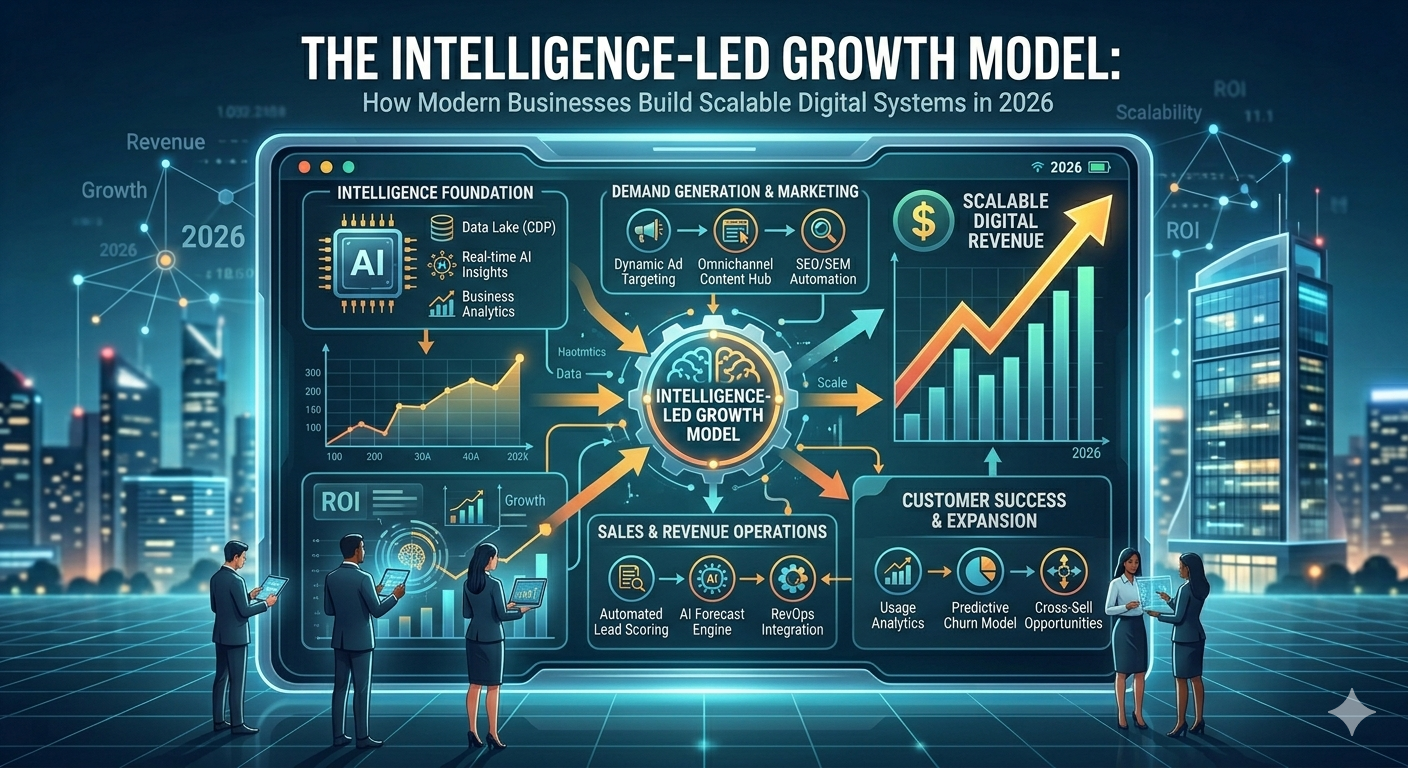
  • The Intelligence-Led Growth Model: How Modern Businesses Build Scalable Digital Systems in 2026

    The Intelligence-Led Growth Model: How Modern Businesses Build Scalable Digital Systems in 2026

    Introduction: The End of Random Growth

    For more than a decade, digital marketing has been treated as a collection of isolated activities—advertising, social media posting, SEO optimization, email campaigns, and content production. Each function operates independently, often without a unified structure connecting them.

    This fragmented approach is now obsolete.

    In 2026, the businesses that scale consistently are not those that “do more marketing,” but those that design intelligent growth systems—integrated ecosystems where every digital action is measurable, connected, and continuously optimized.

    Growth is no longer a matter of execution alone. It is a matter of system intelligence.

    The Intelligence-Led Growth Model represents this shift. It replaces fragmented marketing with structured, data-driven, and self-improving revenue systems.


    1. The Fundamental Problem With Traditional Digital Marketing

    Traditional digital marketing suffers from three structural limitations:

    1.1 Disconnected Channels

    Most businesses treat each channel separately:

    • SEO team works independently
    • Paid ads run independently
    • Social media operates independently
    • Email marketing is reactive instead of integrated

    This creates inconsistency in messaging, targeting, and performance tracking.


    1.2 Short-Term Thinking

    Campaign-based execution focuses on immediate results rather than compounding performance.

    Once a campaign ends, momentum disappears.


    1.3 Lack of System Feedback

    Most businesses collect data but do not integrate it into a unified optimization loop.

    As a result, decisions are reactive instead of predictive.


    These limitations explain why many businesses experience growth spikes but fail to sustain them.


    2. Defining Intelligence-Led Growth

    Intelligence-Led Growth (ILG) is a structured model where every marketing, sales, and customer interaction is:

    • Connected
    • Measurable
    • Adaptive
    • Continuously optimized

    It transforms marketing from a set of actions into a living system of performance intelligence.

    The core principle is simple:

    Every interaction generates data. Every data point improves the system.


    3. The Four Layers of a Modern Growth System

    A functional intelligence-led system is built on four interdependent layers.


    3.1 Acquisition Layer: Structured Attention Generation

    This layer is responsible for generating predictable and qualified traffic.

    It includes:

    • Paid media systems (search, social, programmatic)
    • Organic visibility engines (SEO + content systems)
    • Distribution networks (partners, affiliates, influencers)

    However, unlike traditional marketing, acquisition is not treated as an endpoint. It is the entry node of a larger system.

    Key shift:

    Traffic is not the goal. Qualified attention is.


    3.2 Conversion Layer: Turning Attention Into Action

    This layer transforms attention into measurable business outcomes.

    It includes:

    • Landing page architecture
    • Offer engineering
    • Funnel optimization
    • Behavioral persuasion design

    In intelligence-led systems, conversion is not static. It evolves based on continuous behavioral data.

    For example:

    • If bounce rate increases → landing page structure is adjusted
    • If drop-off occurs → offer positioning is refined
    • If engagement improves → funnel is expanded

    Conversion is a live optimization environment.


    3.3 Intelligence Layer: The Core Differentiator

    This is the most important but most overlooked layer.

    The intelligence layer collects and processes system-wide data:

    • Customer acquisition cost trends
    • Funnel drop-off behavior
    • Engagement depth
    • Retention curves
    • Lifetime value progression
    • Channel attribution performance

    This layer acts as the central nervous system of the business.

    It answers questions such as:

    • Which channel produces long-term value, not just leads?
    • Where does the funnel lose efficiency?
    • What behavioral patterns predict conversion?

    Without this layer, growth becomes guesswork.


    3.4 Retention Layer: Compounding Revenue Engine

    Most businesses focus heavily on acquisition and ignore retention.

    However, in modern systems:

    Retention determines scalability.

    Retention includes:

    • Customer lifecycle automation
    • Re-engagement systems
    • Loyalty structures
    • Community ecosystems
    • Upsell/cross-sell logic

    A strong retention layer reduces dependency on constant acquisition.

    It converts one-time buyers into long-term revenue assets.


    4. Why Systems Outperform Campaigns

    Campaign-based marketing is linear:

    • Spend → Launch → Results → Stop → Restart

    System-based growth is cyclical:

    • Acquire → Analyze → Optimize → Reinvest → Expand

    The difference is compounding.

    Systems improve over time. Campaigns reset.

    This is why businesses using structured growth systems achieve:

    • Lower acquisition costs
    • Higher conversion efficiency
    • Better retention rates
    • More predictable revenue

    5. Data as the Foundation of Predictability

    In intelligence-led systems, data is not reporting—it is operational fuel.

    However, most businesses misuse data in three ways:

    5.1 Descriptive Use Only

    They look at what happened instead of why it happened.

    5.2 Fragmented Analytics

    Data exists in separate dashboards without integration.

    5.3 Delayed Decision Making

    Insights are applied too late to impact performance.


    Modern systems require:

    • Unified tracking architecture
    • Real-time behavioral signals
    • Cross-channel attribution logic
    • Predictive modeling inputs

    The goal is not analysis.

    The goal is system response.


    6. The Role of Automation in Scaling Intelligence

    Automation transforms intelligence into execution.

    Without automation, insights remain theoretical.

    Key automation layers include:

    6.1 Behavioral Triggers

    Actions based on user behavior:

    • Email sequences triggered by inactivity
    • Retargeting based on page visits
    • Offers based on engagement depth

    6.2 Lifecycle Automation

    Customers move through structured stages automatically:

    • Lead → Prospect → Customer → Repeat Buyer → Advocate

    6.3 System Optimization Loops

    Performance changes automatically based on thresholds:

    • Ad budgets reallocated
    • Funnel steps adjusted
    • Audience segments refined

    Automation ensures that intelligence is not passive—it becomes operational.


    7. Content as a System Component, Not a Marketing Tool

    In intelligence-led growth, content is not branding—it is infrastructure.

    Content serves three strategic functions:

    7.1 Attraction Layer

    Drives inbound attention through search and distribution systems.

    7.2 Education Layer

    Reduces friction in decision-making by increasing clarity.

    7.3 Conversion Layer

    Supports final-stage persuasion through trust reinforcement.

    Content must be engineered into the system, not produced independently.


    8. Funnel Architecture in 2026: Dynamic, Not Linear

    Traditional funnels assume linear progression:

    Awareness → Interest → Decision → Purchase

    Modern systems operate differently.

    Funnels are now:

    • Multi-entry
    • Non-linear
    • Behavior-adaptive
    • Feedback-driven

    A user may enter at any stage and still be guided through the system based on behavior signals.

    This requires:

    • Multi-path funnel design
    • Dynamic content mapping
    • Adaptive offer sequencing

    Funnels are no longer static diagrams—they are adaptive systems.


    9. Scaling Through System Replication

    Once a growth system is built, scaling becomes replication, not reinvention.

    Businesses can:

    • Duplicate funnels across markets
    • Clone acquisition systems across channels
    • Reuse automation frameworks
    • Expand intelligence models with new data inputs

    Scaling becomes controlled expansion instead of chaotic growth.


    10. The Strategic Advantage of Intelligence-Led Growth

    The competitive gap between system-driven businesses and traditional marketers is widening.

    System-driven businesses achieve:

    • Lower marginal acquisition costs
    • Higher lifetime value
    • Predictable scaling patterns
    • Faster optimization cycles

    Traditional businesses remain dependent on:

    • Ad spend fluctuations
    • Platform algorithm changes
    • Manual decision-making delays

    In 2026, the dominant advantage is not creativity or budget.

    It is system intelligence density.


    Conclusion: Growth Is Now an Engineering Discipline

    Digital growth is no longer a creative experiment.

    It is an engineering discipline built on structure, intelligence, and continuous optimization.

    The Intelligence-Led Growth Model replaces randomness with architecture. It replaces intuition with data-driven systems. It replaces campaigns with compounding infrastructure.

    Businesses that adopt this model do not just grow faster.

    They grow predictably.

    And in modern digital ecosystems, predictability is the highest form of competitive advantage.

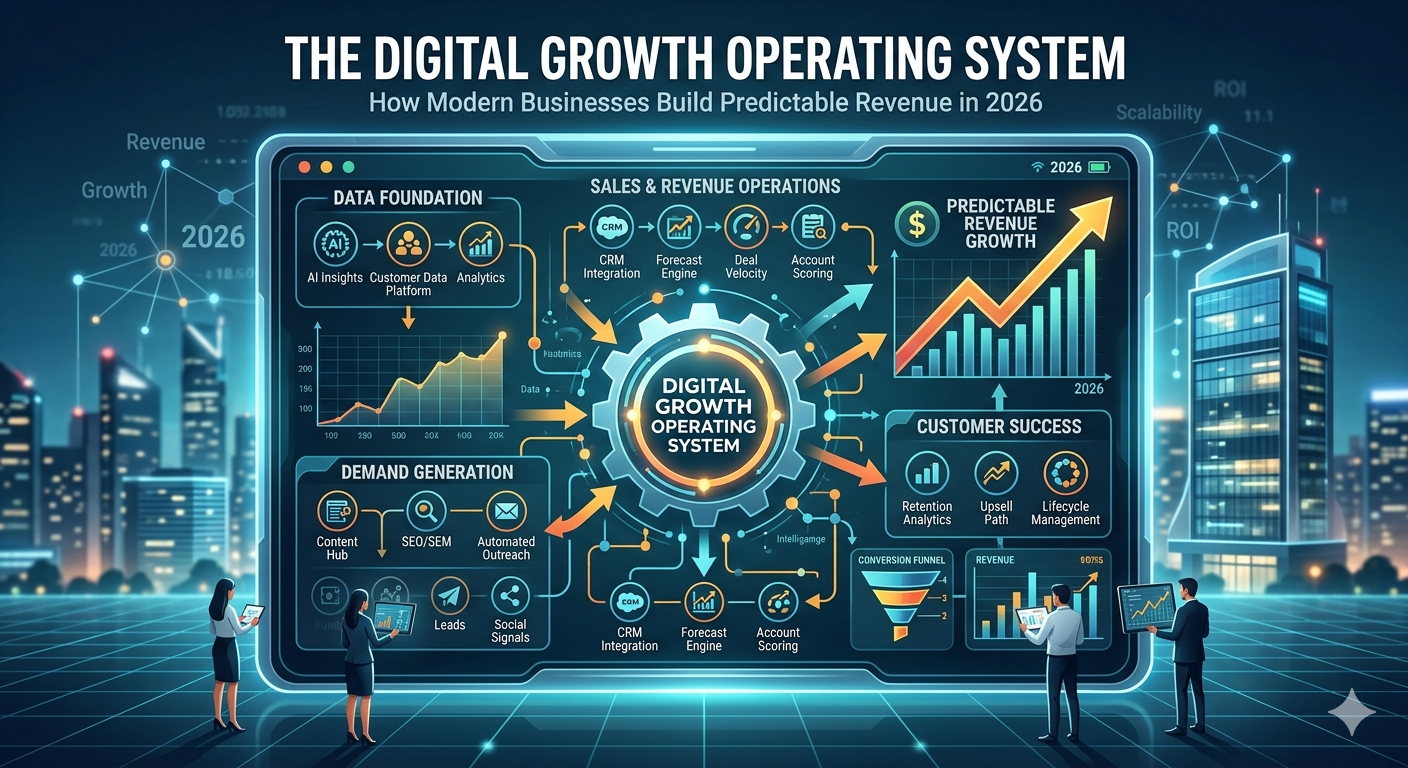
  • The Digital Growth Operating System: How Modern Businesses Build Predictable Revenue in 2026

    The Digital Growth Operating System: How Modern Businesses Build Predictable Revenue in 2026

    Introduction: Why Random Marketing No Longer Works

    Most businesses today are not struggling because they lack marketing activities. They are struggling because their marketing is disconnected.

    They run ads without a content system.
    They publish content without conversion logic.
    They collect traffic without a structured follow-up process.
    They invest in SEO without understanding revenue pathways.

    The result is predictable: inconsistent growth, unstable revenue, and unclear return on marketing investment.

    In 2026, digital competition has evolved beyond isolated tactics. Success now depends on whether a business operates with a systemized growth architecture instead of fragmented marketing efforts.

    This article breaks down a structured framework—referred to here as a Digital Growth Operating System (DGOS)—that aligns traffic, branding, content, and conversion into a unified revenue engine.


    1. The Core Problem: Fragmented Digital Execution

    Modern businesses typically operate in four disconnected silos:

    1.1 Traffic Generation Without Strategy

    Paid ads, SEO, influencer campaigns, and social media bring visitors—but without clear intent mapping, most traffic is low-quality or untracked.

    1.2 Content Without Conversion Logic

    Blogs, reels, and posts are published for visibility rather than guided customer progression.

    1.3 Branding Without Performance Tracking

    Many companies invest in design and identity but cannot measure how branding affects revenue.

    1.4 Sales Without Digital Integration

    Sales teams operate separately from marketing systems, losing valuable behavioral data.

    This fragmentation creates inefficiency at every stage of the funnel.


    2. The Shift: From Marketing Campaigns to Growth Systems

    Traditional marketing focuses on campaigns.

    Modern growth focuses on systems.

    A system ensures that every digital action contributes to one outcome:

    predictable revenue generation

    A Digital Growth Operating System connects five essential layers:

    1. Visibility Layer (SEO + Ads)
    2. Engagement Layer (Content + Social)
    3. Trust Layer (Branding + Authority)
    4. Conversion Layer (Funnels + UX)
    5. Retention Layer (CRM + Email + Loyalty)

    When these layers operate together, growth becomes measurable and scalable.


    3. The Visibility Layer: Controlled Attention Acquisition

    Visibility is no longer about being everywhere—it is about being present in the right intent zones.

    Key Components

    • Search Engine Optimization (SEO)
    • Paid Search Campaigns
    • Social Discovery Algorithms
    • Strategic Content Distribution

    However, visibility without filtering is expensive. The key is intent-based acquisition, where traffic is segmented into:

    • High intent (ready to buy)
    • Mid intent (comparing solutions)
    • Low intent (educational awareness)

    Modern systems do not treat all traffic equally. They route users differently based on behavioral signals.


    4. The Engagement Layer: Building Meaningful Interaction

    Once users arrive, attention must be structured, not assumed.

    Engagement is built through:

    • Educational content
    • Interactive assets
    • Value-first messaging
    • Problem-solution storytelling

    The goal is not to entertain—it is to guide understanding.

    At this stage, businesses must answer:

    • What problem does the user recognize?
    • What solution are they currently considering?
    • What friction is stopping them from deciding?

    Without structured engagement, traffic leaks immediately.


    5. The Trust Layer: Why Branding Now Equals Revenue

    Branding is often misunderstood as design. In reality, it is perception engineering.

    In 2026, trust is built through:

    • Consistent messaging across platforms
    • Demonstrated expertise (case studies, data)
    • Social proof systems
    • Transparent communication

    A strong brand reduces acquisition cost because it compresses the decision cycle.

    Users no longer ask:

    “What is this company?”

    They ask:

    “Can I trust this company to solve my problem?”

    Trust is the currency that converts attention into action.


    6. The Conversion Layer: Engineering User Decisions

    Conversion is not a single button or checkout page.

    It is a sequence of micro-decisions:

    Conversion architecture includes:

    • Landing page structure
    • Offer positioning
    • Psychological triggers
    • CTA placement
    • Friction reduction

    A high-performing system ensures that every user interaction moves them closer to one of three outcomes:

    1. Purchase
    2. Lead submission
    3. Return engagement

    Conversion optimization is not design-based alone—it is behavioral engineering.


    7. The Retention Layer: Where Real Profit is Made

    Most businesses over-invest in acquisition and under-invest in retention.

    However, in stable growth systems:

    Retention determines profitability more than acquisition.

    Retention systems include:

    • Email automation sequences
    • CRM segmentation
    • Loyalty mechanisms
    • Personalized offers
    • Re-engagement campaigns

    A customer who returns costs significantly less than acquiring a new one.

    Businesses that ignore retention effectively rebuild revenue from zero every month.


    8. The Integration Principle: Why Systems Fail Without Alignment

    Even when all five layers exist, many businesses still fail.

    The reason is lack of integration.

    A proper Digital Growth Operating System ensures:

    • SEO data informs content strategy
    • Content informs ad targeting
    • Ads inform funnel optimization
    • Funnels inform CRM segmentation
    • CRM data loops back into content creation

    This creates a continuous optimization cycle instead of isolated performance spikes.


    9. The Role of Data: From Guesswork to Predictability

    Data transforms marketing from creative guessing into operational science.

    Key performance indicators include:

    • Customer acquisition cost (CAC)
    • Lifetime value (LTV)
    • Conversion rate per funnel stage
    • Engagement depth
    • Retention curve

    Businesses that track these metrics accurately can forecast revenue with high precision.


    10. The 2026 Advantage: AI-Augmented Growth Systems

    Artificial intelligence has changed execution speed, not strategy fundamentals.

    AI enhances:

    • Content production scaling
    • Audience segmentation
    • Predictive analytics
    • Ad optimization
    • Personalization at scale

    However, AI does not replace the need for structure. Without a system, AI simply produces faster chaos.


    11. Implementation Framework: Building a Growth System Step-by-Step

    A practical rollout follows this sequence:

    Step 1: Define Core Offer

    Clarify product-market fit and pricing structure.

    Step 2: Build Visibility Engine

    Establish SEO + paid acquisition channels.

    Step 3: Design Content Architecture

    Map content to customer intent stages.

    Step 4: Build Conversion Funnel

    Create structured landing pages and lead paths.

    Step 5: Implement Retention System

    Set up CRM and automated lifecycle communication.

    Step 6: Connect Data Feedback Loop

    Align analytics across all stages.


    Conclusion: The Future Belongs to System-Driven Businesses

    Marketing in 2026 is no longer about isolated tactics or viral moments.

    It is about building structured systems that consistently convert attention into revenue.

    Businesses that adopt a Digital Growth Operating System will achieve:

    • predictable scaling
    • reduced acquisition costs
    • higher customer lifetime value
    • stable long-term growth

    Those that continue relying on fragmented strategies will face increasing inefficiency and rising marketing costs.

    The difference is no longer creativity alone.

    It is system design capability.