Category: Uncategorized

  • Better Deals Come From Better Exposure: How Visibility Attracts the Right Buyers

    Better Deals Come From Better Exposure: How Visibility Attracts the Right Buyers

    Selling a business is not only about finding any buyer. It is about positioning the business in front of the right buyers, at the right time, with the right message. A strong deal does not usually happen by chance. It happens when serious buyers understand the value of the opportunity and see why it is worth their attention.

    This is why the message better deals come from better exposure matters.

    When a business is presented clearly and strategically, it can attract more qualified interest, create stronger conversations, and improve the chance of a better sale outcome. Without the right exposure, even a strong business may not receive the attention it deserves.

    At Merger Sales, the focus is on helping business owners position their opportunity in front of serious, qualified buyers so they can move toward stronger offers, better terms, and a more confident sale process.

    1. Why Exposure Matters When Selling a Business

    Business sale exposure means making the right buyers aware that your business is available and worth considering. It is not simply about advertising everywhere. It is about reaching the people who are most likely to understand the value of the business.

    Good exposure helps create buyer interest. Better exposure helps create better buyer interest.

    When a business is exposed to the right audience, it can lead to:

    • More qualified buyer inquiries
    • Stronger buyer competition
    • Better conversations
    • More serious negotiations
    • Improved deal confidence
    • Stronger sale outcomes

    The quality of exposure can directly affect the quality of the deal process.

    2. Better Exposure Means Reaching the Right Buyers

    Not every buyer is suitable for every business. Some buyers may be curious but not financially ready. Others may not understand the industry. Some may not be aligned with the seller’s goals.

    Better exposure means focusing on buyers who are more likely to be serious, capable, and strategically aligned.

    2.1 Who Are the Right Buyers?

    The right buyers may include:

    • Strategic acquirers
    • Industry operators
    • Private equity groups
    • Growth investors
    • Family offices
    • Corporate buyers
    • Experienced business owners

    These buyers may see value in the business because it supports their growth plans, market expansion, customer base, or investment goals.

    3. Targeted Exposure Creates Stronger Buyer Attention

    Targeted exposure is more effective than random visibility. A business does not need to be shown to everyone. It needs to be shown to the buyers who are most likely to understand its strengths and future potential.

    Targeted exposure helps the sale process become more focused and more efficient.

    3.1 Why Targeting Matters

    When the business is presented to the wrong audience, the seller may receive weak inquiries, slow responses, or unrealistic offers. When the business is presented to the right audience, the quality of interest improves.

    Targeted exposure can help improve:

    • Buyer relevance
    • Inquiry quality
    • Negotiation strength
    • Deal momentum
    • Seller confidence

    Better targeting can save time and help business owners focus on serious opportunities.

    4. Qualified Buyers Improve the Sale Process

    A qualified buyer is not just someone who is interested. A qualified buyer has the intent, financial ability, and strategic reason to move forward.

    Working with qualified buyers helps reduce wasted time and supports a smoother transaction process.

    4.1 What Makes a Buyer Qualified?

    A qualified buyer may have:

    • Clear acquisition intent
    • Financial capability
    • Industry understanding
    • Decision-making authority
    • Professional communication
    • Respect for confidentiality
    • Ability to complete due diligence

    When the buyer is qualified, the seller can have more productive conversations and better evaluate whether the deal is worth pursuing.

    5. Stronger Interest Can Lead to Better Deal Outcomes

    When more serious buyers understand the value of a business, the seller may have more options. More quality interest can create stronger deal positioning and improve the chances of better terms.

    This does not mean every buyer will make the same offer. It means that better exposure can help the business reach buyers who may value the opportunity more highly.

    5.1 What Drives Stronger Buyer Interest?

    Stronger buyer interest usually comes from clear presentation and strong positioning. Buyers want to understand why the business is attractive and what future potential it offers.

    Important value points may include:

    • Strong financial performance
    • Established brand presence
    • Loyal customer base
    • Proven operations
    • Growth potential
    • Experienced team
    • Clear market position
    • Reliable systems and processes

    When these strengths are communicated clearly, buyers can evaluate the opportunity with more confidence.

    6. Better Exposure Requires Better Positioning

    Exposure alone is not enough. A business must also be positioned correctly. Positioning explains what makes the business valuable, attractive, and worth acquiring.

    A strong business sale presentation should help buyers quickly understand the opportunity.

    6.1 What Strong Positioning Includes

    Strong positioning may include:

    • A clear business summary
    • Key financial highlights
    • Operational strengths
    • Customer and market advantages
    • Growth opportunities
    • Competitive position
    • Reason for sale
    • Transition potential

    When the story is clear, buyers are more likely to take the opportunity seriously.

    7. Confidentiality Still Matters

    Better exposure does not mean exposing sensitive information to everyone. Business sale exposure must be controlled carefully to protect the seller, employees, customers, and business reputation.

    A professional sale process balances visibility with confidentiality.

    7.1 Why Confidentiality Is Important

    If sale information is shared too widely or too early, it can create unnecessary concern. Employees may become uncertain, customers may ask questions, and competitors may try to use the information.

    Confidentiality helps protect:

    • Business stability
    • Employee confidence
    • Customer relationships
    • Supplier trust
    • Negotiation strength
    • Market reputation

    The goal is to reach the right buyers without creating unnecessary risk.

    8. How Merger Sales Helps Create Better Exposure

    Merger Sales helps business owners present their opportunity professionally and connect with buyers who are more likely to understand its value.

    The process focuses on exposure that is targeted, strategic, and designed to support stronger deal outcomes.

    8.1 Targeted Exposure

    Merger Sales helps position businesses in front of the right audience instead of relying on random visibility.

    8.2 Qualified Buyers

    The focus is on serious buyers who have the ability and interest to move forward with a business acquisition.

    8.3 Stronger Interest

    Clear positioning and better visibility can help generate stronger buyer attention and more meaningful conversations.

    8.4 Better Deal Outcomes

    When the right buyers understand the opportunity, sellers may have a better chance of improving value, terms, and confidence throughout the deal process.

    9. Preparing Your Business for Better Exposure

    Before presenting a business to buyers, owners should prepare the information buyers will want to review. Preparation helps build trust and improves the quality of buyer conversations.

    9.1 Key Preparation Steps

    • Organize financial records
    • Identify business strengths
    • Clarify growth opportunities
    • Document key operations
    • Review customer relationships
    • Understand buyer appeal
    • Prepare a clear business summary
    • Define the ideal buyer profile

    Preparation makes the business easier to understand and more attractive to serious buyers.

    10. Benefits of Better Business Sale Exposure

    Better exposure can create major advantages during the sale process. It helps sellers reach stronger buyer groups and improve the quality of interest around the opportunity.

    Key benefits include:

    • More relevant buyer inquiries
    • Stronger buyer confidence
    • Better market visibility
    • Improved negotiation position
    • Greater deal momentum
    • More serious conversations
    • Better potential sale outcomes

    When exposure is targeted and professional, the business has a stronger chance of attracting the right kind of attention.

    Conclusion: Reach the Right Buyers and Create Stronger Opportunities

    A successful business sale depends on more than simply listing the business. It depends on how the opportunity is positioned, who sees it, and how clearly the value is communicated.

    The message is simple: better deals come from better exposure.

    With targeted exposure, qualified buyers, stronger interest, and better deal outcomes, business owners can move through the sale process with more confidence.

    At Merger Sales, the focus is on helping sellers reach the right buyers, create stronger opportunities, and position their business for a better result.

    Reach the right buyers. Create stronger opportunities.

  • Global Buyer Network: Connecting Your Business with Serious Buyers Worldwide

    Global Buyer Network: Connecting Your Business with Serious Buyers Worldwide

    Selling a business is not only about placing it on the market. It is about finding the right buyer, creating the right level of interest, and positioning the opportunity in front of people who understand its true value.

    This is where a global buyer network becomes powerful.

    Business owners often want more than a quick inquiry. They want serious buyers, strategic interest, stronger offers, and a sale process that feels professional from start to finish. A strong buyer network can help create that advantage by connecting businesses with qualified buyers across different markets, industries, and regions.

    At Merger Sales, the focus is on helping business owners reach the right buyers, create stronger opportunities, and move through the sale process with confidence.

    1. Why a Global Buyer Network Matters

    A business sale can be limited if it only reaches a small local audience. While local buyers can be important, the best buyer may not always be nearby. Sometimes, the strongest buyer is in another city, another region, or even another country.

    A global buyer network helps expand the reach of a business sale by connecting the opportunity with a wider pool of potential buyers.

    This can include:

    • Strategic buyers
    • Industry investors
    • Private buyers
    • International acquirers
    • Expansion-focused companies
    • Financial buyers
    • Experienced business operators

    The wider the qualified reach, the better the chance of finding a buyer who understands the value and future potential of the business.

    2. Qualified Buyers Create Stronger Opportunities

    Not every interested person is the right buyer. A serious buyer should have the financial ability, strategic interest, and decision-making capacity to move forward with the deal.

    That is why qualification matters.

    2.1 What Makes a Buyer Qualified?

    A qualified buyer is someone who is not only interested but also capable of completing a transaction. They understand the business opportunity and have a realistic reason to acquire it.

    Important buyer qualities may include:

    • Financial readiness
    • Clear acquisition intent
    • Industry understanding
    • Professional communication
    • Respect for confidentiality
    • Ability to complete due diligence
    • Strong strategic fit

    When a business is presented to qualified buyers, the sale process becomes more focused and more productive.

    2.2 Avoiding Unqualified Interest

    Unqualified buyers can waste time, create delays, and distract the seller from stronger opportunities. They may ask many questions but lack the ability or seriousness to complete the purchase.

    A structured buyer network helps filter interest so business owners can focus on real opportunities rather than random inquiries.

    3. Global Reach Expands the Buyer Pool

    Global reach gives business owners access to a broader market. Instead of depending only on one local buyer group, the business can be positioned in front of buyers who may see greater strategic value.

    This is especially important for businesses with strong systems, recurring revenue, loyal customers, specialized services, or expansion potential.

    3.1 Why Buyers Look Beyond Local Markets

    Many buyers search outside their local area because they want to expand into new markets, acquire skilled teams, gain customers, or enter a profitable industry segment.

    A buyer from another market may value the business because it offers:

    • New customer access
    • Regional expansion
    • Operational capability
    • Brand presence
    • Industry expertise
    • Growth potential
    • Strategic positioning

    When the business is visible to the right buyers globally, it can create stronger interest and better conversations.

    4. Strategic Matches Improve Sale Outcomes

    A successful business sale depends on more than buyer quantity. It depends on buyer quality and strategic fit.

    A strategic match happens when the buyer sees clear value in the business because it supports their goals.

    4.1 What Is a Strategic Buyer Match?

    A strategic buyer may want to acquire a business because it helps them grow, enter a market, add services, strengthen operations, or improve competitiveness.

    Strategic buyers may be interested in:

    • Expanding their customer base
    • Adding new products or services
    • Entering a new location
    • Improving market share
    • Acquiring skilled employees
    • Reducing competition
    • Strengthening long-term growth

    When the buyer’s goals align with the seller’s business, the deal can become more attractive for both sides.

    4.2 Strategic Fit Can Support Stronger Value

    A buyer who sees strategic value may be willing to engage more seriously because the business offers more than basic financial performance. It offers a growth opportunity.

    This can improve the quality of negotiations and help create a stronger deal structure.

    5. Stronger Offers Start with Better Positioning

    Business owners often want the highest possible value, but strong offers do not happen by chance. They are usually the result of good preparation, clear positioning, and access to the right buyers.

    A business must be presented in a way that helps buyers understand why it is worth acquiring.

    5.1 What Buyers Want to Understand

    Before making an offer, buyers usually want to understand several important areas:

    • Revenue and profit performance
    • Customer base
    • Operational systems
    • Team structure
    • Market position
    • Growth opportunities
    • Risks and challenges
    • Reason for sale
    • Transition requirements

    Clear information helps buyers feel more confident. Better confidence can lead to better offers and smoother negotiations.

    5.2 Buyer Confidence Supports Deal Progress

    When buyers trust the information and understand the opportunity, they are more likely to move forward. Confidence is built through professional presentation, accurate data, clear communication, and a structured process.

    This is why a strong buyer network works best when combined with strong business positioning.

    6. The Role of Confidentiality in a Buyer Network

    Confidentiality is a major part of selling a business. Owners usually do not want employees, customers, suppliers, or competitors to know too early that the business may be for sale.

    A professional buyer network should help protect sensitive information while still allowing qualified buyers to evaluate the opportunity.

    6.1 Why Confidentiality Matters

    If sale information is shared too widely or too early, it can create unnecessary concern. Employees may feel uncertain, customers may ask questions, and competitors may try to use the information.

    Confidentiality helps protect:

    • Business reputation
    • Employee confidence
    • Customer relationships
    • Supplier trust
    • Negotiation strength
    • Operational stability

    A structured buyer process helps control who receives information and when they receive it.

    7. From Buyer Interest to Serious Conversations

    Generating buyer interest is only the first step. The next step is turning that interest into serious conversations.

    This requires clear communication, organized information, and a process that helps both seller and buyer move forward professionally.

    7.1 What Serious Buyers Need

    Serious buyers usually need enough information to understand the opportunity without exposing unnecessary sensitive details too early.

    This may include:

    • Business summary
    • Industry overview
    • Key strengths
    • Financial highlights
    • Growth potential
    • Basic operating structure
    • Next steps in the process

    When information is presented clearly, buyer conversations become more productive.

    7.2 A Structured Process Saves Time

    A business sale can become difficult when there is no clear process. A structured approach helps manage buyer inquiries, protect confidentiality, organize communication, and keep the deal moving.

    This reduces confusion and helps sellers stay focused on serious opportunities.

    8. How Merger Sales Supports Global Buyer Connections

    Merger Sales helps business owners connect with serious buyers through a professional and strategic process.

    The goal is not simply to create attention. The goal is to create the right attention from qualified buyers who understand the value of the business.

    8.1 Qualified Buyers

    Merger Sales focuses on connecting sellers with serious buyers who have genuine interest and the ability to move forward.

    8.2 Global Reach

    A wider buyer network helps place the opportunity in front of buyers across different markets and industries.

    8.3 Strategic Matches

    Better buyer matching helps create stronger conversations with buyers who see real strategic value in the business.

    8.4 Stronger Offers

    When the right buyers understand the opportunity clearly, the business has a stronger chance of attracting serious and competitive offers.

    9. Preparing Your Business for a Global Buyer Network

    Before presenting a business to buyers, owners should prepare key information and understand what makes their business attractive.

    Preparation helps improve buyer confidence and makes the sale process smoother.

    9.1 Key Preparation Steps

    • Organize financial records
    • Clarify business strengths
    • Identify growth opportunities
    • Document operational systems
    • Review customer and supplier relationships
    • Prepare a clear business summary
    • Understand realistic valuation expectations
    • Define the ideal buyer profile

    The better prepared the business is, the stronger it can appear to serious buyers.

    10. Why the Right Buyer Matters More Than Any Buyer

    Selling to the wrong buyer can create delays, weak negotiations, or an uncertain transition. Selling to the right buyer can support a smoother process and a better result.

    The right buyer should understand the business, respect its value, and have a clear plan for the future.

    This is why a global buyer network is so valuable. It increases the chance of finding the buyer who is not only interested, but truly aligned with the opportunity.

    Conclusion: Reach the Right Buyers and Create Stronger Opportunities

    A successful business sale depends on visibility, qualification, strategy, and trust. It is not enough to simply list a business and wait for interest. Owners need access to serious buyers who understand the value of the opportunity.

    The message is clear: a global buyer network can help create stronger business sale opportunities.

    With qualified buyers, global reach, strategic matches, and stronger offer potential, business owners can move through the sale process with more confidence.

    At Merger Sales, the mission is to help sellers connect with the right buyers and create better outcomes through a professional, strategic, and trusted business sale process.

    If you are preparing to sell your business, reaching the right buyer can make all the difference. With the right network and the right guidance, your business can be positioned for stronger opportunities and a more successful transition.

  • From Listing to Closing: A Clear Roadmap for a Confident Business Sale

    From Listing to Closing: A Clear Roadmap for a Confident Business Sale

    Selling a business is a major decision, and the journey does not end when the business is listed. In many ways, the real work begins after the listing goes live.

    A successful business sale requires planning, buyer targeting, clear communication, strong negotiation, due diligence, and a smooth closing process. Without structure, the sale can become stressful, delayed, or less valuable than expected.

    This is why the journey from listing to closing matters.

    Business owners need more than exposure. They need the right buyer, the right strategy, and expert guidance through every stage of the sale process.

    At Merger Sales, the focus is on helping business owners move through the sale journey with clarity, confidence, and a process designed to support better outcomes.

    1. Understanding the Business Sale Journey

    A business sale is not a single event. It is a structured process that moves through several important stages.

    Each stage has its own purpose, challenges, and decisions. If one stage is handled poorly, it can affect the rest of the transaction.

    The main stages often include:

    • Listing the business
    • Attracting buyer interest
    • Screening qualified buyers
    • Negotiating terms
    • Completing due diligence
    • Finalizing the sale
    • Closing the deal

    When these steps are managed properly, the owner can move forward with more confidence and less confusion.

    2. Step One: Creating a Strong Business Listing

    The first visible step in the sale process is the listing. A strong listing does more than announce that the business is available. It creates interest and helps the right buyers understand the opportunity.

    A weak listing may attract the wrong audience or fail to communicate the true value of the business.

    2.1 What a Strong Listing Should Include

    A professional business listing should clearly explain the important details buyers need to know.

    This may include:

    • Business overview
    • Industry and market position
    • Revenue and performance highlights
    • Growth opportunities
    • Key strengths
    • Operational structure
    • Reason for sale
    • Buyer opportunity

    The goal is to present the business in a way that is clear, honest, and attractive to serious buyers.

    2.2 Positioning Matters

    Listing a business is not only about sharing information. It is about positioning the business correctly.

    Good positioning answers the buyer’s main question: “Why is this business worth considering?”

    A well-positioned business highlights its strengths, reduces confusion, and gives buyers a clear reason to take the next step.

    3. Step Two: Attracting Serious Buyer Interest

    Once the business is listed, the next goal is to attract buyer interest. However, not all interest is valuable.

    Some buyers may be curious but not serious. Others may not have the financial ability or industry understanding needed to complete the deal.

    That is why attracting the right buyer matters more than attracting many buyers.

    3.1 What Makes a Buyer Serious?

    A serious buyer usually has clear intent, financial capability, and a strong reason to acquire the business.

    Signs of a qualified buyer may include:

    • Clear acquisition interest
    • Financial capacity
    • Relevant industry knowledge
    • Professional communication
    • Willingness to follow a structured process
    • Respect for confidentiality

    Working with serious buyers helps protect time, energy, and deal quality.

    3.2 Why Buyer Screening Is Important

    Buyer screening helps identify who is genuinely capable of moving forward.

    Without screening, business owners may waste time sharing information with people who are not ready or able to buy.

    A professional screening process helps protect confidentiality and keeps the sale process focused.

    4. Step Three: Managing Buyer Conversations

    After serious buyers show interest, conversations begin. These conversations must be handled carefully because they shape buyer confidence.

    Buyers will want to understand the business, its performance, risks, operations, and future potential.

    4.1 Clear Communication Builds Trust

    Clear communication helps buyers feel more confident about the opportunity.

    Business owners should be prepared to explain:

    • How the business operates
    • What drives revenue
    • Who the customers are
    • How the team is structured
    • Where growth opportunities exist
    • What makes the business valuable

    When information is presented clearly, buyers can make better decisions.

    4.2 Confidentiality Must Be Protected

    During the sale process, confidentiality is important. Employees, customers, suppliers, or competitors may not need to know the business is being sold at the early stage.

    A professional process helps protect sensitive information while still giving qualified buyers what they need to evaluate the opportunity.

    5. Step Four: Negotiation and Deal Structure

    Negotiation is one of the most important stages in the business sale process. It is where both sides work toward agreement on price, terms, structure, and expectations.

    Strong negotiation is not only about pushing for the highest number. It is about creating terms that support a successful and realistic transaction.

    5.1 Key Areas of Negotiation

    Business sale negotiations may include:

    • Purchase price
    • Payment structure
    • Seller involvement after closing
    • Transition period
    • Asset or share sale structure
    • Working capital expectations
    • Timelines
    • Conditions before closing

    Each of these areas can affect the final outcome of the deal.

    5.2 Confidence During Negotiation

    Sellers negotiate with more confidence when they understand the value of the business and have strong supporting information.

    This includes financial records, performance history, customer data, operational details, and growth potential.

    The more prepared the seller is, the stronger the negotiation position can become.

    6. Step Five: Due Diligence

    Due diligence is the detailed review stage. It allows the buyer to verify information before completing the purchase.

    This stage is important because it can either strengthen buyer confidence or reveal concerns that affect the deal.

    6.1 What Buyers Review During Due Diligence

    Buyers may review many areas of the business, including:

    • Financial statements
    • Tax records
    • Customer contracts
    • Supplier agreements
    • Employee details
    • Business assets
    • Legal documents
    • Operational processes
    • Technology systems
    • Liabilities or risks

    Being prepared for due diligence helps keep the process smoother and more professional.

    6.2 Preparation Reduces Delays

    If documents are missing or unclear, due diligence can become slow and stressful.

    Business owners should organize key information before the process begins. This helps avoid delays and supports buyer trust.

    7. Step Six: Closing the Deal

    Closing is the final stage of the sale process. This is where agreements are finalized, documents are signed, and ownership transitions.

    A successful closing depends on everything that came before it. If the listing, buyer screening, negotiation, and due diligence were handled properly, closing becomes much smoother.

    7.1 What Happens at Closing?

    The closing stage may include:

    • Final agreement review
    • Legal document signing
    • Payment completion
    • Transfer of assets or shares
    • Handover of key business information
    • Transition planning
    • Communication with relevant stakeholders

    This stage should be handled carefully to avoid confusion and protect both sides of the transaction.

    7.2 A Smooth Closing Requires Clear Coordination

    Closing involves multiple people and details. Sellers, buyers, advisors, legal teams, and financial professionals may all be involved.

    Clear coordination helps make sure every requirement is completed properly and on time.

    8. Common Mistakes Business Owners Should Avoid

    Many business owners make mistakes during the sale process that can reduce value or create delays.

    8.1 Listing Without Preparation

    A business should not be listed before key information is ready. Poor preparation can weaken buyer confidence.

    8.2 Accepting Unqualified Buyer Interest

    Not every interested buyer is serious. Owners should avoid wasting time with buyers who cannot complete the transaction.

    8.3 Overvaluing Without Evidence

    Every owner wants a strong price, but buyers need proof. Valuation should be supported by financial performance and business quality.

    8.4 Poor Communication During Negotiation

    Unclear communication can create misunderstandings and slow down the deal.

    8.5 Entering Due Diligence Unprepared

    Missing documents or unclear records can create buyer concern and delay closing.

    9. How Merger Sales Supports the Process From Listing to Closing

    Merger Sales helps business owners move through the sale process with structure, clarity, and confidence.

    The goal is to support owners from the first listing stage to the final closing stage, while helping them protect value and manage the process professionally.

    9.1 Targeted Listing

    A targeted listing helps position the business in front of the right audience instead of simply chasing attention.

    9.2 Qualified Buyers

    Merger Sales focuses on attracting and identifying serious buyers who are more likely to understand the value of the business.

    9.3 Smooth Negotiations

    Negotiation support helps owners approach deal discussions with preparation and confidence.

    9.4 Due Diligence Guidance

    Being ready for buyer review can reduce delays and build stronger trust throughout the process.

    9.5 Successful Closing

    A structured process helps guide the sale toward a smoother and more confident closing.

    10. Why the Right Process Creates Better Outcomes

    A business sale can feel overwhelming when there is no clear process. But when each stage is managed carefully, the experience becomes more organized and less stressful.

    The right process helps owners:

    • Present the business professionally
    • Attract better buyers
    • Protect confidentiality
    • Negotiate with confidence
    • Prepare for due diligence
    • Move toward closing with clarity

    From listing to closing, every step matters.

    Conclusion: Move From Listing to Closing With Confidence

    Selling a business is a journey that requires more than simply finding a buyer. It requires preparation, strategy, communication, negotiation, and careful execution.

    The message is simple: from listing to closing, the right guidance can make the process clearer and more confident.

    At Merger Sales, the goal is to help business owners move through each stage of the sale process with structure and support.

    Whether you are preparing to list your business, reviewing buyer interest, entering negotiation, or moving toward closing, a clear process can help protect value and create a smoother transition.

    With the right approach, your business sale can move forward with confidence from start to finish.

  • Build, Then Sell: How to Prepare Your Business for a Stronger Exit

    Build, Then Sell: How to Prepare Your Business for a Stronger Exit

    Selling a business is not just about finding a buyer. It is about building something valuable enough that the right buyer can see its potential, trust its performance, and feel confident making an offer.

    Many business owners wait until they are ready to sell before they start thinking about value. But in reality, the best exits are usually prepared long before the business goes to market.

    This is why the idea of Build, then Sell matters.

    Before a business owner can achieve a successful exit, the business must be positioned correctly. It needs stronger operations, cleaner systems, clearer financial performance, and a compelling story that shows buyers why the business is worth acquiring.

    At Merger Sales, the focus is on helping business owners understand this journey clearly: create value, strengthen operations, attract the right buyers, and exit on better terms.

    1. Why Business Owners Should Build Before They Sell

    A business sale is not only a transaction. It is the result of years of decisions, systems, performance, reputation, and growth.

    When buyers review a business, they are not only looking at current revenue. They are also looking at the quality of the operation behind that revenue.

    They want to know:

    • Is the business stable?
    • Are the operations organized?
    • Is the revenue reliable?
    • Can the business grow after acquisition?
    • Is the owner too involved in daily operations?
    • Are the financial records clear?
    • Is there a strong reason to buy this business now?

    If these questions are not answered properly, buyers may hesitate, reduce their offer, or walk away completely.

    That is why building value before selling is so important.

    2. What “Build, Then Sell” Really Means

    The phrase Build, then Sell means preparing the business before presenting it to potential buyers.

    It does not mean waiting forever. It means improving the parts of the business that directly affect buyer confidence and valuation.

    A stronger business is usually easier to explain, easier to trust, and easier to sell.

    2.1 Build Value

    Value is not only about revenue. A business can have strong sales but still be difficult to sell if it lacks structure, systems, or buyer appeal.

    Business value often comes from:

    • Consistent revenue
    • Clear profit margins
    • Reliable customers
    • Strong internal systems
    • Documented processes
    • A capable team
    • Growth potential
    • Reduced owner dependency

    When these areas are improved, the business becomes more attractive to serious buyers.

    2.2 Improve Positioning

    Positioning means presenting the business in a way that clearly explains its strengths, value, and future potential.

    A well-positioned business tells a clear story:

    • What the business does
    • Why it is valuable
    • Who it serves
    • How it makes money
    • Why it can keep growing
    • Why a buyer should be interested

    Good positioning helps buyers understand the opportunity quickly and confidently.

    2.3 Sell at the Right Time

    Timing matters in business sales.

    A business owner should not only ask, “Can I sell?” They should also ask, “Is the business ready to be sold well?”

    The right time to sell is often when the business has strong performance, clear systems, buyer interest, and future growth potential.

    3. Key Areas Buyers Look at Before Making an Offer

    Buyers want confidence. They want to understand what they are purchasing and whether the business can continue to perform after the sale.

    Below are some of the most important areas buyers usually evaluate.

    3.1 Financial Performance

    Clear financial performance is one of the most important parts of a business sale.

    Buyers want to review:

    • Revenue trends
    • Profit margins
    • Cash flow
    • Operating expenses
    • Customer concentration
    • Debt or liabilities
    • Growth history

    If the financial records are unclear, buyers may question the reliability of the business.

    3.2 Operations and Systems

    A business with strong operations is easier to transfer to a new owner.

    Buyers want to see that the business can run without confusion.

    Strong operations may include:

    • Documented workflows
    • Clear team responsibilities
    • Organized customer management
    • Reliable suppliers
    • Efficient delivery processes
    • Consistent service quality

    The more organized the business is, the more confident a buyer can feel.

    3.3 Customer Base

    A strong customer base adds value.

    Buyers often look at:

    • Customer loyalty
    • Repeat business
    • Customer diversity
    • Contract stability
    • Retention rates
    • Market reputation

    A business that depends too heavily on one or two customers may be seen as risky.

    3.4 Owner Dependency

    If a business depends too much on the owner, it can become harder to sell.

    Buyers may worry that once the owner leaves, the business will lose customers, relationships, knowledge, or performance.

    To reduce this risk, owners should build systems, train teams, document processes, and create leadership support before selling.

    3.5 Growth Potential

    Buyers are not only buying what the business is today. They are also interested in what it can become tomorrow.

    Growth potential may include:

    • New markets
    • New services
    • Expansion opportunities
    • Technology improvements
    • Brand development
    • Operational efficiency

    A business with a clear growth path is often more attractive than one with uncertain direction.

    4. How to Strengthen a Business Before Selling

    Preparing a business for sale does not happen overnight. It requires planning and focused improvement.

    Here are practical steps business owners can take before going to market.

    Step 1: Review the Current Position

    The first step is understanding where the business stands today.

    Owners should review:

    • Financial performance
    • Operations
    • Customer relationships
    • Team structure
    • Market position
    • Growth opportunities
    • Weaknesses that may concern buyers

    This creates a clear starting point for improvement.

    Step 2: Clean Up Financial Records

    Strong financial records help buyers trust the business.

    Business owners should make sure financial information is accurate, organized, and easy to understand.

    This may include reviewing revenue, expenses, profit, tax records, invoices, contracts, and cash flow reports.

    Step 3: Document Key Processes

    Documented processes make the business easier to transfer.

    Important processes may include:

    • Sales process
    • Customer onboarding
    • Service delivery
    • Supplier management
    • Staff responsibilities
    • Reporting systems
    • Quality control

    When processes are clear, the buyer can see how the business works.

    Step 4: Strengthen the Team

    A strong team makes a business more attractive.

    Buyers want to know that the business can continue operating after the owner exits.

    This means the business should have capable staff, clear roles, and leadership support where possible.

    Step 5: Improve Market Positioning

    A business should have a clear and professional story before it is presented to buyers.

    This story should explain:

    • What makes the business valuable
    • Why customers choose it
    • What growth opportunities exist
    • How the business stands apart from competitors
    • Why it is a strong acquisition opportunity

    Strong positioning can help attract better buyers and stronger offers.

    5. Attracting the Right Buyers

    Not every buyer is the right buyer.

    A successful sale often depends on finding buyers who understand the industry, see the value, and have the ability to complete the transaction.

    5.1 Strategic Buyers

    Strategic buyers may already operate in a related industry. They may be interested in acquiring the business to expand their market, increase customers, add services, or improve their competitive position.

    5.2 Financial Buyers

    Financial buyers may focus more on return, cash flow, growth potential, and future value creation.

    5.3 Individual Buyers

    Some buyers may be entrepreneurs or operators looking to acquire and run a business themselves.

    The right buyer depends on the type of business, market, value, and owner goals.

    6. Why Confidence Matters During a Business Sale

    Confidence is one of the most important factors in a business sale.

    The seller needs confidence in the process, and the buyer needs confidence in the opportunity.

    When a business is well-prepared, it becomes easier to answer buyer questions, support valuation, manage negotiations, and move toward closing.

    6.1 Confidence in Valuation

    A stronger business can support a stronger valuation story.

    When financials, operations, systems, and growth opportunities are clear, buyers can better understand why the business has value.

    6.2 Confidence in Negotiation

    Negotiations are easier when the business has strong supporting information.

    A prepared seller can explain the business clearly and respond to concerns with confidence.

    6.3 Confidence in Closing

    Closing a sale requires trust, organization, and clear communication.

    When the business is prepared properly, the process becomes smoother and more professional.

    7. Common Mistakes Business Owners Should Avoid

    Many business owners make the same mistakes when preparing to sell.

    7.1 Waiting Too Long to Prepare

    Preparation should begin before the owner is ready to exit. Waiting until the last moment can limit options and reduce value.

    7.2 Overvaluing the Business Without Evidence

    Every owner wants the best price, but buyers need proof. Strong records, performance, and growth potential help support value.

    7.3 Ignoring Operational Weaknesses

    If systems are weak, buyers may see risk. Improving operations before sale can make the business more attractive.

    7.4 Not Understanding Buyer Concerns

    Buyers will ask difficult questions. Sellers should be ready to explain the business clearly and honestly.

    7.5 Trying to Sell Without a Clear Strategy

    A business sale should not be random. It needs planning, positioning, buyer targeting, and structured communication.

    8. How Merger Sales Supports Business Owners

    Merger Sales helps business owners think beyond simply selling. The focus is on preparing the business for a stronger exit.

    This includes helping owners understand value, improve positioning, attract qualified buyers, and approach the sale process with greater confidence.

    The goal is to make the journey clearer from preparation to closing.

    8.1 Build Value

    Merger Sales helps business owners focus on the areas that can improve buyer confidence and business appeal.

    8.2 Improve Positioning

    A strong business needs a strong story. Clear positioning helps buyers understand the opportunity faster.

    8.3 Attract Buyers

    The right buyer can make a major difference in the final outcome. Merger Sales helps support a more focused buyer approach.

    8.4 Close With Confidence

    From preparation to negotiation, confidence comes from having a clear process and strong support.

    9. Build Today for a Better Exit Tomorrow

    The best time to prepare a business for sale is before the owner urgently needs to sell.

    Building value early gives the owner more options, stronger positioning, and greater control over the exit process.

    Even small improvements can make a meaningful difference over time.

    These improvements may include stronger systems, better reporting, improved customer retention, clearer team roles, and a stronger growth strategy.

    Conclusion: Stronger Businesses Create Stronger Exits

    Selling a business successfully starts long before the final handshake.

    It starts with building value, improving operations, strengthening positioning, and preparing the business for the right buyer.

    The message is simple: Build, then Sell.

    Business owners who prepare early are more likely to enter the sale process with confidence, clarity, and stronger opportunities.

    At Merger Sales, the goal is to help owners prepare their business for a stronger exit by focusing on value, positioning, buyers, and confidence from start to close.

    If you want to sell on better terms, start by building a business that buyers can believe in.

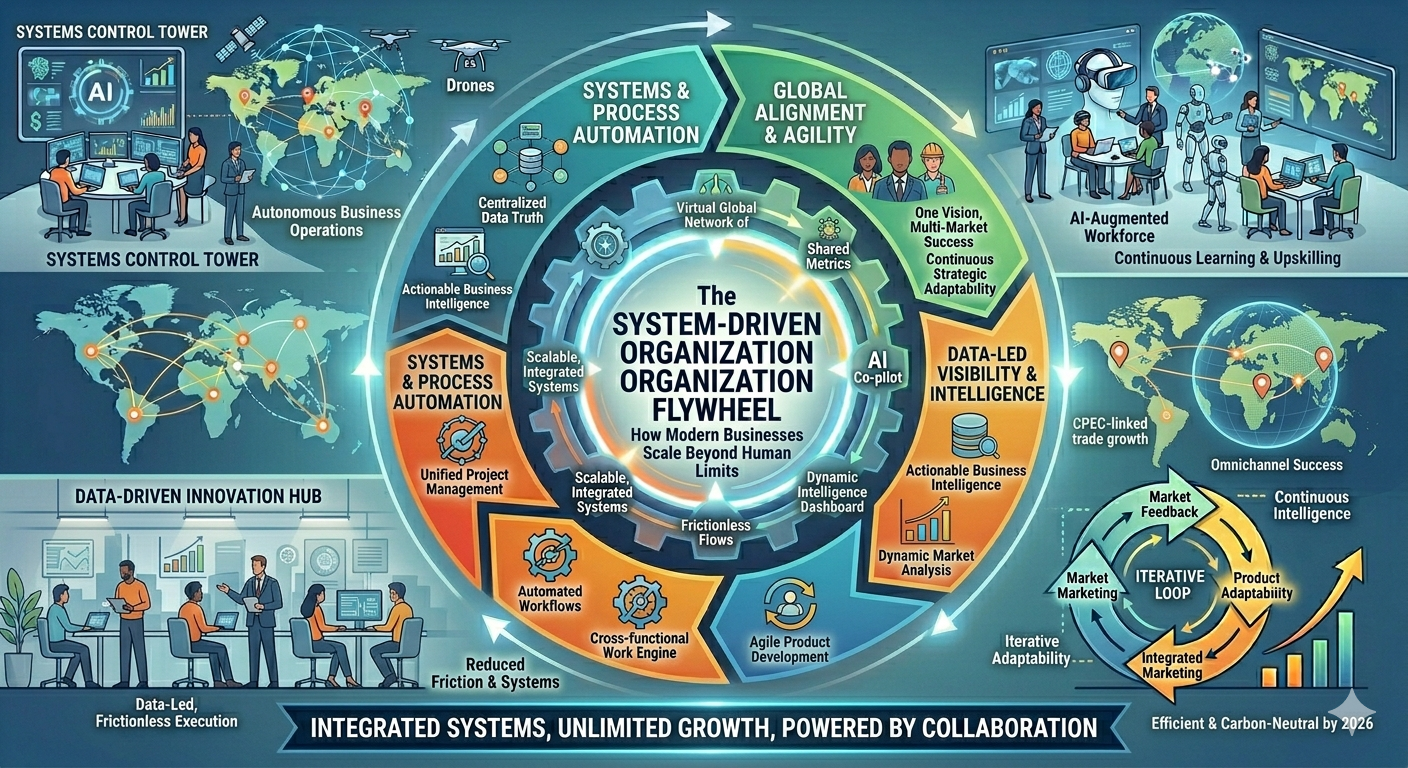
  • The System-Driven Organization: How Modern Businesses Scale Beyond Human Limits

    The System-Driven Organization: How Modern Businesses Scale Beyond Human Limits

    Introduction: Why Traditional Business Growth Is Breaking

    For decades, business growth followed a simple logic: hire more people, increase output, expand revenue. But that model is increasingly fragile in a world defined by speed, digital transformation, and distributed teams.

    Today, companies are no longer constrained by market demand alone. They are constrained by coordination capacity.

    The real question is no longer “How do we grow?” but rather:

    “How do we design systems that allow growth to happen without proportional complexity?”

    This is where system-driven organizations emerge as the next evolution of business structure.

    They are not defined by size, but by architecture:

    • How work is structured
    • How communication flows
    • How decisions are made
    • How execution is tracked and optimized

    A system-driven business is essentially an organization that behaves more like software than a hierarchy.


    1. The Shift from Hierarchies to Systems

    Traditional organizations rely on layered management structures. Information flows vertically, decisions are bottlenecked, and execution depends heavily on individuals.

    This model works in stable environments but fails under modern conditions:

    • Remote and hybrid teams
    • Rapid market changes
    • Cross-functional collaboration
    • Globalized operations

    A system-driven organization replaces hierarchy with structured workflows and interconnected processes.

    Instead of asking:

    • “Who manages this?”

    It asks:

    • “What system ensures this always happens correctly?”

    This subtle shift transforms scalability from a human limitation into a design problem.


    2. The Core Components of a Scalable Business System

    Every scalable organization, regardless of industry, is built on four structural layers:

    2.1 Workflow Architecture

    This defines how tasks move from initiation to completion.

    Key elements:

    • Clear task definitions
    • Repeatable processes
    • Standard operating procedures (SOPs)
    • Automated handovers between stages

    Without workflow architecture, growth creates chaos instead of output.


    2.2 Communication Layer

    Most businesses fail not due to lack of talent, but due to fragmented communication.

    A structured communication system ensures:

    • Context is preserved
    • Decisions are traceable
    • Conversations are organized by function or project
    • Noise is minimized

    The goal is not more communication, but relevant communication at the right point in the system.


    2.3 Resource Allocation Layer

    Growth requires intelligent distribution of:

    • Time
    • Talent
    • Budget
    • Tools

    A scalable system ensures resources are dynamically assigned based on priority and impact rather than static job roles.

    This is where operational efficiency becomes measurable.


    2.4 Feedback and Optimization Loop

    Without feedback, systems decay.

    A high-performing organization continuously collects:

    • Performance metrics
    • Execution delays
    • Bottleneck identification
    • Outcome tracking

    Then it uses this data to refine processes, not just evaluate people.


    3. Why Most Businesses Fail to Scale Properly

    Scaling failure is rarely a revenue problem. It is almost always a structural problem.

    Common failure patterns include:

    3.1 Dependency on Key Individuals

    When knowledge lives in people instead of systems, scaling becomes risky and inconsistent.

    3.2 Process Drift

    Processes exist, but over time they are modified informally, losing standardization.

    3.3 Communication Overload

    As teams grow, communication channels multiply, creating confusion instead of clarity.

    3.4 Lack of Visibility

    Leadership cannot see real-time execution status, leading to reactive decision-making.

    These issues are symptoms of one core problem:

    The absence of an integrated operational system.


    4. The Rise of Platform-Based Organizations

    Modern organizations are increasingly adopting platform thinking.

    Instead of isolated departments, they build:

    • Centralized workspaces
    • Shared collaboration environments
    • Integrated communication systems
    • Unified project tracking layers

    This approach mirrors how digital platforms operate:

    • Modular
    • Connected
    • Scalable
    • Data-driven

    In such environments, teams do not “report work”—they operate within a system that continuously reflects their progress.


    5. Network-Driven Growth: The New Competitive Advantage

    In traditional business, growth came from internal optimization.

    In modern business, growth increasingly comes from:

    • Partnerships
    • External collaborators
    • Ecosystem participation
    • Network effects

    The more connected a business system is, the more powerful its execution capacity becomes.

    This creates a shift from isolated companies to networked organizations where external and internal contributors operate within the same structured environment.


    6. The Role of Digital Workspaces in Scaling

    Digital workspaces are becoming the operational backbone of modern businesses.

    They unify:

    • Tasks
    • Communication
    • Documentation
    • Project lifecycle management
    • Collaboration networks

    Instead of fragmented tools, they provide a centralized environment where work is not just managed, but orchestrated.

    The impact is significant:

    • Faster decision cycles
    • Reduced operational friction
    • Higher transparency
    • Improved accountability

    Ultimately, they convert organizational complexity into structured clarity.


    7. From Execution to Orchestration

    The future of business is not execution-heavy; it is orchestration-heavy.

    Execution implies manual effort at every step.

    Orchestration implies:

    • Systems that trigger actions
    • Workflows that self-progress
    • Data-driven adjustments
    • Automated coordination between teams

    In orchestration-based organizations, leadership focuses less on assigning tasks and more on designing systems that execute themselves.


    8. Building a System-Driven Organization: Practical Framework

    To transition toward a scalable structure, businesses should focus on:

    Step 1: Map Core Processes

    Identify repeatable workflows across departments.

    Step 2: Standardize Execution

    Convert informal practices into documented systems.

    Step 3: Centralize Collaboration

    Reduce fragmentation by unifying communication and task tracking.

    Step 4: Introduce Measurable Outputs

    Every function should have measurable performance indicators.

    Step 5: Close Feedback Loops

    Ensure continuous improvement through structured data review.


    9. Strategic Advantage of System Thinking

    Organizations that adopt system thinking gain:

    • Predictable scaling
    • Lower operational dependency
    • Faster onboarding of teams
    • Reduced communication friction
    • Higher output consistency

    More importantly, they become resilient to volatility because their structure—not individuals—drives performance.


    Conclusion: The Future Belongs to Structured Organizations

    The next decade of business evolution will not reward the largest companies, but the most structurally intelligent ones.

    Growth will no longer be defined by headcount or capital alone, but by how effectively an organization can convert intention into execution through systems.

    Businesses that master this shift will not just scale—they will compound.

    And in that environment, structure becomes the most valuable asset of all.

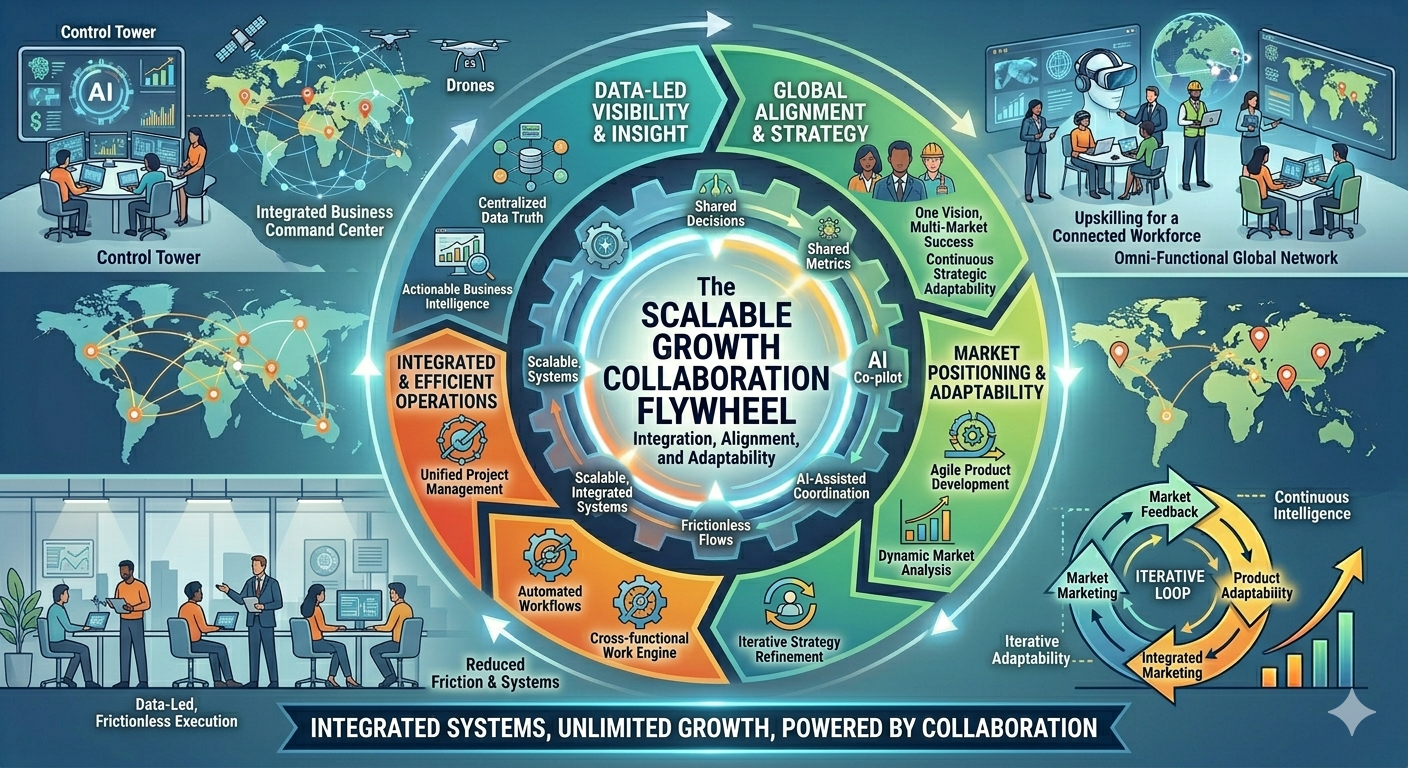
  • The Future of Scalable Business Growth: Why Integrated Collaboration Systems Are Replacing Traditional Operations

    The Future of Scalable Business Growth: Why Integrated Collaboration Systems Are Replacing Traditional Operations

    Introduction: A Shift in How Modern Businesses Scale

    Business growth is no longer driven purely by capital, manpower, or isolated departments. Instead, the strongest organizations today operate through integrated collaboration ecosystems—systems where communication, operations, data, and decision-making flow continuously across teams, partners, and stakeholders.

    This shift is not incremental. It represents a structural transformation in how companies build, scale, and sustain competitive advantage in a volatile global market.

    The businesses that adapt early to this model gain faster execution cycles, improved operational intelligence, and stronger resilience under uncertainty.

    This article explores how integrated systems are reshaping growth strategy, why traditional silos are becoming obsolete, and how organizations can transition toward scalable, network-driven performance models.


    1. The End of Isolated Business Functions

    Traditional business structures rely on segmented departments: marketing, operations, finance, HR, and IT working independently with periodic coordination points.

    This structure introduces three core inefficiencies:

    • Delayed decision-making due to communication gaps
    • Data fragmentation across systems
    • Reduced adaptability in fast-moving markets

    In modern environments, these limitations directly impact competitiveness. Markets now reward speed, coordination, and real-time responsiveness rather than rigid hierarchies.

    As a result, organizations are shifting toward connected operational models, where functions are integrated through shared platforms and continuous collaboration flows.


    2. What Defines an Integrated Growth System

    An integrated growth system is not just a software stack or communication tool. It is an operational philosophy built on four pillars:

    a) Unified Communication Layer

    All stakeholders operate through a centralized communication ecosystem, reducing dependency on fragmented channels.

    b) Shared Operational Workflows

    Tasks, projects, and workflows are visible across departments, improving accountability and coordination.

    c) Real-Time Data Synchronization

    Decision-making is driven by live data rather than delayed reports.

    d) External Network Integration

    Partners, vendors, and clients are included within controlled collaboration environments, extending organizational capability beyond internal teams.

    Together, these pillars create a continuous execution environment, where strategy and operations remain tightly aligned.


    3. Why Collaboration Infrastructure Is Now a Growth Driver

    Historically, infrastructure referred to physical assets such as offices, machinery, or logistics systems. Today, infrastructure increasingly means digital collaboration architecture.

    This shift is happening for three key reasons:

    Speed of Execution

    Organizations with integrated systems reduce operational delays and execute faster than competitors relying on manual coordination.

    Scalability Without Linear Cost Growth

    Traditional scaling requires proportional increases in headcount. Integrated systems allow output growth without equivalent cost expansion.

    Decision Intelligence

    When all operational data is centralized, leadership gains clearer visibility into performance trends, risks, and opportunities.

    This transforms infrastructure from a support function into a primary growth engine.


    4. The Role of Networks in Modern Business Expansion

    One of the most important changes in modern strategy is the rise of network-based business models.

    Instead of operating as isolated entities, companies now function as nodes within larger ecosystems:

    • Suppliers become integrated partners
    • Customers become active participants in feedback loops
    • External experts contribute directly to internal workflows

    This network-based approach increases adaptability and reduces dependency on internal constraints.

    Organizations with strong collaboration networks often outperform larger but disconnected competitors.


    5. From Project Management to Lifecycle Management

    Traditional project management focuses on task completion within fixed timelines.

    Modern systems extend this into lifecycle management, which includes:

    • Ideation and planning
    • Resource allocation
    • Execution tracking
    • Performance evaluation
    • Continuous optimization

    This approach ensures that projects are not treated as isolated events but as evolving systems that generate long-term value.

    Lifecycle thinking also improves institutional learning, as each cycle feeds intelligence into the next.


    6. Data as the Central Decision Layer

    In integrated systems, data is no longer a reporting tool—it becomes the decision layer of the organization.

    Key transformations include:

    • Real-time dashboards replacing static reports
    • Predictive analytics guiding operational adjustments
    • Cross-functional data visibility enabling unified decision-making

    This reduces reliance on intuition alone and increases precision in strategic execution.

    Companies that fail to centralize data typically experience slower response times and reduced market sensitivity.


    7. The Competitive Advantage of Operational Fluidity

    The most successful organizations today share one defining trait: fluid operations.

    Operational fluidity means:

    • Teams can reorganize quickly around priorities
    • Resources shift dynamically based on demand
    • Communication flows without bottlenecks
    • Execution is continuous, not episodic

    This is only possible when systems are integrated and collaboration is embedded at every level.

    Fluid organizations outperform rigid structures even with fewer resources.


    8. Challenges in Transitioning to Integrated Systems

    Despite the advantages, transitioning is not simple. Common challenges include:

    Cultural Resistance

    Employees accustomed to siloed operations may resist transparency and shared workflows.

    System Integration Complexity

    Legacy tools often lack compatibility with modern collaboration platforms.

    Governance and Security Concerns

    Expanding access across networks introduces new security and compliance requirements.

    Successful transformation requires both technological upgrades and cultural alignment.


    9. Strategic Roadmap for Implementation

    Organizations aiming to transition toward integrated growth systems typically follow this progression:

    Phase 1: Centralize Communication

    Consolidate communication channels into a unified system.

    Phase 2: Digitize Workflows

    Convert manual processes into structured digital workflows.

    Phase 3: Integrate Data Systems

    Ensure all departments feed into a shared data architecture.

    Phase 4: Extend to External Networks

    Gradually include partners and stakeholders into controlled collaboration environments.

    Phase 5: Optimize Through Analytics

    Use real-time insights to continuously refine operations.

    This staged approach minimizes disruption while maximizing adoption success.


    10. The Future: Autonomous Collaborative Ecosystems

    The next evolution of business systems is already emerging: semi-autonomous collaboration ecosystems.

    These systems will combine:

    • Artificial intelligence for decision support
    • Automated workflow orchestration
    • Predictive resource allocation
    • Self-optimizing performance structures

    In such environments, human leadership focuses less on coordination and more on strategic direction.

    The organizations that begin building this foundation today will define tomorrow’s competitive landscape.


    Conclusion: Growth Is Becoming a System, Not an Outcome

    Business growth is no longer a result of isolated effort. It is the outcome of well-designed systems that connect people, data, and processes into a unified operational engine.

    Organizations that embrace integrated collaboration models gain:

    • Faster execution
    • Higher adaptability
    • Stronger scalability
    • Smarter decision-making

    The shift is already underway. The question is no longer whether this model will dominate, but how quickly businesses can adapt to it.

    Those who build integrated systems now will not just compete—they will set the standard for the next generation of enterprise performance.

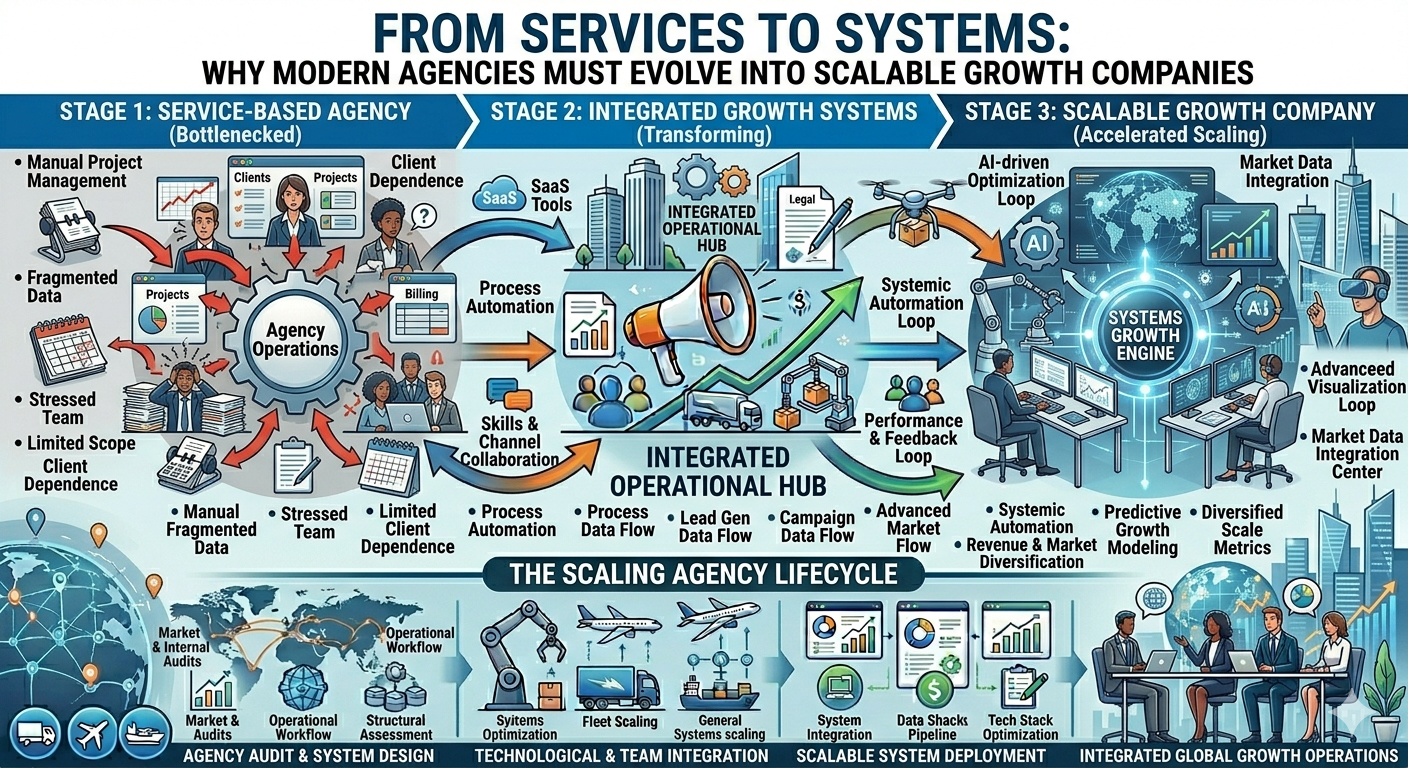
  • From Services to Systems: Why Modern Agencies Must Evolve Into Scalable Growth Companies

    From Services to Systems: Why Modern Agencies Must Evolve Into Scalable Growth Companies

    Introduction: The Agency Model Is Reaching Its Limit

    The traditional agency model was built for a different era of business.

    It was designed around:

    • Project-based work
    • Hourly or monthly retainers
    • Function-specific execution (marketing, design, development, recruitment)
    • Client-by-client delivery cycles

    For a long time, this model worked.

    But today, it is structurally constrained.

    The modern market no longer rewards isolated execution. It rewards systems that compound value across multiple business layers simultaneously.

    This shift is subtle but fundamental:

    Agencies are no longer competing on output. They are competing on integration.

    And integration requires a completely different operating model.


    1. The Core Problem: Execution Without Architecture

    Most agencies still operate as execution units.

    They deliver:

    • Campaigns
    • Websites
    • Funnels
    • Content
    • Recruitment pipelines
    • Branding systems

    But these outputs often exist in isolation.

    The result is predictable:

    • Marketing works, but sales underperform
    • Hiring increases capacity, but not capability
    • Branding improves perception, but not conversion
    • Traffic increases, but revenue stagnates

    This is not a skill issue.

    It is an architecture issue.

    Execution without architecture produces activity, not scale.


    2. Why the Market Is Changing

    Three structural shifts are redefining how businesses grow:

    1. Increased Competition at Every Layer

    Every niche is saturated. Tactical differentiation is no longer enough.

    2. Tool Democratization

    AI, automation, and no-code systems have reduced execution barriers dramatically.

    3. Buyer Sophistication

    Clients no longer want isolated services. They want outcomes tied to business performance.

    These changes mean:

    Execution is now cheap. Coordination is valuable.


    3. The New Agency Paradigm: Systems Thinking

    To remain relevant, agencies must evolve from service providers into systems builders.

    A system is different from a service in one key way:

    • A service delivers output
    • A system delivers continuous outcomes

    Example:

    Service Model:

    • Run ads
    • Deliver leads
    • Design website

    System Model:

    • Build demand engine
    • Engineer conversion pathways
    • Align hiring with demand cycles
    • Optimize end-to-end revenue flow

    The second model does not just execute growth.

    It produces growth as a byproduct of structure.


    4. The Three Engines of a Scalable Growth System

    Modern scalable companies operate through three interconnected engines:

    1. Demand Engine (Marketing & Positioning)

    Responsible for:

    • Market visibility
    • Brand authority
    • Lead generation
    • Category positioning

    2. Capability Engine (Talent & Recruitment)

    Responsible for:

    • Hiring aligned with growth direction
    • Skill development
    • Organizational scalability
    • Leadership structuring

    3. Delivery Engine (Operations & Experience)

    Responsible for:

    • Execution quality
    • Customer experience
    • Retention systems
    • Operational efficiency

    When these three engines operate independently, growth becomes fragmented.

    When they operate together, growth becomes exponential.


    5. The Failure of Traditional Agency Scaling

    Most agencies attempt to scale in the same way:

    1. Get more clients
    2. Hire more staff
    3. Increase output volume
    4. Expand service offerings

    This approach creates linear scaling.

    But linear scaling introduces friction:

    • Quality drops as team expands
    • Communication overhead increases
    • Margins compress
    • Delivery inconsistency grows
    • Founder dependency increases

    Eventually, the agency hits a ceiling.

    Not because demand is missing, but because structure cannot support scale.


    6. The Shift From Clients to Ecosystems

    A critical transition happens when agencies stop thinking in terms of clients and start thinking in terms of ecosystems.

    A client is a single revenue unit.

    An ecosystem is a multi-layer growth structure including:

    • Acquisition channels
    • Conversion infrastructure
    • Talent systems
    • Retention loops
    • Brand positioning layers

    In ecosystem thinking:

    Every action is evaluated based on its impact across the entire system, not just one deliverable.

    This changes decision-making entirely.


    7. The Role of Integration in Modern Growth

    Integration is the core differentiator between average agencies and scalable growth companies.

    Integration means:

    • Marketing informs hiring
    • Hiring informs service design
    • Service performance informs marketing messaging
    • Customer feedback reshapes positioning

    Without integration:

    • Each function optimizes independently
    • Misalignment compounds over time

    With integration:

    • Every function reinforces the others

    This creates what can be described as a compounding feedback loop.


    8. Why Most Agencies Cannot Transition

    The transition from services to systems fails for three main reasons:

    1. Skill-Based Identity Lock

    Agencies define themselves by what they do:

    • “We are a marketing agency”
    • “We are a design studio”
    • “We are a dev shop”

    This limits strategic evolution.

    2. Revenue Dependency on Execution Hours

    Revenue is tied to output volume, not system value.

    3. Lack of Cross-Functional Design Thinking

    Teams are specialized but not integrated.

    As a result, agencies optimize delivery instead of architecture.


    9. The New Operating Model: System-Led Growth Architecture

    To evolve, agencies must redesign their operating model around systems rather than services.

    Step 1: Define the Growth Outcome

    Not “deliver marketing” but:

    • Increase qualified demand
    • Improve conversion efficiency
    • Increase lifetime value

    Step 2: Map the Full Growth Flow

    From:

    • Awareness → Interest → Conversion → Retention → Expansion

    Step 3: Identify System Leverage Points

    Where does the system break?
    Where does friction exist?

    Step 4: Align Talent With System Needs

    Hiring becomes architecture-driven, not task-driven.

    Step 5: Close Feedback Loops

    Performance data must continuously reshape execution.


    10. The Role of Strategy in a System-Led Agency

    Strategy is often misunderstood as planning.

    In system-based organizations, strategy is:

    The design of interdependencies between functions to maximize compounding outcomes.

    This includes:

    • Defining how marketing influences hiring
    • Defining how operations influence positioning
    • Defining how delivery influences demand

    Strategy is not a document.

    It is a structural blueprint.


    11. What Scalable Agencies Actually Look Like

    A scalable agency operating as a growth system has distinct characteristics:

    1. Multi-layer revenue design

    Revenue does not depend on one service line.

    2. Cross-functional KPIs

    Teams are measured on shared outcomes, not isolated metrics.

    3. Embedded intelligence loops

    Data flows across departments in real time.

    4. Modular talent structure

    Teams can expand or contract without breaking systems.

    5. Outcome ownership

    The agency is responsible for business outcomes, not deliverables.


    12. The Competitive Advantage of Systems-Based Agencies

    Systems-based agencies outperform service-based agencies because:

    1. They scale without proportional cost increases

    Execution is embedded in structure.

    2. They reduce dependency on individual talent

    Systems replace hero-based execution.

    3. They create compounding value

    Each improvement strengthens the entire system.

    4. They become harder to replicate

    Competitors can copy services, not systems.


    13. The Future: Agencies as Growth Infrastructure Providers

    The next evolution of agencies is not creative, technical, or marketing-focused.

    It is infrastructural.

    Future agencies will:

    • Design growth architectures
    • Build integrated business systems
    • Orchestrate cross-functional performance
    • Own end-to-end outcome responsibility

    They will not sell services.

    They will sell growth capacity.


    Conclusion: The End of the Service Era

    The agency industry is undergoing a structural transition.

    The old model—based on execution, specialization, and isolated services—is reaching its natural limit.

    The new model is built on:

    • Integration
    • Systems thinking
    • Outcome ownership
    • Structural design
    • Compounding feedback loops

    In this new environment, success will not belong to those who execute better.

    It will belong to those who design better systems.

    Because in modern business:

    Growth is no longer produced. It is engineered.

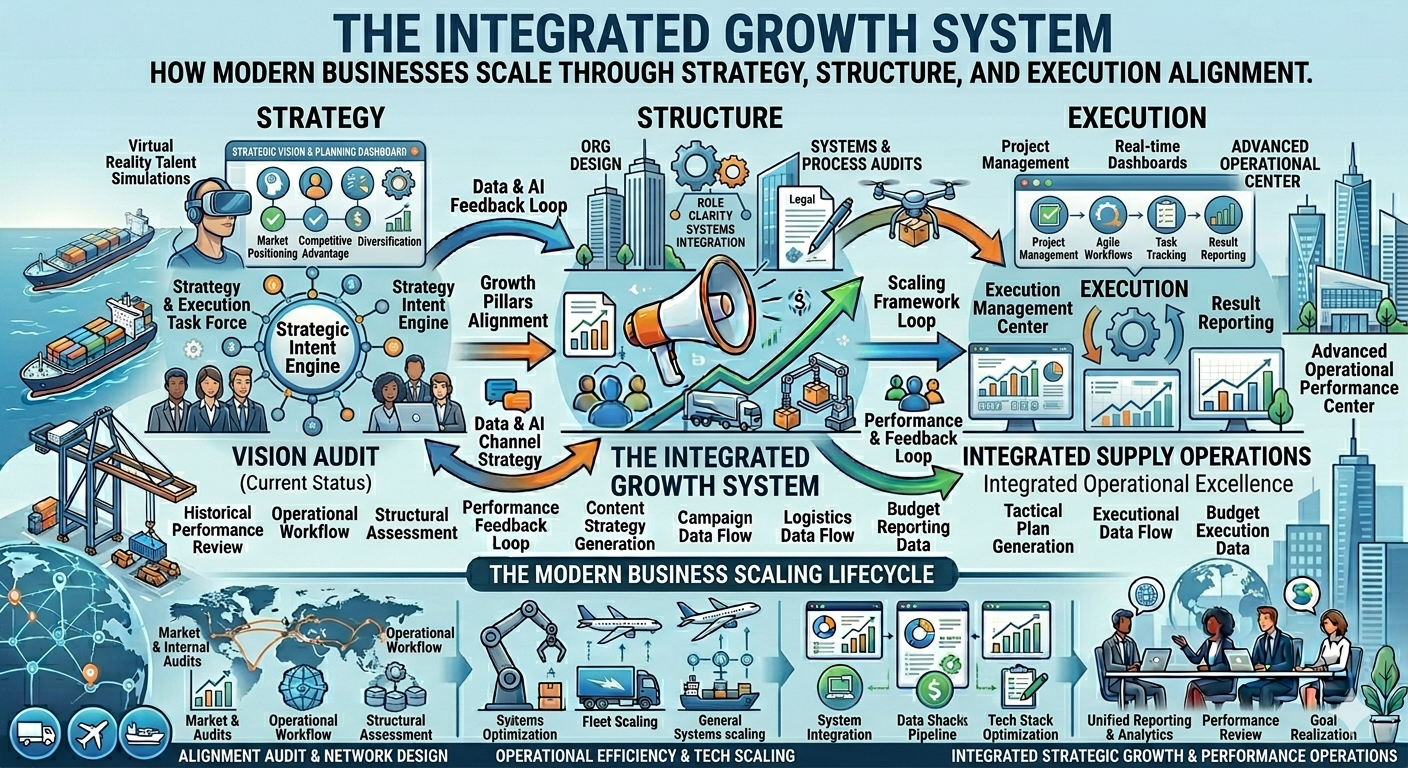
  • The Integrated Growth System: How Modern Businesses Scale Through Strategy, Structure, and Execution Alignment

    The Integrated Growth System: How Modern Businesses Scale Through Strategy, Structure, and Execution Alignment

    Introduction: Why Most Businesses Stop Growing (Even When They Are Doing Everything “Right”)

    Most companies assume growth is a result of doing more—more marketing, more hiring, more campaigns, more tools.

    But in reality, growth rarely fails due to effort. It fails due to misalignment.

    Teams operate in silos. Marketing builds visibility without sales readiness. Recruitment expands headcount without operational structure. Leadership defines strategy without execution clarity.

    The result is predictable:

    • Increased cost
    • Stagnant conversion
    • Operational fatigue
    • Unclear ROI across functions

    Modern growth requires a shift in thinking. Not toward doing more, but toward connecting everything that already exists into a unified system.

    This is where integrated growth becomes essential.

    It is not a tactic. It is an operating model.


    1. The Modern Growth Problem: Fragmentation

    Today’s business environment is built on specialization. Companies separate functions to improve focus:

    • Marketing handles awareness
    • Sales handles conversion
    • HR handles hiring
    • Operations handles delivery
    • Finance handles control

    On paper, this structure is efficient. In practice, it creates disconnects between intent and execution.

    The Core Issue

    Each function optimizes for its own KPIs:

    • Marketing optimizes for leads
    • Sales optimizes for closing deals
    • HR optimizes for hiring speed
    • Finance optimizes for cost control

    But no one optimizes for end-to-end business growth.

    This leads to what can be described as “local optimization, global inefficiency.”


    2. What Integrated Growth Actually Means

    Integrated growth is not a buzzword. It is a structural approach where three core engines operate as one system:

    1. Talent Engine (Recruitment & Capability)
    2. Market Engine (Marketing & Demand Creation)
    3. Value Engine (Delivery, Operations, and Experience)

    Instead of operating independently, these systems continuously feed each other.

    Example of Integration

    • Marketing identifies demand trends
    • Recruitment builds capabilities aligned with that demand
    • Operations ensures delivery quality matches expectations
    • Customer feedback loops back into marketing positioning

    This creates a self-reinforcing growth loop instead of isolated output streams.


    3. Recruitment as a Strategic Growth Lever (Not Just Hiring)

    Traditional recruitment focuses on filling vacancies.

    Integrated recruitment focuses on building capability architecture.

    The Shift in Thinking

    Instead of asking:

    “Who do we need to hire?”

    Integrated systems ask:

    “What capabilities must exist for the business to scale 12–18 months from now?”

    This includes:

    • Skill forecasting
    • Culture alignment with scaling stages
    • Role evolution planning
    • Leadership pipeline development

    Why This Matters

    Companies often hit a growth ceiling not due to lack of market demand, but due to lack of internal capability readiness.

    Hiring reactively creates instability. Hiring strategically creates scalability.


    4. Marketing as a Demand Engineering System

    Marketing is often treated as a visibility function.

    In integrated growth, marketing is repositioned as demand engineering.

    This means marketing is responsible not just for attention, but for shaping:

    • Market perception
    • Buyer readiness
    • Category positioning
    • Conversion pathways

    Key Shift

    Traditional:

    • “How do we get more traffic?”

    Integrated:

    • “How do we align market perception with our delivery capability so conversion becomes inevitable?”

    The Three Layers of Modern Marketing

    1. Attention Layer – visibility, awareness, reach
    2. Intent Layer – trust, positioning, authority
    3. Conversion Layer – structured buyer journey

    Most businesses only operate at layer 1.

    Sustainable growth requires alignment across all three.


    5. M&A as a Structural Growth Accelerator

    Mergers and acquisitions are often treated as financial decisions.

    In integrated systems, M&A is a capability acceleration mechanism.

    Why Businesses Acquire

    Not just for revenue expansion, but for:

    • Talent acquisition at scale
    • Market entry acceleration
    • Technology integration
    • Operational efficiency gains

    The Strategic Reality

    Organic growth is slow and sequential.

    Acquisition allows:

    • Parallel scaling instead of linear scaling
    • Immediate capability injection
    • Faster market positioning shifts

    However, M&A only works when internal systems are aligned enough to absorb and integrate new entities effectively.

    Without integration capability, acquisitions create complexity instead of growth.


    6. The Missing Layer: Operational Intelligence

    Most companies overlook operational intelligence.

    This refers to how well a business can:

    • Measure real performance (not vanity metrics)
    • Detect inefficiencies early
    • Adjust execution in real time
    • Translate data into decisions

    The Core Problem

    Data exists everywhere, but insight is fragmented.

    Marketing tools, CRM systems, HR platforms, and finance dashboards all generate data—but not unified intelligence.

    What Integrated Systems Require

    • Centralized performance visibility
    • Cross-functional KPI alignment
    • Real-time feedback loops
    • Decision frameworks tied to outcomes

    Without this layer, businesses operate blind between departments.


    7. The Integrated Growth Loop

    When recruitment, marketing, and M&A align, they form a continuous loop:

    Step 1: Market signals are identified

    Demand patterns, customer behavior, and competitive shifts are observed.

    Step 2: Marketing shapes positioning

    The business aligns messaging and demand generation accordingly.

    Step 3: Recruitment builds capability

    The right talent is acquired to support execution.

    Step 4: Operations deliver value

    Systems ensure consistent service/product delivery.

    Step 5: M&A accelerates gaps

    Where internal development is slow, acquisitions fill capability gaps.

    Step 6: Feedback resets the system

    Performance data feeds back into market understanding.

    This is not linear growth. It is compounding system growth.


    8. Why Most Scaling Attempts Fail

    Even well-funded businesses fail to scale effectively because they:

    • Scale marketing without operational readiness
    • Hire without strategic alignment
    • Acquire without integration systems
    • Optimize departments independently

    The result is:

    Growth in one area creates strain in another

    This is why many companies experience “growth stress” rather than “growth success.”


    9. Building a Scalable Growth Architecture

    To implement integrated growth, businesses must redesign structure around three principles:

    1. Alignment over expansion

    Before scaling, ensure functions are aligned.

    2. Systems over activity

    Replace task-based execution with system-based workflows.

    3. Feedback over assumptions

    Decisions must be driven by real performance loops, not intuition.


    10. The Future of Business Growth

    The next decade of business will not be defined by who has the best marketing or the largest workforce.

    It will be defined by:

    • Who integrates fastest
    • Who aligns functions most effectively
    • Who converts data into decisions in real time
    • Who builds systems that compound rather than fragment

    Companies that master integration will scale exponentially.

    Companies that don’t will continue to experience linear, expensive growth.


    Conclusion: Growth is Not a Departmental Function

    Growth is not owned by marketing, HR, or operations.

    Growth is the outcome of system-wide alignment.

    When recruitment, marketing, and strategic expansion (including M&A) operate as a single coordinated structure, businesses stop scaling by effort and start scaling by design.

    That is the difference between working in growth… and engineering it.

  • The Rise of Integrated Intelligence Systems: How Unified Digital Ecosystems Are Replacing Fragmented Business Models

    The Rise of Integrated Intelligence Systems: How Unified Digital Ecosystems Are Replacing Fragmented Business Models

    Introduction: The End of Fragmented Thinking

    For decades, businesses have been built on separation. Marketing operated independently from operations. Sales teams rarely aligned deeply with product development. Logistics, finance, branding, and customer experience existed as isolated departments with minimal synchronization.

    This fragmentation was once considered normal. In fact, it was seen as necessary for specialization.

    But the global digital transformation of the last ten years has exposed a structural weakness in this model: separated systems cannot compete in real-time environments.

    Today, markets shift faster than organizational communication cycles. Customer expectations evolve faster than internal approvals. Data flows faster than decision-making structures.

    As a result, a new paradigm is emerging: integrated intelligence systems—business ecosystems where strategy, data, execution, and experience operate as one unified system rather than disconnected parts.

    This shift is not incremental. It is structural. And it is redefining how modern organizations are built, scaled, and sustained.


    1. The Problem With Traditional Business Architecture

    Traditional organizations are built like mechanical machines. Each department is a gear. Each gear performs a specific function. The assumption is simple: if every part performs well individually, the system performs well collectively.

    However, modern environments do not behave like machines. They behave like networks.

    In a networked environment:

    • Information is non-linear
    • Feedback is instantaneous
    • Decisions are interconnected
    • Delays compound system-wide inefficiencies

    This creates a fundamental mismatch.

    1.1 Information Lag

    In traditional systems, data moves through layers:

    Customer → Sales → Reporting → Management → Strategy → Execution

    By the time data reaches decision-makers, it is already outdated.

    1.2 Execution Disconnect

    Even when insights are correct, execution is delayed due to structural barriers between departments.

    1.3 Optimization Failure

    Each department optimizes for itself rather than for the system as a whole.

    The result is a paradox: highly efficient parts, but an inefficient whole.


    2. The Shift Toward System-Level Thinking

    Modern organizations are beginning to adopt a different model: system-level integration.

    Instead of optimizing departments independently, they optimize the interaction between components.

    This shift is driven by three technological forces:

    2.1 Real-Time Data Infrastructure

    Cloud computing and API ecosystems now allow organizations to access real-time operational data across all functions.

    2.2 Automation and AI Layering

    Automation reduces dependency on sequential workflows. AI systems now connect marketing, analytics, customer service, and operations simultaneously.

    2.3 Platform-Based Architecture

    Companies are transitioning from hierarchical structures to platform ecosystems where functions are modular and interconnected.

    This leads to one central principle:

    Competitive advantage is no longer about isolated excellence. It is about system coherence.


    3. What an Integrated Intelligence System Actually Means

    An Integrated Intelligence System is not just software integration.

    It is a structural redesign of how an organization thinks and operates.

    It combines:

    • Strategy (decision logic)
    • Data (real-time intelligence)
    • Execution (workflow systems)
    • Experience (customer interaction layers)

    All four operate continuously in feedback loops.

    3.1 Strategy Becomes Dynamic

    Instead of annual or quarterly planning, strategy becomes adaptive and continuously updated based on live data.

    3.2 Data Becomes Actionable

    Data is no longer stored for reporting. It is used as an immediate input into decision-making systems.

    3.3 Execution Becomes Automated

    Repetitive tasks are handled through automated pipelines, reducing latency between decision and action.

    3.4 Experience Becomes Personalized

    Customer interaction is shaped in real time based on behavioral inputs and predictive models.


    4. Why Fragmented Models Are Becoming Obsolete

    The decline of traditional models is not theoretical—it is observable across industries.

    4.1 Marketing vs Operations Misalignment

    Marketing campaigns often promote promises that operations cannot consistently deliver at scale.

    4.2 Supply Chain Blind Spots

    Logistics systems frequently operate independently from demand forecasting systems, leading to inefficiencies and waste.

    4.3 Customer Experience Gaps

    Customer service is often reactive rather than predictive due to disconnected data systems.

    The root issue is not competence. It is structure.


    5. The Core Principle of Modern Systems: Feedback Loops

    The most important concept in integrated systems is the feedback loop.

    A feedback loop ensures that every action produces data that immediately informs the next action.

    There are three types:

    5.1 Internal Feedback Loop

    Between departments within an organization.

    5.2 External Feedback Loop

    Between the organization and its customers or market environment.

    5.3 Predictive Feedback Loop

    Where systems anticipate outcomes before they fully occur using historical patterns and AI modeling.

    Organizations that master feedback loops evolve faster than competitors because they reduce the delay between insight and adaptation.


    6. From Linear Growth to Systemic Growth

    Traditional business growth follows a linear pattern:

    More customers → more revenue → more resources → more expansion

    But integrated systems generate exponential growth dynamics because:

    • Each improvement strengthens the entire system
    • Efficiency compounds across departments
    • Data improves decision quality continuously
    • Automation scales execution without proportional cost increase

    This creates a compounding effect known as systemic scaling.


    7. The Role of Intelligence Layering

    Modern systems are not just integrated—they are layered.

    7.1 Data Layer

    Raw information from users, operations, and markets.

    7.2 Logic Layer

    Rules, algorithms, and decision frameworks.

    7.3 Execution Layer

    Automated systems that implement decisions.

    7.4 Experience Layer

    User-facing interaction and engagement systems.

    Each layer feeds the others continuously.

    This structure replaces traditional hierarchy with functional interdependence.


    8. Organizational Culture in Integrated Systems

    Technology alone is not enough. Cultural transformation is required.

    8.1 From Ownership to Flow

    Employees no longer “own” isolated tasks. They participate in system flows.

    8.2 From Departmental Identity to System Identity

    The organization is no longer a collection of departments but a unified system with shared objectives.

    8.3 From Control to Coordination

    Leadership shifts from controlling processes to optimizing system coordination.


    9. Competitive Advantage in the New Era

    In integrated environments, competitive advantage is defined by:

    • Speed of adaptation
    • Quality of internal data connectivity
    • Degree of automation
    • Strength of feedback loops
    • System coherence

    Not by isolated excellence.

    Companies that continue operating in fragmented models will face increasing inefficiency gaps compared to integrated competitors.


    10. Future Direction: Self-Optimizing Organizations

    The next stage of evolution is already emerging: self-optimizing organizations.

    These systems will:

    • Detect inefficiencies automatically
    • Adjust workflows without human intervention
    • Predict market changes in advance
    • Reallocate resources dynamically
    • Continuously refine strategy in real time

    This represents a shift from management-driven systems to intelligence-driven systems.


    Conclusion: The Structural Transformation of Business

    The global economy is moving from fragmented organizational models toward integrated intelligence systems.

    This is not a trend in tools. It is a transformation in structure.

    Organizations that adapt will operate as unified systems where strategy, data, execution, and experience are seamlessly connected.

    Organizations that do not will continue to operate in delayed cycles, inefficiencies, and disconnected decision-making structures.

    The future belongs to systems—not silos.

    And in that future, success is determined not by how strong individual parts are, but by how intelligently they work together.

  • The Rise of Hyper-Personalized Systems: How Customization Is Rewriting the Future of Consumer Industries

    The Rise of Hyper-Personalized Systems: How Customization Is Rewriting the Future of Consumer Industries

    Introduction: The Shift from Products to Systems

    For decades, global industries have operated on a simple principle: companies design standardized products, manufacture them at scale, and distribute them to mass markets. This model has powered industrial growth since the early 20th century and remains the foundation of most consumer sectors today.

    However, a structural shift is underway. The modern consumer is no longer satisfied with “one-size-fits-all” solutions. Expectations have evolved toward precision, individuality, and adaptive systems that respond to personal needs in real time.

    This transition is not just a branding trend—it represents a fundamental change in how value is created. Industries are moving from static products to dynamic personalization systems, where users actively participate in shaping outcomes.

    The most visible expression of this transformation can be seen in sectors like beauty tech, fashion, wellness, food customization, and even logistics. At the core of this evolution lies a single idea: the future belongs to systems that create unique outputs for every individual.


    1. The End of Mass Standardization

    Mass production succeeded because it solved a historical problem: efficiency. Producing identical goods at scale reduced cost, simplified logistics, and expanded accessibility.

    But today, three major pressures are eroding this model:

    1.1 Consumer Identity Fragmentation

    Modern consumers are no longer part of a single dominant cultural identity. Instead, they represent fragmented micro-identities shaped by:

    • Digital influence
    • Social media aesthetics
    • Cultural blending
    • Personal expression

    As a result, standardized products fail to represent individual identity accurately.

    1.2 Rising Expectations of Precision

    Consumers now expect products to align with:

    • Skin tone, body type, or lifestyle
    • Environmental conditions
    • Emotional or psychological preferences

    Generic solutions are increasingly perceived as outdated.

    1.3 Technology Enablement

    Advances in AI, IoT, and smart devices have made customization scalable. What was once expensive and manual is now automated and precise.

    This combination is dismantling traditional manufacturing logic and replacing it with adaptive production systems.


    2. The Rise of Customization Systems

    The new industrial paradigm is not about products—it is about systems that generate products dynamically.

    A customization system typically includes:

    • A digital interface (for user input)
    • A data model (for preference analysis)
    • A physical output mechanism (for production)
    • A feedback loop (for continuous refinement)

    Instead of selecting from predefined options, users define parameters, and the system generates a personalized output.

    This model is already visible across industries:

    • Streaming platforms recommend content individually
    • E-commerce platforms personalize storefronts
    • Fitness apps design adaptive training programs
    • Beauty systems generate customized formulations

    The shift is clear: production is becoming computational.


    3. Beauty Tech as a Leading Example of Personalization

    One of the clearest demonstrations of hyper-personalized systems can be found in the beauty industry, particularly in advanced cosmetic customization platforms.

    Modern beauty systems are no longer limited to selling fixed shades or formulas. Instead, they operate as interactive creation environments, where users define parameters such as:

    • Undertone
    • Coverage level
    • Finish (matte, gloss, shimmer)
    • Color intensity

    The system then generates a tailored product in real time.

    This transforms beauty from a retail experience into a design experience.

    Why beauty became the first major adopter

    The beauty industry is uniquely suited for personalization due to:

    • High variability in human skin tones
    • Strong emotional connection to appearance
    • Frequent product experimentation cycles
    • High dissatisfaction with standard shade ranges

    Traditional product lines struggled to cover the diversity of human appearance. Custom systems solve this by removing “fixed inventory limitations” entirely.


    4. The Technology Behind Hyper-Personalization

    At the core of modern customization systems lies a combination of hardware and software innovation.

    4.1 Data-Driven Preference Mapping

    Systems begin by analyzing user input:

    • Physical characteristics (color, tone, shape)
    • Behavioral preferences
    • Environmental context

    This data is translated into a digital profile.

    4.2 Algorithmic Formulation Engines

    Instead of selecting pre-made variants, algorithms generate outputs based on formula logic. These systems adjust:

    • Ingredient ratios
    • Color composition
    • Intensity curves

    This allows infinite variation within controlled boundaries.

    4.3 Precision Dispensing Hardware

    Physical systems translate digital decisions into real-world output using:

    • Micro-dispensing mechanisms
    • Cartridge-based systems
    • Automated mixing chambers

    The result is a product created “on demand” rather than pre-manufactured.

    4.4 Feedback Learning Loops

    User feedback is integrated to improve future outputs, making the system adaptive over time.

    This is where personalization becomes intelligent rather than static.


    5. Why Customization Systems Outperform Traditional Models

    The shift toward personalization systems is not aesthetic—it is structural.

    5.1 Reduced Waste

    Traditional manufacturing produces excess inventory. Custom systems produce only what is needed.

    5.2 Infinite Variability

    Instead of limited SKUs, systems can generate millions of variations dynamically.

    5.3 Higher Customer Satisfaction

    Products are aligned precisely with individual needs, reducing mismatch and returns.

    5.4 Stronger Brand Engagement

    Users become co-creators, not passive buyers. This increases emotional attachment to the system.


    6. Economic Impact: From Supply Chains to Demand Chains

    Traditional business models are supply-driven. Companies forecast demand, produce goods, and push them into markets.

    Customization systems reverse this logic.

    They create demand-first production systems, where:

    1. Demand is expressed digitally
    2. Product is generated instantly
    3. Supply chain becomes reactive rather than predictive

    This has major implications:

    • Inventory risk is minimized
    • Storage requirements decrease
    • Production becomes decentralized
    • Logistics shift toward micro-distribution

    The supply chain becomes a real-time response system rather than a static pipeline.


    7. Psychological Drivers Behind Personalization Demand

    The success of customization systems is not only technological but psychological.

    7.1 Identity Expression

    Consumers increasingly use products as identity markers. Personalized systems allow direct expression of individuality.

    7.2 Control and Agency

    Users prefer systems where they can influence outcomes rather than accept predefined choices.

    7.3 Novelty and Experimentation

    Customization introduces variability and creativity into everyday consumption.

    7.4 Perceived Exclusivity

    A personalized output feels inherently unique, increasing perceived value.


    8. Expansion Beyond Beauty: The Broader Industrial Shift

    While beauty tech is a visible example, similar transformations are occurring in multiple sectors.

    8.1 Fashion

    On-demand clothing manufacturing based on body scanning and AI design systems.

    8.2 Food Industry

    Nutrition-based meal customization driven by health data and dietary algorithms.

    8.3 Healthcare

    Personalized treatment plans based on genetic and lifestyle analysis.

    8.4 Logistics and Supply Chain Systems

    Adaptive logistics platforms that route, store, and deliver goods based on real-time demand signals.

    The common thread is clear: industries are moving from standardized output to adaptive systems.


    9. Challenges of Hyper-Personalized Systems

    Despite their advantages, these systems introduce new complexities:

    9.1 Infrastructure Cost

    Advanced systems require significant upfront investment in hardware and software integration.

    9.2 Operational Complexity

    Managing real-time production systems is significantly more complex than batch manufacturing.

    9.3 Data Privacy Concerns

    Personalization relies heavily on user data, raising ethical and regulatory concerns.

    9.4 Scalability Constraints

    Some systems struggle to maintain consistency at extreme scale without optimization.


    10. The Future: From Products to Living Systems

    The next phase of industrial evolution will not focus on better products—but on living systems that evolve continuously.

    Future systems will likely:

    • Learn continuously from user behavior
    • Adapt in real time
    • Predict needs before they are expressed
    • Generate outputs autonomously

    In this model, the boundary between product, service, and platform disappears entirely.

    We move toward a world where:

    The system itself becomes the product.


    Conclusion: The End of Fixed Products

    The global economy is undergoing a structural transition from mass production to intelligent personalization. This shift is not incremental—it is foundational.

    Industries that once relied on static inventory and standardized design are being replaced by systems capable of dynamic, real-time creation.

    Whether in beauty, fashion, healthcare, or logistics, the underlying principle remains consistent:

    Value is no longer in what is produced, but in how precisely it is adapted to the individual.

    As this transition accelerates, businesses that fail to adopt system-based personalization will gradually lose relevance. Those that embrace it will define the next industrial era.